How to Say Blender in French: Kitchen vs Software
Learn how to say blender in French for kitchen use and Blender software, with common terms, pronunciation tips, and usage notes for shopping, cooking, and tech contexts.


In French, the common kitchen blender is phrased as a mixeur (or mixeur électrique). The Blender software keeps its name, simply called Blender in French. If you’re talking about immersion blending or handheld devices, you’ll often hear mixeur plongeant. In casual conversation, people may also say blender as a loanword, especially in stores or online. Use mixeur for formal writing.
French basics for translation
When learning how to say blender in french, the first step is to recognize two distinct senses: a kitchen blender and a digital 3D program. French speakers generally rely on context to choose the right word. In everyday shopping and recipes, the standard noun is mixeur (often electric). For technical or formal writing, mixeur électrique is common. When discussing the Blender software, the name Blender is used as a proper noun in French as well, sometimes preceded by le logiciel. This distinction matters because using the wrong term can confuse a shopper or a teammate. The goal of this section is to map the landscape so you can choose the most accurate noun in any situation. To improve fluency, practice by pairing the English sentence you want to translate with its French noun: 'I need a new blender' -> 'J’ai besoin d’un nouveau mixeur' and 'I’m using Blender' -> 'J’utilise Blender'.
Understanding the two main senses of blender
The word blender in French can refer to two realities. In the kitchen, it usually denotes a device that blends ingredients, while in the world of 3D design software it is a brand name used internationally. The noun you choose signals context: mixeur or mixeur électrique points toward hardware; Blender as a software title stays recognizable across Francophone communities. The BlendHowTo team emphasizes that keeping the software name intact helps avoid confusion, especially in tech conversations or classroom settings.
Common translations for the kitchen appliance
For the kitchen appliance, the most common terms are:
- mixeur (general)
- mixeur électrique (electric blender)
- mélangeur (less common, more generic)
- robot mixeur (multi-function appliance)
- blender (loanword used in marketing or casual speech) In everyday French, people will often say "un mixeur" or "un mixeur électrique" when shopping or following a recipe. Example: "J’ai acheté un nouveau mixeur pour faire des smoothies." In some regions, you might still hear "mélangeur" in older catalogs or cookware mentions.
How to choose the right term in conversation
Choosing the right noun depends on context. If you’re in a store or giving a recipe, say 'mixeur' or 'mixeur électrique'. If you’re discussing the software used for 3D modeling, keep the brand name 'Blender' and add a descriptor like 'logiciel de modélisation 3D'. In casual chat, 'blender' is often understood as the appliance loanword. Practicing with real sentences helps you decide quickly in real-time shopping or technical talks.
Pronunciation guide for French terms
- mixeur: roughly pronounced as mee-kœr; the final /r/ is light in most dialects.
- mélang(e)ur: roughly 'may-lahn-zhoor' with a soft nasal vowel.
- mixeur plongeant: 'mee-kœr plawn-zhoo-ahn' with the 'plongeant' ending soft and nasal. Tip: when in doubt, listen to native speakers in product reviews or cooking videos and imitate their rhythm and intonation.
Example dialogues in context
Shopping: "Bonjour, quel est le prix du mixeur électrique?" Vendeur: "Nous avons des mixeurs à partir de 30€." Cuisine: "J’utilise le mixeur pour réduire les bananes." Logiciel: "Comment s’appelle le logiciel Blender en français?" collègue: "On dit simplement Blender, c’est le nom du logiciel."
Regional variations in French-speaking countries
In France, Canada (Québec), Belgium, and parts of Africa, you’ll hear similar terms, with slight preferences. In Canada, some sellers may emphasize 'mixeur' while using 'Blender' for the software. In Quebec, you might encounter more bilingual usage in stores, especially in urban centers. Overall, 'mixeur' remains the standard for appliances, while 'Blender' is widely recognized as the software name.
Practical tips and common mistakes
Avoid translating everything literally; context matters. Don’t use the English loanword 'blender' in formal writing about appliances. Reserve 'Blender' for the software. When teaching kids or beginners, pair each noun with a practical sentence to fix memory. If you’re unsure, default to 'mixeur' for appliances and 'Blender' for software discussions.
How to explain to others in multilingual kitchen contexts
When mixing languages in one kitchen, establish a quick glossary: 'mixeur' = blender in the kitchen; 'Blender' = the software; 'mélangeur' = industrial or commercial mixers. Use situational cues such as recipes (kitchen) or software projects (tech) to guide your terminology. This approach helps multilingual cooks and designers collaborate smoothly.
Tools & Materials
- French-English dictionary or translation app(Useful for quick checks of synonyms like mixeur, mélangeur, mélanger)
- Notebook or digital notes(Jot down preferred terms and phrases)
- Voice recorder(Capture pronunciation examples for review)
- Web browser with pronunciation videos(Watch native speakers to hear natural usage)
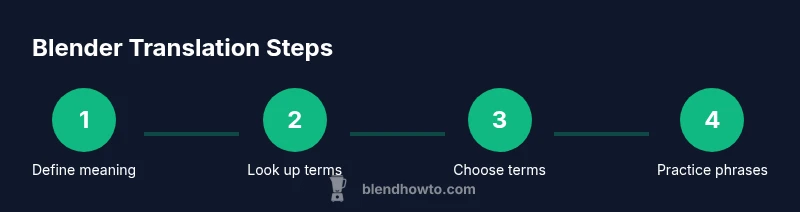
Steps
Estimated time: 30-60 minutes
- 1
Define your meaning
Identify whether you mean the kitchen blender or the Blender software. The term you choose hinges on context, so set your frame before translating.
Tip: If unsure, ask a clarifying question about the context (kitchen or software). - 2
Look up core terms
Consult a bilingual dictionary to confirm translations like mixeur and mélangeur. Note regional preferences and variations.
Tip: Prefer 'mixeur' for appliances in most contexts. - 3
Choose the right noun
For appliances, use mixeur or mixeur électrique; for software, keep Blender as the proper noun. For immersion blenders, mixeur plongeant is common.
Tip: Avoid overusing loanwords in formal documents. - 4
Practice pronunciation
Learn the rough phonetics of 'mixeur' and 'mélangeur' and imitate native speakers via videos or audio resources.
Tip: Record yourself and compare with native pronunciations. - 5
Create example sentences
Write and speak phrases for shopping, cooking, and software contexts to reinforce usage.
Tip: Use real-world contexts to keep memory vivid. - 6
Seek regional nuance
Be aware of variations between France, Canada, and Belgium; adapt terminology accordingly.
Tip: In Canada, bilingual environments may mix terms; stay flexible. - 7
Test with a partner
Quiz a friend or teacher using dialogues to validate your understanding and pronunciation.
Tip: Provide feedback and adjust phrasing as needed.
Frequently Asked Questions
What is the most common French word for blender in everyday conversation?
In everyday conversation, mixeur is the most common term for the kitchen blender. Blender is understood as a loanword when referring to the appliance, especially in casual speech or marketing.
The usual word is mixeur for the kitchen blender, with Blender kept for the software in casual talk.
Is 'blender' used in French, and when is it appropriate?
Yes, blender is used as a loanword in informal contexts and marketing. For formal writing about appliances, prefer mixeur or mixeur électrique.
Yes, you’ll see blender used informally, but for formal writing, stick to mixeur.
How do you say immersion blender in French?
The immersion blender is called a mixeur plongeant. It refers to handheld blending devices used directly in pots or bowls.
Immersion blender is 'mixeur plongeant'.
How do you translate the verb 'to blend' into French when describing mixing ingredients?
The verb for blending is 'mélanger'. Use 'mélanger' to describe mixing ingredients, while nouns will differ as discussed above.
Use 'mélanger' for the verb; nouns include mixeur or Mélangeur.
Does regional variation affect which word I should use?
Yes. France, Canada, and Belgium all use mixeur for appliances, but you’ll encounter loanwords and preferences in marketing and informal speech depending on the region.
Regional differences exist; stay flexible and listen to local usage.
Can I use 'mélangeur' to refer to a kitchen blender?
'Mélangeur' is valid but less common for consumer kitchen appliances; it's more general and can refer to industrial mixers.
Mélangeur exists but is less common for home appliances.
Watch Video
What to Remember
- Identify context to choose the correct term.
- Mixeur covers kitchen appliances; Blender remains a software proper noun.
- Use mixeur plongeant for immersion blenders.
- Pronunciation matters; practice with native resources.
- Adapt terms to regional usage to improve understanding.