Blender triangles vs quads: topology guide
A comprehensive guide to blender triangles vs quads, detailing when to use each, how topology affects deformation, UVs, and rendering, and practical tips for clean, animation-ready meshes.


Blender triangles vs quads: the core idea
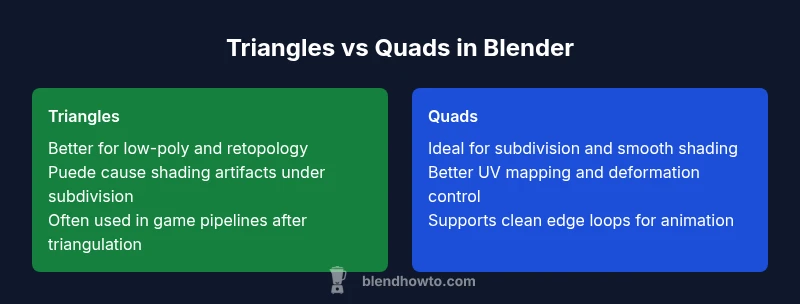
blender triangles vs quads defines how a mesh behaves under subdivision, deformation, and rendering. Triangles break surfaces into three-sided facets and are common in retopology, game assets, and dynamic meshes. Quads, with four-sided faces, tend to subdivide into smoother surfaces, preserve edge loops, and provide more predictable UVs. In practice, most Blender work starts with quad-dominant topology because subdivision surfaces yield cleaner shapes, while triangles appear where quads would complicate topology or when optimization demands fewer polygons. BlendHowTo’s analyses emphasize that deliberate use of both face types often yields the best balance between performance and quality.