Blender 4.4 0: Complete Practical Guide
Learn Blender 4.4 0 with practical steps: installation, UI changes, modeling, shading, rendering, add-ons, and troubleshooting. A BlendHowTo educational guide for 3D artists seeking clear instructions and reliable workflows.


With this guide, you will master Blender 4.4 0 by installing the software, understanding its core interface, and completing a practical project. You’ll confirm system requirements, perform a clean upgrade from older versions, and execute a repeatable workflow for modeling, shading, and rendering. Expect hands-on steps, concrete tips, and a clear path to your first Blender 4.4 0 render.
What is Blender 4.4 0?
Blender 4.4 0 marks the latest major release in the Blender 4.x series, bringing a refined user experience, performance optimizations, and workflow adjustments designed for both beginners and seasoned artists. This version emphasizes faster viewport interaction, improved real-time rendering previews, and more robust scripting options. It’s a natural evolution for artists who want a smoother path from concept to render while keeping backward compatibility where possible. For home cooks and hobbyists exploring 3D design, Blender 4.4 0 remains accessible through guided templates and a growing ecosystem of add-ons. Throughout this article, we’ll reference how BlendHowTo approaches Blender 4.4 0 with practical steps and reproducible workflows.
Keywords to note include Blender 4.4 0, Blender 4.4, and related terms like Eevee, Cycles, and add-ons. Understanding the terminology early helps you follow tutorials, replicate results, and customize your workspace without getting bogged down by jargon. BlendHowTo emphasizes practical learning paths and clear checkpoints so you can measure progress as you explore the new features.
Why Blender 4.4 0 matters for creators
For creators working with 3D, Blender 4.4 0 introduces improvements that affect modeling speed, shading quality, and render reliability. The updated viewport and better memory management help you iterate ideas quickly, while new shader nodes streamline materials without sacrificing control. The release also enhances animation workflows and adds scripting flexibility, which is especially valuable for automating repetitive tasks. Whether you’re building game assets, product visuals, or character concepts, these enhancements can save time and boost confidence when delivering results.
BlendHowTo’s approach to Blender 4.4 0 centers on hands-on learning. By following a tested upgrade path, applying practical modeling and shading techniques, and testing renders early, you’ll minimize wasted effort and maximize learning gains. This section previews a structured path you’ll follow throughout the guide, including a mini-project you can complete in a single session.
Installation and system requirements for Blender 4.4 0
Blender 4.4 0 runs on Windows, macOS, and Linux, with modest to robust hardware options depending on your project scope. A modern GPU is recommended for real-time shading previews and faster renders, while a multi-core CPU helps with general scene updates and simulation work. Before installing, ensure you have a stable internet connection to download the official build from Blender's site. After installation, confirm that drivers for your GPU are up to date to avoid compatibility issues during rendering. This section outlines minimum and recommended configurations and explains how to verify your setup before starting a project.
Upgrading from older Blender versions
Upgrading to Blender 4.4 0 from older 3.x branches typically involves running the new installer and choosing whether to import your preferences. In many cases, Blender preserves key bindings and layouts, but some add-ons may require updates to work with the new APIs. It’s wise to back up your custom startup file, keymaps, and important projects before upgrading. If you encounter unexpected behavior after upgrade, you can launch Blender with factory settings to isolate whether issues are project-related or version-related. This plan helps you maintain a stable workflow as you explore the new features.
User interface changes in Blender 4.4 0
The user interface in Blender 4.4 0 focuses on clarity and faster access to essential tools. You’ll notice tweaks to the default workspace, improved context menus, and streamlined hotkeys that reduce clicks for common tasks. New panels may appear in different locations depending on your chosen workspace, but you can customize them to fit your preferred workflow. For beginners, templates and guided onboarding steps simplify the initial learning curve, while advanced users can tailor the interface for efficiency during complex scenes.
Modeling, sculpting, and object workflows
Modeling remains a core strength of Blender, and 4.4 0 continues to refine polygonal modeling, modifiers, and sculpting workflows. You’ll experience smoother mesh edits, improved snapping, and clearer feedback when applying modifiers. Sculpting gains more brush options and performance improvements, which are valuable for creating organic shapes and fine details. The object workflow now emphasizes non-destructive edits, enabling you to revisit decisions without starting from scratch. This section covers practical techniques to build your toolkit, including how to leverage modifiers and mirror modeling for symmetrical designs.
Materials, shading, and rendering improvements
Blender 4.4 0 enhances shading workflows with more intuitive node connections, faster shader previews, and more stable render paths. Eevee remains a real-time renderer for fast previews, while Cycles continues to offer high-quality path tracing for final renders. You’ll learn to assemble basic materials, tune roughness and metallic values, and explore simple texture workflows. The update also improves light paths and sampling strategies to produce cleaner images with fewer noisy samples, helping you achieve better results with less trial-and-error.
Animation and rigging updates
Animation and rigging receive important refinements in 4.4 0, including enhanced pose libraries, improved playback performance, and more predictable interpolation. The timeline and dope sheet gains increased responsiveness, making it easier to choreograph shots and adjust animation curves. If you’re a hobbyist exploring character animation or product motion, you’ll appreciate the smoother workflow and expanded tooling that reduces friction during iteration.
Add-ons and scripting in Blender 4.4 0
The add-on ecosystem remains a cornerstone of Blender’s flexibility. 4.4 0 expands scripting options, with updated Python APIs and more robust integration for common workflows like rigging, shading, and asset management. You’ll find new or updated add-ons that streamline tasks such as auto-UV mapping, procedural materials, and data export. For those who like to automate, the version provides stronger support for scripts and batch operations, helping you scale your projects without repetitive manual steps.
Performance and troubleshooting tips
Performance in Blender 4.4 0 benefits from better memory management and optimization in the renderer and editor. If you’re working on large scenes or complex shaders, ensure your hardware meets the requirements and keep your scene’s geometry and textures as lean as possible. When things don’t go as planned, consult the console log, check for add-on conflicts, and test with a minimal scene to identify the root cause. This section provides practical checks to minimize downtime and keep your project on track.
A hands-on mini-project: create a simple scene
This hands-on mini-project demonstrates a practical use case for Blender 4.4 0. a basic desk lamp scene built from a few primitive objects, with simple materials and a render pass. You’ll start from a clean scene, create the lamp base and shade, apply a metal or plastic material, light the scene, and render a preview. The project is designed to be completed in a single session, giving you a concrete result to reference as you learn more advanced techniques in later sections.
toolsMaterialsHintText ultra? false},
stepByStepContentToBeFilledLaterSorry
Tools & Materials
- Computer with at least 8 GB RAM (16 GB recommended)(Ensure compatible graphics drivers and sufficient storage for projects.)
- Blender 4.4 0 installer(Download from Blender’s official site; verify checksum if provided.)
- External storage for backups(USB3 or SSD for backing up large projects.)
- Reference assets library (textures/meshes)(Useful for quick prototyping and learning.)
- Monitor setup (optional but helpful)(Dual monitors improve multitasking during modeling and shading.)
- Workspace preferences (themes/keymaps)(Customize for faster access to your tools.)
Steps
Estimated time: 60-90 minutes
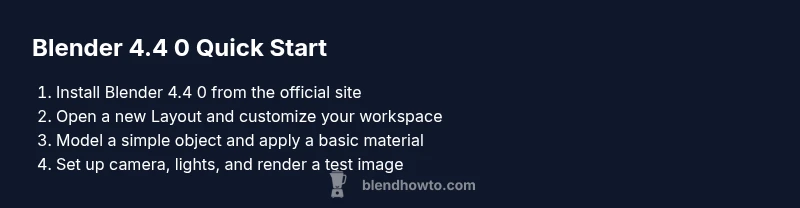
- 1
Install Blender 4.4 0
Download the installer from the official Blender site and run it. Follow the on-screen prompts and choose a clean install to avoid legacy config conflicts. After installation, launch Blender to confirm it opens correctly.
Tip: Opt for a fresh install if you’re upgrading from a much older version to avoid legacy preferences. - 2
Configure your workspace
Open a default layout (Layout workspace) and adjust panels for modeling and shading. Save your preferred startup file so every new project starts in your preferred arrangement.
Tip: Use a right-click drag to snap panels and create a personalized workspace layout. - 3
Create a simple scene
Add a primitive object (Cube) and position it as your scene’s focal point. Place a camera and a light so you can render a basic image. This frames your workflow and gives you a baseline to test materials.
Tip: Enable viewport shading to visually confirm lighting and geometry before rendering. - 4
Apply a basic material
Create a new material and assign simple color and roughness values. Observe how lighting interacts with the material in both Eevee and Cycles previews to compare results.
Tip: Use a basic metallic/roughness combo to learn how reflections behave under lighting. - 5
Set up camera and render
Position the camera for a clean shot, adjust render settings (samples, denoise), and perform a quick render. Compare results between Eevee and Cycles to understand trade-offs.
Tip: Start with lower samples to iterate quickly, then increase for final renders. - 6
Save and organize
Save your Blender file with a descriptive name and organize textures and external assets in a dedicated folder. Maintain a consistent naming convention for easy reference later.
Tip: Create a versioned folder so you can roll back to previous iterations.
Frequently Asked Questions
What is Blender 4.4 0 and why should I care?
Blender 4.4 0 is the latest major release of the Blender 3D software. It brings UX refinements, performance improvements, and enhanced rendering options. If you’re learning Blender or upgrading, this version provides a smoother workflow and more reliable results.
Blender 4.4 0 is the latest version with UI refinements and better performance, making it a good time to learn or upgrade.
Can beginners use Blender 4.4 0 effectively?
Yes. Blender 4.4 0 includes onboarding templates, guided workflows, and improved documentation. Start with simple scenes and gradually add complexity as you grow more comfortable with modeling, shading, and rendering.
Absolutely, beginners can start with templates and simple scenes and build up skills over time.
How do I upgrade from Blender 3.x to 4.4 0 safely?
Back up your projects and settings before upgrading. Install Blender 4.4 0 alongside the old version if possible, and gradually migrate projects. Check add-ons for compatibility and update them as needed.
Back up your work, install the new version, and test add-ons for compatibility.
What are the system requirements for Blender 4.4 0?
A modern multi-core CPU, a compatible GPU, and 8–16 GB of RAM are recommended. Storage and drivers should be up to date to ensure smooth operation and rendering performance.
A relatively recent computer with a capable GPU and enough RAM will handle Blender 4.4 0 well.
Where can I find official Blender 4.4 0 documentation?
Official Blender documentation and tutorials are available on Blender’s website. These resources cover installation, workflow, rendering, and scripting for Blender 4.4 0.
Check the Blender official docs for the latest features and tutorials.
What common issues appear after upgrading, and how can I fix them?
Common issues include add-ons incompatibility, missing preferences, and slower renders due to new defaults. Start with a clean startup file, update add-ons, and adjust render settings to match your project needs.
If problems pop up after upgrading, reset preferences and update or disable incompatible add-ons.
Watch Video
What to Remember
- Upgrade Blender safely and start from a clean workspace
- Explore new UI changes without sacrificing familiar workflows
- Build a simple scene to sanity-check materials and lighting
- Compare Eevee vs Cycles to understand rendering trade-offs
- Organize your assets for scalable projects