Blender 1500 Watts: Power, Performance, and Home Picks
Understand what a 1500-watt blender can do, compare features, and get practical buying tips for home cooks and hobbyists seeking reliable, high-torque blending.


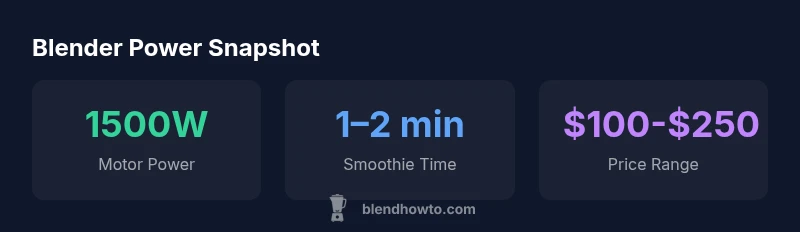
A blender rated at 1500 watts typically delivers strong torque for dense ingredients and smooth purees, handling ice crushing efficiently. Expect practical performance around 1–2 minutes for a full smoothie batch, and price ranges commonly fall between $100 and $250 depending on features and build quality.
What 1500 watts really delivers in a home blender
A 1500-watt motor represents a high-torque workhorse in most countertop blenders. The wattage indicates electrical power available to the rotor, but performance also depends on blade geometry, jar design, and drive system. In practice, a true 1500-watt blender will typically blend frozen ingredients, nuts, and dense mixtures with fewer passes and less heat buildup than lower-wattage models. Look for models that maintain torque at higher speeds and feature overload protection to prevent motor burnout.
How to interpret watts vs. real-world performance
Engine power is only part of the story. Two blenders with the same rated wattage can perform differently due to motor drive electronics, cooling, and blade design. The best 1500-watt units maintain consistent torque when the jar is loaded and include intelligent controls that prevent stalling. When evaluating, balance wattage with rated RPM range, blade count, and jar capacity to gauge true performance.
Key features that amplify 1500-watt performance
Beyond power, look for four pillars: (1) blade geometry and edge material that stay sharp longer; (2) a robust drive coupling that transfers torque without slipping; (3) a sturdy jar with a tight lid to prevent leaks; (4) smart controls (pre-programmed modes, pulse, variable speeds) that optimize texture. A good model keeps the motor cool under heavy loads, avoiding heat buildup that lowers performance over time.
Real-world tasks and expected outcomes
For smoothies, a true 1500-watt blender should puree fruits, vegetables, and ice into a smooth texture in a short cycle. When making nut butters or almond butter, expect a thick, creamy consistency after several minutes of steady blending. For hot soups, follow manufacturer guidance; some models handle heated ingredients, while others require caution to avoid pressure buildup. Frozen dessert prep and grinding tougher ingredients also benefit from the torque available at this power level.
Maintenance, safety, and energy considerations
Regular maintenance extends life: clean after heavy use, inspect blades for nicks, and ensure the seal is intact. Safety features to prioritize include thermal cut-off, overload protection, and a locking lid. Energy-wise, a 1500-watt blender will consume more electricity during peak blending than smaller models, so plan usage during off-peak hours if possible. Always unplug before disassembly and never blend closed jars with hot liquids unless permitted by the manual.
How to choose a 1500-watt blender: a practical checklist
Use a simple checklist to compare models: (1) confirm “1500 watts” continuous rating (not peak), (2) review the materials of the blade and jar, (3) test drive variable speeds and pulse, (4) check warranty length and customer support, (5) assess noise level and cooling features, (6) consider accessories like grinding cups or pre-programmed modes. A solid choice delivers reliable torque, efficient cooling, and easy maintenance.
Common misconceptions about 1500-watt blenders
Many shoppers think wattage alone determines quality. While higher power helps, design and build quality matter just as much: torque stability under load, blade durability, and a well-sealed jar all influence the user experience. Also, higher wattage sometimes means louder operation; look for models with sound-dampening features or quieter drive systems.
Blending safety and ergonomic design
Ergonomics matters: a comfortable, well-balanced pitcher, intuitive controls, and a stable base reduce fatigue during long blending sessions. Safety notes include avoiding overfilling, using the pulse mode for controlled bursts, and never removing the jar while the blades are still spinning. Choose models with clear indicators for motor heat or overload so you can respond quickly when needed.
Final buying considerations and next steps
Before purchasing, align your needs with the power profile: daily smoothies? raw nut butters? batch cooking? Also, read independent reviews to verify reliability across models and confirm the availability of spare parts. With a measured approach, a 1500-watt blender can become a versatile tool for a wide range of home tasks, delivering consistent texture and speed.
Power tiers for blenders around 1500 watts
| Model tier | Power range (watts) | Notes |
|---|---|---|
| Budget | 800-1000 | Great value, basic blades, louder operation |
| Mid-range | 1200-1500 | Balanced performance, better durability, quieter |
| Premium | 1500-1800 | Top torque, premium materials, more features |
Frequently Asked Questions
Is a 1500-watt blender necessary for everyday blending?
Not always; for simple smoothies a 1000W model may suffice, but 1500W improves torque with dense ingredients.
For everyday blending, a 1500-watt model isn't always necessary, but it helps with dense ingredients.
Can 1500-watt blenders blend hot liquids safely?
Some models are designed to handle hot liquids; always check the user manual and use caution.
Check the manual; some models handle hot liquids, but never exceed recommended temperatures.
What should I look for beyond wattage?
Torque stability, blade quality, jar material, cooling, noise, and warranty matter.
Look at torque stability, blade quality, jar, cooling, noise, and warranty.
Are 1500-watt blenders loud?
Yes, many are loud; choose models with sound dampening or quieter drive tech.
They can be loud; check for noise-reduction features.
What maintenance steps extend a 1500-watt blender's life?
Clean after use, inspect seals, avoid overheating, and replace blades as needed.
Clean after use and check seals; replace blades when dull.
“A well-designed 1500-watt blender can handle demanding tasks with reliable consistency, provided the motor is cooled and the drive is efficient.”
What to Remember
- Prioritize true 1500-watt continuous rating over peak figures
- Look for torque-friendly features and cooling
- Choose with practical accessories and warranty
- Expect price range of roughly $100-$250 for solid 1500W performance