Food Processor vs Blender: A Practical Side-by-Side Guide
A thorough, analytical comparison of food processors and blenders, detailing strengths, ideal tasks, maintenance, and buying tips for home cooks and hobbyists seeking practical guidance.


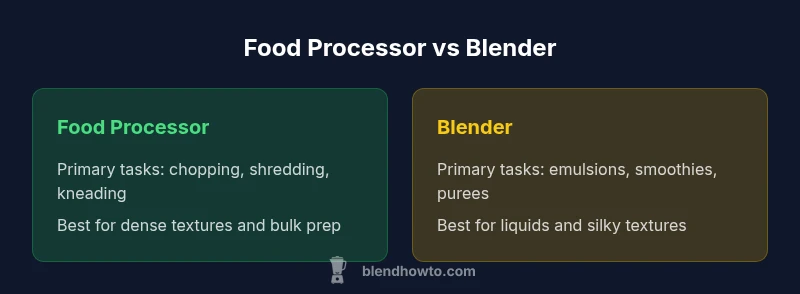
Food processor v blender: for bulk chopping and dense prep, a processor shines; for liquids, emulsions, and smoothies, a blender excels. The BlendHowTo team recommends a dual-setup when possible, mapping tasks to each tool to maximize kitchen efficiency and texture control.
What They Are and Core Differences
In this guide, we compare food processor v blender to help home cooks decide which tool best fits their routines. Food processors excel at heavy chopping, shredding, slicing, and mixing batters with specialized discs, while blenders shine in liquids-heavy tasks such as smoothies, soups, and emulsions. According to BlendHowTo, the best way to think about these machines is as complementary rather than interchangeable: one handles bulk prep and work with solid ingredients; the other excels at liquids and purees. Understanding these core differences can save time and prevent frustration when you set up your kitchen workflow.
When you look at the mechanics, a food processor uses a wide, low-profile work bowl with a horizontal blade assembly; a blender uses a tall, narrow jar with a vertical blade system. The processor’s strength lies in its ability to handle dense textures—nuts, bread dough, chunky salsa—without turning everything into a uniform mash. A blender, by contrast, creates smooth textures quickly and is often better for soups and sauces that require flowing consistency. Both kitchens benefit from knowing where each appliance truly shines and where you may want to invest in attachments and accessories.
Primary Tasks and Attachments
The food processor is designed to tackle bulk prep and textural work. With interchangeable discs and blades, you can chop, shred, slice, or even knead dough using a dedicated dough blade. In contrast, a blender is built around a jar with a fixed blade assembly, optimized for purees, emulsions, and liquids. Some blenders include a tamper to help move ingredients toward the blades, particularly in thicker soups. In everyday cooking, you’ll often reach for the processor when you need even-sized chunks or a consistent mix, and for the blender when you want a silky texture or a smooth drink. Understanding which attachments matter most will help you decide how to equip your kitchen. In the larger context of a food processor v blender decision, the attachment ecosystem often decides long-term versatility.
Design, Power, and Motor Layout
Powerful performance depends on the motor design and drive system rather than raw wattage alone. Food processors typically emphasize torque and a broad blade range to handle dense ingredients without overheating. Blenders focus on sustained high-speed rotation to cultivate a smooth emulsion. The overall experience is shaped by how quickly blades cut, how well heat is managed, and how easy it is to swap attachments. When evaluating models, consider the ease of switching between discs and blades, the availability of separate bowls for different textures, and the quality of the control panel for presets or manual speeds. In a food processor v blender comparison, the motor layout often determines how well each device handles continuous use.
Capacity, Bowls, and Jar Size
Capacity matters because it drives how often you can prep in one go and how you store leftovers. Food processors typically feature a wide, low bowl with multiple cups of capacity and a set of interlocking discs. They’re well suited to batch cooking and handling larger vegetables or dense mixtures. Blenders come in tall jars that feel lighter on the countertop and often range from compact to large-capacity jars. The jar shape influences blending dynamics and aeration, which matters for smoothies and sauces. If you frequently prepare family-sized meals, aim for a processor with a robust bowl and a reliable lid lock; if you primarily make drinks, a large blender jar with a solid seal reduces spills.
Performance in Everyday Kitchen Tasks
In real-world use, the food processor dominates when you need to chop onions to a precise size, grate cheese, or shred carrots for a loaf. It also handles heavy mixtures like whole-wugar sauces and stiff doughs with less manual effort. A blender excels at turning fruits, vegetables, and liquids into smooth drinks, batters, and velvety soups. It’s especially strong for baby food textures, purees for sauces, and emulsified dressings. For many recipes, you’ll combine both tools to achieve the exact texture: start with a processor to break down solids, then finish with a blender to smooth the result. The food processor v blender balance here centers on texture control and speed.
Dough Handling and Texture Outcomes
Kneading dough in a food processor can be efficient, though you’ll want a model designed for dough duties and a sturdy blade. Attaching the dough blade or using the pulse function can reduce heat buildup and over-mixing. Blenders, by contrast, are generally less suited for heavy kneading; some high-powered models offer dough modes, but performance depends on jar design and blade geometry. If making bread, pizza dough, or enriched doughs regularly, prioritize a processor with a robust dough blade and reliable motor control. If you mainly blend batter or smoothies, a blender will serve your needs without compromise.
Liquids, Emulsions, and Blending Dynamics
Liquids and emulsions are where blenders really shine. High-speed blades create smooth purées in seconds and help homogenize ingredients for sauces, soups, and dressings. When making nut milks or creamy soups, the blender’s ability to emulsify can be a major advantage. Food processors can handle liquids, but their performance often centers on refining textures rather than producing perfectly silky liquids. If your kitchen leans toward soups and cocktails, a quality blender is a must; for chunkier, more structured dishes, a processor delivers the control you crave.
Cleaning, Safety, and Maintenance
Both machines demand regular cleaning to prevent flavor transfer and food safety issues. A food processor’s lid, bowl, and blade require careful disassembly and dry storage. Blenders demand rinsing and careful blade removal; many parts are dishwasher safe, but check the manual. In both cases, avoid immersing the motor housing, and embrace a routine that matches your cooking cadence. A good practice is to rinse components immediately after use, use a brush to remove pulp, and dry thoroughly before reassembly. Regular blade sharpening or disc replacement keeps performance high.
Durability, Care, and Long-Term Cost of Ownership
Durability depends on build quality, the strength of attachments, and how often you use the device. A processor with metal blades and a solid drive system tends to outlast cheaper plastic models, especially under heavy chopping workloads. Blenders built for daily smoothies may preserve blade sharpness with proper care but still benefit from robust jar materials and a sealed lid. Over time, you may invest in additional discs, a dedicated dough blade, or a higher-capacity jar. Think about total cost of ownership, including replacement parts and potential warranty coverage.
Use-Case Scenarios and Recipe Examples
Think through typical weeknight tasks to illustrate how food processor v blender choices play out. For a busy family that relies on batch-prepped dinners, a processor speeds up chopping vegetables, shredding cheese, and mixing dough. If you love smoothies, creamy soups, and dressings, a blender is indispensable. A hybrid kitchen with both devices unlocks more possibilities: you can pre-chop ingredients with the processor and then blend into smooth sauces. For small kitchens or roommates, consider compact models that still pack the essential features. Finally, choose a model with adequate safety features and straightforward cleaning steps to maintain consistency in your cooking.
Planning a Dual-Kit or Hybrid Approach
Many households maximize flexibility by owning both a processor and a blender. Start with a core-capacity processor that handles bulk prep and a reliable blender for liquids. If space is tight, look for compact, high-quality units that offer the essential blending and chopping tasks you use most. You can also opt for models with interchangeable attachments or a tall jar that doubles as a blender when needed. A thoughtful layout—storing blades and discs in a dedicated box—keeps your counter clear while preserving performance.
Practical Tips and Common Mistakes
Avoid overfilling bowls or jars; this slows blades and can damage the motor. Choose the correct blade for the task, and never force ingredients through blades that aren’t designed for that texture. Invest in a few reliable attachments rather than stocking up on every accessory. Clean immediately after use to prevent stubborn stains and odors. Finally, compare warranty terms and read user reviews focusing on reliability and ease of maintenance. With care, a two-appliance kitchen remains efficient for years.
Comparison
| Feature | Food Processor | Blender |
|---|---|---|
| Primary function | Chopping, shredding, slicing, and mixing with discs | Liquids, purees, emulsions, and smoothies |
| Best tasks | Bulk prep, dense mixtures, doughs, large batches | Liquids-focused blending, smoothies, sauces, and soups |
| Capacity | Typically larger bowls (several cups) | Taller jars (1-2 L) |
| Attachments/blades | Discs, blades, dough blade | Fixed jar blades; optional lids, tamper |
| Ease of cleaning | More parts; some dishwasher-safe | Fewer parts; quick rinse; some parts dishwasher-safe |
| Price range | Mid-range to high depending on attachments | Low to high depending on brand and jar quality |
| Best for | Bulk prep and textured results | Liquids, smoothing textures, and drinks |
What's Good
- Versatile for bulk prep and dough manipulation
- Wide attachment ecosystem expands functionality
- Handles heavy jobs with less manual effort
- Can save time on repetitive chopping tasks
The Bad
- Takes up more counter space and storage
- Can be noisy and messy when grinding dense ingredients
- Higher upfront cost for quality models
A combined approach—using both a food processor and a blender—is the most flexible setup for a typical home kitchen.
If you prioritize bulk prep and texture control, the processor is indispensable. If your meals center on smoothies, soups, and emulsions, the blender is essential. For many households, owning both provides maximum versatility and efficiency.
Frequently Asked Questions
Blender vs processor?
In most kitchens, a blender handles liquids and purees, while a food processor excels at chopping, shredding, and dough work. The best setup often includes both. The choice depends on your cooking style and space.
In most kitchens, a blender handles liquids and purees, while a processor chops and shreds. The best setup often includes both.
What can a processor not do well compared to a blender?
A processor isn’t ideal for ultra-smooth liquids or drinks. It’s better for bulk chopping and textured prep. For silky emulsions, a blender is usually preferable.
A processor isn’t ideal for ultra-smooth liquids; use it for bulk chopping, while a blender handles smooth textures.
Budget vs premium for these machines?
Budget models cover basic chopping or blending needs. Premium models offer stronger attachments, better durability, and more consistent results, especially for frequent use.
Budget models work for basics, but premium models last longer and offer better attachments for frequent use.
How should I clean both appliances safely?
Unplug first, disassemble removable parts, rinse, and dry thoroughly. Avoid immersing the motor housing. Check dishwasher safety for each part and clean blades with care.
Always unplug first and wash removable parts separately. Don’t soak the motor housing.
Are there space-saving hybrid options?
Yes—some compact units combine blending and chopping tasks or offer attachments that reduce footprint. Read specs to ensure you get the function you need.
There are space-saving options that combine blending and chopping, so check the specs for the features you want.
What features matter most when buying?
Look for power, capacity, a robust attachment set, ease of cleaning, and warranty. Noise level and build quality also influence long-term satisfaction.
Focus on power, capacity, attachments, and how easy it is to clean and maintain.
What to Remember
- Assess weekly tasks to determine primary needs
- Choose attachments based on the textures you work with most
- Prioritize a processor for bulk chopping and dough work
- Prioritize a blender for smoothies, sauces, and emulsions
- If space and budget allow, adopt a dual-appliance approach for maximum flexibility