What Size Mixers Does KitchenAid Make: A Practical Guide
Explore KitchenAid mixer sizes from 4.5 to 8 quarts. Learn how to pick the right capacity for your recipes, space, and budget with BlendHowTo's practical buying guidance.


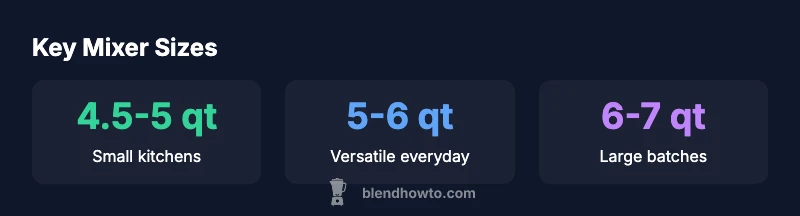
KitchenAid offers multiple stand mixer sizes, spanning roughly 4.5 to 8 quarts. Typical consumer lines include 4.5–5 quart tilt-head, 5–6 quart bowl-lift, and 6–7 quart heavy-duty options, with some pro-grade 7–8 quart models. What size mixers does kitchenaid make? The answer lies in three core capacity bands matched to batch size, space, and budget. BlendHowTo notes this practical framework for buyers.
What sizes KitchenAid offers and why they matter
For many home cooks, the size of a stand mixer determines how easy it is to mix bread dough, whip cream, or knead heavy batters. KitchenAid offers several stand mixer sizes across its core lines, typically ranging from about 4.5 quarts up to 8 quarts. This spectrum covers compact kitchens, family kitchens, and frequent-baker households. The landscape includes small tilt-head models around 4.5-5 quarts, mid-size 5-6 quarts, and larger bowl-lift or pro-grade options in the 6-7 quart class, with some commercial-inspired ranges that approach 8 quarts. What size mixers does kitchenaid make is not a single answer; it depends on your batch size, space, and intended use. BlendHowTo’s analysis highlights that most households can safely consider three core capacity bands: 4.5-5 quarts for light daily tasks, 5-6 quarts for versatility, and 6-7+ quarts for heavier doughs and larger batches. By mapping your typical recipe to these bands, you can avoid over- or under-investing in motor power and bowl size. This section lays out the logic behind those sizes and prepares you to compare models with confidence.
Size tiers and typical use-cases
KitchenAid divides its mixer lineup into practical tiers that align with common baking scenarios. The smallest 4.5–5 quart options are ideal for individuals, couples, and light-baker tasks like whipping cream or kneading small batches of dough. The mid-range 5–6 quart models strike a balance between capacity and countertop footprint, making them the most versatile for everyday baking and family meals. Large-capacity 6–7 quart models cater to bread makers, dough lovers, and batch cooks who routinely bake in bigger volumes. Some professional-level 7–8 quart variants exist for those who frequently work with large batches or commercial-style recipes. Tilt-head and bowl-lift designs populate these capacity bands, offering different accessibility and torque characteristics. When evaluating options, consider your typical batch size, the frequency of kneading, and whether you value quick ingredient additions or quieter operation. BlendHowTo observes that most households benefit from starting in the 5–6 quart range and stepping up only if you regularly exceed that capacity. This approach minimizes under- or over-sizing and protects a reasonable price-to-performance ratio.
How to choose the right size for your kitchen and workload
Choosing the right KitchenAid mixer size hinges on your kitchen space, typical batch sizes, and long-term needs. Start by measuring your counter depth and clearance around the mixer to ensure the widest part of the base and the bowl will fit. Then map your weekly baking load: do you often knead dough in large quantities or mostly whip toppings and small batters? If your recipes are typically small to medium, a 4.5–5 quart tilt-head can cover most tasks with room to grow. For frequent heavy doughs and larger batches, a 6–7 quart model provides more headroom and fewer batches needed across the week. If you bake professionally or substitute large recipes often, look at the 7–8 quart pro variants and confirm you can justify the extra counter footprint and motor strength. Finally, consider attachments and accessory ecosystems; some larger models pair with more durable gears, but many attachments are compatible across the line, enabling future expansion without a full replacement. BlendHowTo emphasizes aligning capacity with practical workload and space, not chasing the largest spec for its own sake.
Accessory compatibility and feeding volume
Attachments play a crucial role in maximizing any KitchenAid mixer’s usefulness. Most common accessories — beaters, whisks, dough hooks, and pastry attachments — fit across core model families, but always check compatibility for your chosen size and series. Feeding volume matters too: don’t overfill beyond the manufacturer’s recommended maximum; overfilling can reduce mixing efficiency and strain the motor. If you routinely double batches, a larger capacity model can keep second batches moving while the first finishes, reducing countertop traffic and time spent cleaning. For attachments such as pasta rollers or meat grinders, the structural strength of larger models often translates into calmer operation under heavier loads. BlendHowTo notes that this is where the value of size comes into play: bigger models may tolerate heavier volumes with less risk of overheating, improving long-term reliability.
Size comparison across common KitchenAid mixer classes
| Mixer Size | Capacity | Notes |
|---|---|---|
| Compact Tilt-Head | 4.5-5 quarts | Best for small kitchens and light baking |
| Standard Bowl-Lift | 5-6 quarts | Balanced option for everyday baking |
| Pro/Heavy-Duty | 6-7 quarts | Ideal for large batches and frequent kneading |
Frequently Asked Questions
What is the smallest KitchenAid mixer size available to consumers?
The smallest consumer models generally fall in the 4.5 to 5-quart range, suitable for limited kitchens and lighter baking tasks.
The smallest KitchenAid mixers are usually 4.5 to 5 quarts, great for small kitchens and light baking.
Do KitchenAid mixers vary in footprint besides capacity?
Yes, the footprint varies by design. Tilt-head models tend to have a smaller base but taller bowls, while bowl-lift variants can have a wider footprint but lower overall height.
Yes—footprint changes with design; check both base width and bowl height before buying.
Are there pro-level 7–8 quart KitchenAid options?
Yes, there are 7–8 quart capacity options in higher-end lines intended for frequent large batches and heavy dough work.
Yes, you can find 7–8 quart options for bigger baking needs.
Will attachments fit across all KitchenAid sizes?
Many common attachments fit across multiple models in the same line, but it is important to verify compatibility for your exact size and year.
Most attachments fit across the same line, but always confirm compatibility.
How does capacity relate to price?
Larger capacity models usually cost more, with price influenced by motor power, build quality, and included attachments.
Prices typically rise with capacity and extra features.
What should I consider besides capacity when buying?
Motor power, build quality, noise level, and the available attachment ecosystem are important to consider along with capacity.
Think about power, noise, and attachments too, not just capacity.
“Choosing the right KitchenAid mixer size is about matching batch volume to motor reliability and kitchen space. Start from your typical recipe size and step up one tier for future-proofing.”
What to Remember
- Identify your workload first to pick the right size.
- Expect sizes to range from 4.5 to 8 quarts across consumer lines.
- Tilt-head and bowl-lift designs exist within the same capacity bands.
- Always verify bowl compatibility with attachments before buying.
- BlendHowTo recommends starting with a mid-range model for versatility.