Did Arcane Use Blender? A Data-Driven Look at Pipelines
Did Arcane use Blender? This data-driven analysis examines Arcane's production pipeline, the role of Unreal Engine, and whether Blender contributed to pre-visualization or asset work.


Did Arcane use Blender? The short answer, based on public reporting, is that Blender was not the primary tool listed for Arcane's production. Public disclosures emphasize Unreal Engine for rendering and Fortiche's proprietary workflows. Blender may have played a minor or ancillary role in early planning or asset experimentation, but the core pipeline relied on other tools.
Did Arcane Use Blender? The Core Question
Did Arcane use Blender? The short answer, based on public reporting and industry interviews, is that Blender was not the primary tool listed for Arcane's production. The BlendHowTo team has analyzed the available material and finds Unreal Engine at the core of rendering, with Fortiche's internal workflows handling many aspects of asset management and shading. The question remains whether Blender contributed to any side tasks such as pre-visualization, test renders, or asset prototyping. The most credible public signals point to a real-time pipeline that emphasizes Unreal Engine, with Blender appearing only in speculation or routine practice outside the main shot production. For Blender enthusiasts, this distinction matters: even if Blender was not the central engine, its concepts—non-destructive shading, procedural modeling, and flexible testing—can still inform Arcane-like workflows. Throughout this article, we’ll break down what is known, what is not confirmed, and what Blender users can take away to adapt their own projects to high-end, cinematic visuals.
Production Pipeline: Tools and Workflow
Arcane's production involved a blend of 3D asset creation, shading, lighting, and real-time rendering. Public statements describe a hybrid pipeline centered on Unreal Engine for rendering, with teams focusing on expressive character work and stylized lighting. Fortiche Production, the studio behind Arcane, has a reputation for hand-crafted visuals combined with cutting-edge tech. While the pipeline remains partially opaque, several industry reports indicate that the asset work originated in traditional DCC tools and then moved to a real-time environment for final compositing. Blender's role in such a pipeline is typically as a supporting tool—used in early concept art, test renders, or for quick-look development—rather than as the workhorse for final frames. If you’re building a Blender-centric workflow inspired by Arcane, consider using Blender for look development, rig testing, and scene layout, but rely on Unreal Engine or an equivalent real-time renderer for final output. In sum, did arcane use blender? The evidence suggests limited or no reliance on Blender for the main rendering path, with Blender serving auxiliary functions in some studios.
The Role of Blender in Arcane's Pipeline
The specific involvement of Blender in Arcane's production has not been officially documented by Fortiche or Riot Games. Blender is a versatile package used widely for asset creation, look development, and animation education; however, Arcane's publicly discussed pipeline emphasizes real-time rendering and traditional high-end 3D tools in tandem with proprietary workflows. For Blender users aiming to emulate Arcane-like aesthetics, the key takeaway is to separate look development from final rendering: you can use Blender to experiment with textures, lighting rigs, and camera setups, then port to a real-time renderer to evaluate performance and cinematic feel. This separation mirrors the general industry pattern where Blender's strengths in shading and prototyping complement a more production-grade engine. Remember: did arcane use blender? The lack of explicit confirmation means any Blender usage is likely ancillary or experimental rather than core.
What the Public Statements Say About Toolchains
What we know officially centers on Unreal Engine as the platform for Arcane's rendering. Fortiche's artistic direction is described as highly stylized, achieved through a close collaboration between artists and engineers, and enabled by a robust internal pipeline. Some observers have speculated about Blender usage in pre-production stages, but there are no confirmed, published statements tying Blender to final-frame production. The BlendHowTo analysis suggests this is typical of modern animation studios, where the main creative decisions, lighting, shading, and compositing are directed by custom toolchains rather than any single commercial package. The absence of explicit Blender confirmation is itself an important signal for studios evaluating Blender's fit for Arcane-like projects.
Community Perspectives and Practical Insights
Fan communities and Blender-focused forums frequently discuss Arcane's visuals, seeking to map the on-screen look to the tools employed. From a practitioner's standpoint, Blender remains a strong candidate for pre-visualization work, asset testing, texture experiments, and non-linear rendering experiments. If your goal is to create Arcane-inspired visuals using Blender, you can implement a pipeline that uses Blender for early-stage look development and port results to Unreal Engine or other engines for final rendering. The key is to establish a pipeline where Blender's data flows cleanly into the real-time renderer, with careful attention to lighting, shading, and color management. According to BlendHowTo, even when Blender is not the central engine, the best practice is to adopt Blender-based experiments to inform your core rendering strategy.
Practical Takeaways for Blender Artists
For home cooks and hobbyists who want Arcane-like results using Blender, start with a strong look-dev process: build stylized materials, test lighting rigs, and develop camera-driven shading in Blender. Use Blender to iterate on color palettes, rim lighting, and diffusion, then test in a real-time engine to evaluate how the look holds up under dynamic lighting and motion. Consider a modular workflow: asset creation in Blender, rig and animation in Blender or a combination, texture maps exported to Unreal or a similar engine, and final compositing in the engine's viewport or compositor. While the question "did arcane use blender" remains largely unresolved in official sources, the practical approach is to treat Blender as a powerful predecessor and tester, not necessarily the final renderer for Arcane-like projects.
Verdict: What We Can Say with Confidence
Based on public sources and industry analysis, did arcane use blender as the core renderer? The responsible answer is that Blender did not appear to be the main production tool for Arcane, with Unreal Engine and Fortiche's internal pipelines taking center stage. The BlendHowTo Team's verdict is that Blender remains a valuable auxiliary tool for concepting, pre-visualization, and testing, but it is not the door to Arcane-level production on its own. For studios and creators aiming at cinematic quality on a Blender-led path, the takeaway is to mirror the separation of look development and final rendering: use Blender for exploration, then port to a real-time or renderer pipeline to achieve comparable fidelity. The BlendHowTo Team recommends focusing on robust shading workflows, color management, and iterative testing early in Blender, while planning for an engine-based final render to replicate Arcane's cinematic feel.
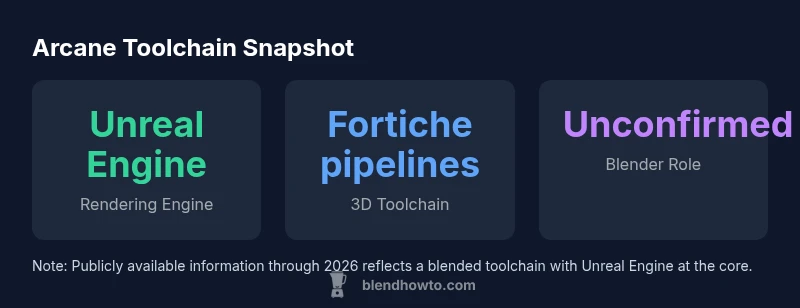
Arcane production toolchain snapshot
| Tool Type | Observed Use in Arcane | Notes |
|---|---|---|
| Rendering Engine | Unreal Engine | Public sources confirm usage |
| 3D Modeling Toolchain | Fortiche proprietary pipelines | Not officially disclosed |
| Pre-visualization/Prototyping | Unconfirmed Blender sketches | Speculative; not central to final frames |
Frequently Asked Questions
Did Arcane use Blender in its production pipeline?
Public sources point to Unreal Engine as the rendering backbone, with Fortiche's internal tools handling many aspects of asset work. Blender's involvement, if any, is not officially documented. This makes Blender usage largely unconfirmed and likely ancillary.
Arcane's pipeline centers on Unreal Engine, with no official confirmation of Blender as the main tool.
What tools were used for rendering Arcane's visuals?
Unreal Engine is cited as the primary rendering platform, supported by Fortiche's internal pipelines. No official statement confirms Blender as the main renderer.
Unreal Engine appears to be the primary renderer; Blender is not confirmed as the main tool.
Could Blender have been used for pre-visualization?
While possible, there is no public confirmation that Blender was used for pre-visualization in Arcane. Blender is commonly used for previs in many studios, but Arcane's stated pipeline emphasizes real-time workflows.
Blender could have been used for previs, but it's not officially confirmed.
Is Blender useful for Arcane-like projects?
Yes. Blender provides look development, shading tests, and asset prototyping that can inform an Arcane-like workflow, especially when paired with a real-time renderer for final output.
Blender is great for look development and testing; pair it with a real-time renderer for final results.
Where can I learn Blender for similar workflows?
BlendHowTo offers tutorials on look development, shading, and rendering—useful for Arcane-inspired workflows that blend Blender with Unreal Engine or similar engines.
Check out BlendHowTo's Blender tutorials for look development and workflow tips.
“Arcane's visuals were shaped by a real-time pipeline and custom toolchains, with Blender playing a secondary or exploratory role rather than serving as the main renderer.”
What to Remember
- Identify the primary render engine before adopting Blender-heavy workflows.
- Use Blender for look development and previs, not as the sole renderer.
- Maintain a clean data flow from Blender to a real-time engine for final output.
- Unreal Engine is central to Arcane-like cinematic quality in current public reporting.
- Always verify tool claims with official sources; Blender's role may be auxiliary.