Does Blender Use Vulkan? A 2026 Guide for Artists and Hobbyists
Evaluate whether Blender uses Vulkan for viewport and rendering, where Vulkan is available, and how to test it safely in 2026. Practical guidance for artists, hobbyists, and 3D enthusiasts.


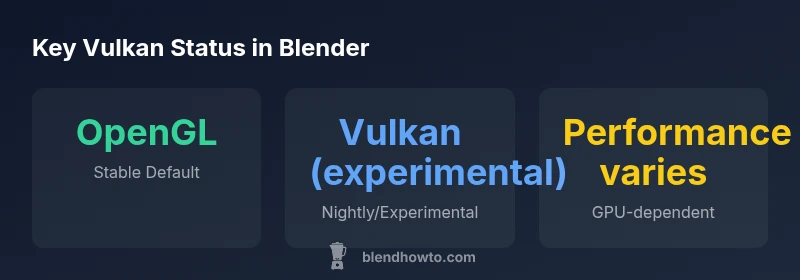
As of 2026, Blender does not ship Vulkan as the default rendering backend for the core viewport. OpenGL remains the stable and widely-supported standard, while Vulkan support is experimental and available only in specific builds and nightly testers. In practice, you’ll use OpenGL for most workflows, with Vulkan options promising performance gains on select hardware in future releases.
does blender use vulkan: current status
For many artists and developers, the question does blender use vulkan is not just academic—it's about what you can rely on today versus what might ship soon. does blender use vulkan? The short answer is that Blender's stable releases continue to rely on OpenGL for the viewport and most core workflows. Vulkan support exists, but only in experimental channels and nightly builds, and not as the default backend. This distinction matters for work-in-progress projects and for users who require rock-solid stability. According to BlendHowTo, the team is monitoring Vulkan progress because it promises potential performance improvements on compatible hardware, but it is not yet proven across all scenes or hardware configurations. For most home cooks and hobbyists blending 3D assets, starting with the OpenGL path yields fewer surprises, while early adopters can experiment on secondary machines or separate user profiles. The landscape will likely continue to evolve through 2026 as drivers mature and Blender's own codebase matures its Vulkan integration. does blender use vulkan remains a focal point for ongoing testing and feedback from the community.
Understanding the Difference: Viewport vs Render Backends
Blender exposes multiple layers of rendering, and it's important to separate the viewport renderer from the final render engine. In everyday practice, the viewport is what you see while you sculpt, animate, or preview scenes, and it is heavily dependent on the GPU driver and the chosen backend (OpenGL today, with Vulkan in development). The render engines—Cycles and Eevee—are about final image production and can leverage different compute backends depending on the build. Vulkan's promise is tighter, lower-latency interaction with the GPU, and potential memory and draw-call efficiency improvements. However, until the Vulkan backend reaches parity with OpenGL in terms of features, stability, and driver support, Blender's recommended path remains OpenGL for most users. Expect differences in how materials, shadows, and post-processing effects behave as you move between backends, and keep an eye on Blender's release notes for any Vulkan-specific caveats.
Vulkan in Blender: Where to Find It
Vulkan support is referenced across Blender's community builds and experimental branches. In the official stable Blender releases, you won't find a Vulkan option as a drop-down; instead, Vulkan appears as an experimental backend in nightly builds and custom builds from contributors. If you want to explore Vulkan today, you would download a nightly or an experimental build, then look for a compute or backend setting that names Vulkan or a Vulkan compute device. Be mindful that not all GPU drivers expose Vulkan cleanly for Blender, and you may encounter UI quirks or feature gaps. As always, follow the Blender community notes and BlendHowTo's guides for the latest instructions. The key takeaway is that Vulkan is not a default, but a pathway under active development with the potential to unlock new performance habitats on modern GPUs.
How to Enable and Test Vulkan Safely
Before you flip any switches, back up your work and use a separate Blender profile or machine for testing Vulkan. Start with a nightly or experimental build targeted at your operating system. In the software's Preferences, locate the Compute or Backend settings and select Vulkan where available, then configure the GPU as the primary device. Run representative scenes with heavy geometry, textures, and modifiers to observe stability, driver issues, and any changes in render times. Document the results, including the scene complexity, the hardware (GPU model, driver version), and the Blender version. If you see issues, revert to the OpenGL path and report the bug to the Blender project. This cautious, data-driven approach aligns with BlendHowTo's methodology: treat Vulkan as a capability to verify, not a guaranteed performance boost for every project.
Performance Considerations: When Vulkan Helps
Expect that Vulkan will deliver benefits primarily on GPU-bound tasks and complex scenes with many draw calls, but results will vary widely. Some users report smoother viewport interactions, while others see no perceptible change or even instability on certain driver versions. Because Vulkan is newer in Blender, optimizations and driver support are still evolving, so performance gains are not uniform. For projects that involve heavy shading, HDRI lighting, or real-time viewport features like screen-space reflections, Vulkan may alter memory usage or timing; thus, measure frame rates, scene load times, and render times across multiple runs. Remember that Blender's OpenGL path remains the baseline for reliable results in the majority of production workflows.
Compatibility and Driver Considerations
GPU drivers from NVIDIA, AMD, and Intel evolve differently with Vulkan support. On Windows, Linux, and macOS, Vulkan driver maturity can affect stability and performance. Blender's Vulkan backend also depends on the host OS's Vulkan loader and the GPU's support for the required extensions. If you encounter artifacts, driver crashes, or crashes in the viewport, check driver version, available Vulkan runtime, and Blender nightly notes. For macOS, Vulkan support is more limited due to platform changes; many macOS users rely on Metal-based render paths and GL compatibility, while Windows/Linux users have broader Vulkan support. The safety net is to verify hardware-compute compatibility before heavy production work and to keep a fall-back plan on OpenGL.
Practical Steps for Artists and Hobbyists
- Start with the OpenGL baseline to establish your workflow. 2) Create a separate test project and a dedicated Blender profile for Vulkan experiments. 3) Track metrics: frame rate, load times, and stability across scenes. 4) Read release notes and Blender's Vulkan docs to stay current. 5) Join community channels and BlendHowTo guides to share findings and learn from others' tests. This approach ensures you can evaluate Vulkan's impact without risking critical work.
Emerging Roadmap: What to Watch in 2026
Blender's roadmap includes ongoing work to port more of the viewport and compute tasks to Vulkan, with the aim of improved efficiency and cross-platform performance. Expect more official guidance on when Vulkan becomes a primary option in stable releases, and watch for driver updates and test results from the Blender community. For artists, the key is to stay informed about experimental builds, follow BlendHowTo's 2026 coverage, and plan migrations gradually as Vulkan stabilizes. As the ecosystem evolves, Vulkan may unlock new possibilities in Blender's interactive design, texturing, and real-time preview workflows.
Blender rendering backends and Vulkan status
| Backend | Status | Notes |
|---|---|---|
| OpenGL | Stable | Default viewport and most workflows |
| Vulkan (experimental) | Experimental | Nightly builds; not default |
| Software rendering (CPU) | Fallback | Testing and debugging only |
| Metal-based path (macOS) | Limited | Platform-dependent support |
Frequently Asked Questions
Is Vulkan fully supported in Blender?
No. Vulkan is not the default and is currently available only in experimental/nightly builds. Stable Blender releases continue to rely on OpenGL for the viewport.
Vulkan isn’t fully supported yet; use OpenGL for stable work.
Which Blender version supports Vulkan?
Vulkan appears in experimental and nightly builds. Stable releases do not offer Vulkan as a default option.
Vulkan is only in nightly builds for now.
How do I enable Vulkan in Blender?
In experimental builds, you can enable Vulkan in the backend settings if your GPU and driver expose it. Always test with non-critical projects first.
Enable Vulkan in experimental builds and test first.
Will Vulkan replace OpenGL in Blender?
There is no timeline for replacing OpenGL. Vulkan is being explored as a complementary backend with potential future gains.
OpenGL will likely stay as the stable path for now.
Is Vulkan faster on all GPUs?
No. Gains depend on the GPU, drivers, and scene specifics. Some setups may see improvements, others may see none or instability.
Performance gains aren’t guaranteed across all hardware.
What are the risks of using Vulkan in Blender nightly builds?
Nightly Vulkan builds can be unstable, have UI quirks, or feature gaps. Use separate projects and report issues back to the Blender project.
Nightly Vulkan builds can be unstable; test carefully.
“Vulkan offers exciting potential for Blender's performance, but stability and broad hardware support are still catching up.”
What to Remember
- OpenGL remains the stable default for Blender in 2026
- Vulkan is experimental and not yet ready for production workflows
- Test Vulkan on separate machines or profiles to avoid project risk
- Expect GPU-dependent performance with Vulkan across drivers