How to Blend with Colored Pencils: A Practical Guide
Master blending with colored pencils through layered strokes, pressure control, and colorless blenders. This educational guide from BlendHowTo covers techniques, materials, and practical exercises to achieve smooth gradients and rich textures.


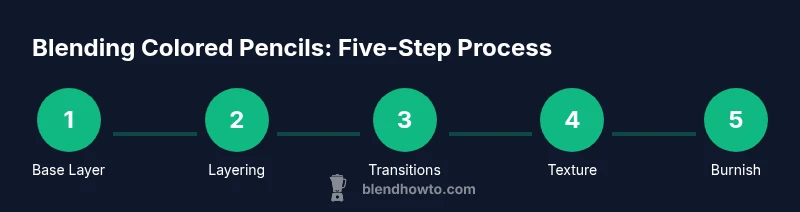
With colored pencils, you’ll learn to build seamless color blends through deliberate layering, careful pressure, and the right blending tools. This guide covers core techniques—layering, color transitions, and burnishing—plus materials and practice routines to help you master how to blend with colored pencils. By following a stepwise approach, you’ll transform simple strokes into polished, gallery-ready blends.
What blending with colored pencils means
Blending with colored pencils is the art of fusing individual strokes into a smooth, cohesive field of color. It’s not simply laying down one color after another; it’s shaping how those colors interact with each other and with the paper. When you learn how to blend with colored pencils, you’re teaching your eye to judge pressure, layering depth, and color relationships. According to BlendHowTo, the foundation starts with selecting pencils that have a soft core and pairing them with a paper that has just enough tooth to grip pigment without creating harsh edges. This sets the stage for gradual, controlled transitions rather than abrupt color shifts. The goal is a believable, unified surface where boundaries disappear and texture remains intact. As you practice, you’ll discover which pencil families blend most smoothly on your chosen paper, and you’ll refine your color choices to achieve clean, luminous results.
Core techniques for blending
There are several proven techniques that work well with colored pencils. Layering involves building color in multiple light passes to create depth without muddying the hues. Scumbling uses quick, circular strokes to lay down pigment in a way that leaves some of the underlayer visible, producing interesting textures. Burnishing is the high-pressure finish that presses pigment into the paper for a smooth, almost painting-like surface. Each technique serves a different result: layering for subtle transitions, scumbling for texture, and burnishing for a polished final look. A practical blend often combines all three: light layers for color balance, controlled scumbles for texture, and a final burnish to unify tone.
Selecting pencils and papers
Choose pencils with soft cores for easier blending—wax-based or oil-based varieties offer distinct blending characteristics. Lightfast pigments help your work stay vibrant over time, so consider artist-grade brands. Paper choice matters more than most beginners realize: smooth papers yield crisper edges, while lightly toothed papers grab pigment and help layers mingle. If your paper is too smooth, you may need to adjust pressure and layering; if it’s too toothy, you might see graininess in flat areas. A mid-weight drawing paper with a gentle tooth is a versatile starting point. Keep a small color palette that you can easily manipulate and plan your color families before you start.
Base layers and underpainting
Start with a light underlayer to establish the overall value structure. This could be a neutral gray wash or a light hue that maps the scene’s shadows and light areas. Underlayers help prevent your top colors from appearing muddy and give you a reliable base for subsequent washes. Apply evenly with short, controlled strokes, then adjust the underlying tones as you refine the composition. The underlayer should be subtle enough that the final colors can breathe, but strong enough to guide your subsequent layers. This stage is where you set up your color relationships and begin to see how neighboring colors influence each other.
Layering and color transitions
After the base layer dries (if you’ve used a solvent or if your paper shows color quickly), begin layering with slightly stronger pressure and added hues. Work in directional strokes that follow the form you’re drawing, gradually expanding your color family. Small incremental changes beat big jumps in hue, so mix new colors in increments and test them on a scrap area. Build up the midtones first, then add the shadows, leaving highlights for the final pass. The aim is a smooth continuum from light to dark without obvious banding.
Using colorless blenders and blending tools
Colorless blender pencils, blending stumps, and tissue can help merge colors without introducing new pigment. A colorless blender can push pigment into the paper grain for a polished finish, but use it sparingly to avoid removing too much color. Blending tools work best when you keep pigment on the surface, not pressed too deeply into the fibers. Clean your blending stump often to prevent muddying and avoid cross-contamination between colors. Alternate between blending tools and re-application of color to maintain vibrancy.
Texture and fine details
Texture is where blending demonstrates its artistry. For fur, skin, fabric, or foliage, vary stroke direction, density, and color placement. Use light, repetitive strokes for general color and reserve short, precise strokes for texture accents. When you want a smooth area, a light burnish can unify tones; for textured areas, allow some of the underlying grain to show through. Remember that texture should support the subject, not overpower it. Practicing small texture studies will help you understand how color interactions translate into realistic surfaces.
Common mistakes and fixes
Muddy colors often come from layering too many similar hues or pressing too hard too early. If this happens, consider lifting some color with a kneaded eraser and reapplying lighter tones. Wax bloom—an opaque haze that appears on the surface—can be reduced by finishing with a clean burnish and using a light touch during the final layers. Avoid using harsh solvents near the final layers unless you’re experienced, as they can cause colors to bleed or paper to warp. When in doubt, step back every few layers to evaluate color balance and contrast.
Finishing touches and preservation
The final stage is about refinement and longevity. Add the last highlights and deep shadows with careful, deliberate strokes. If you plan to preserve your drawing, consider a light protective spray or mount your piece under glass when displayed. However, many pencils’ wax and oils can react to fixatives; test any product on a scrap sheet first. Proper storage—flat, away from direct sunlight, and in a clean portfolio—will keep colors vibrant. Regular practice is essential to sustaining your blending skills over time.
Practice prompts and projects
To solidify your blending skills, try themed prompts that force you to apply the techniques in new contexts: a soft sunset gradient, a fur texture with subtle color shifts, a glassy surface reflection, or a botanical leaf with overlapping color layers. Start with a small 6x6 inch study to focus on control before moving to larger compositions. Keeping a practice journal helps track which color combinations produced the smoothest transitions and which techniques yielded the most natural textures.
Tools & Materials
- Colored pencils (soft core preferred)(Wax-based or oil-based; ensure you have a light-to-dark range in each color family)
- Drawing paper or smooth bristol board(Aim for 80-100 lb (180-220 gsm); some tooth is helpful for layering)
- Colorless blending stump or tortillon(Keep clean; use a new stump for different color families)
- Eraser (kneaded and standard)(Kneaded for lifting; standard for precise corrections)
- Pencil sharpener (with guard)(Keep points sharp for fine control; a ceramic blade works well)
- Optional: Colorless blender pencil(Useful for smooth transitions in wax-pencil work)
- Optional: Blending markers or tissue(Use sparingly and only if you’re comfortable; avoid over-liquid methods)
- Masking tape or light grip board(Helpful for keeping paper flat and clean edges)
- Fixative spray (optional)(Use with caution; test on scrap first as it can alter color slightly)
Steps
Estimated time: 60-90 minutes total
- 1
Gather and prepare materials
Organize pencils, paper, and tools. Sharpen needed colors to fine points and lay out a color plan. Gather a scrap sheet to test color mixes and pressure before applying to the working piece.
Tip: Keeping a clean workspace reduces color contamination between hues. - 2
Choose base colors and lay a light underlayer
Select a small palette for the largest area and apply a light, even underlayer. Use short, even strokes to map values without building heavy pigment. This layer guides your subsequent color applications.
Tip: Start light; you can always add more color later. - 3
Build via layering with directional strokes
Add layers in the same general direction as the form. Begin with adjacent lighter tones and gradually introduce deeper hues. Keep strokes short enough to control texture but long enough to avoid gaps.
Tip: Test color pairings on a scrap area to ensure harmony. - 4
Refine with color transitions
Blend neighboring colors softly to create smooth transitions. Work in incremental steps, avoiding abrupt color changes. Use the edge of your pencil to feather boundaries.
Tip: Pause to evaluate the balance of warm and cool tones. - 5
Incorporate a colorless blender for edge merges
Gently blend across color boundaries using a colorless blender or blending stump. Don’t overwork; you want a cohesive surface without removing depth.
Tip: Wipe or swap the blender between colors to prevent cross-contamination. - 6
Add texture through controlled scumbling
Use small, random, overlapping circles or scribbles to create texture without flattening color. This technique is ideal for skin variation, fur, or foliage.
Tip: Vary pressure to mimic natural texture changes. - 7
Burnish for a unified finish
Apply steady, even pressure to merge pigment into the paper fibers. Burnishing creates a polished surface but reduces tooth, so reserve for final areas.
Tip: Reserve burnishing for sections you want fully smooth. - 8
Review, fix mistakes, and protect
Check for muddy spots and lift color as needed. If you used fixatives, test carefully first on a scrap. Mount your work or place it under glass for display.
Tip: Take a step back every few layers to assess overall balance.
Frequently Asked Questions
What is the best technique for blending colored pencils?
The best technique combines layering, color selection, and controlled pressure. Start with light layers, gradually add hues, and finish with a light burnish to unify tone. Practice will reveal which combinations yield the smoothest blends.
The best technique combines layering, color choice, and controlled pressure—start light, add colors gradually, and finish with a gentle burnish to unify tones.
Should I use solvent or water to blend colored pencils?
Solvents and water are generally not recommended for standard colored pencils on paper. They can cause paper deformation and color bleeding. Stick to layering, blending tools, and burnishing for best results.
Solvents aren’t usually recommended for colored pencils. Use layering, blending tools, and burnishing for best results.
What paper should I use for blending?
A paper with a mild tooth—neither too smooth nor too rough—helps pigment grip while allowing subtle transitions. Look for 80-100 lb (180-220 gsm) drawing papers or smooth bristol with moderate texture.
Choose paper with a gentle tooth, like 180-220 gsm drawing paper, for smooth blending and good pigment grip.
How do I prevent colors from muddying when blending?
Plan a color path before layering and use incremental color additions. Clean blending tools between colors and avoid over-handling the same area. Lift color with a kneaded eraser if needed and re-layer with lighter tones.
To avoid muddiness, plan color paths, clean tools between colors, and lift color if needed before re-layering.
Can I blend with sharp pencils?
Sharp pencils can still blend well, especially for edges and fine details. The key is to apply short, controlled strokes and gradually build color. Duller pencils blend more smoothly in broad areas.
Yes, sharp pencils can blend well for details. Use short strokes and layer gradually.
Is burnishing always necessary?
Not always. Burnishing provides a polished finish in certain areas, but leaving some texture can add realism. Choose burnishing strategically for areas you want to appear smooth and luminous.
Burnishing isn’t required everywhere; use it where you want a smooth, luminous look and keep some texture elsewhere.
Watch Video
What to Remember
- Start with a light underlayer for value control
- Layer progressively to build depth without mud
- Use colorless blenders sparingly for smooth transitions
- Burnish only when you’re ready for a polished finish