3D Modeling with Blender: A Practical Beginner Guide
Learn practical, step-by-step 3D modeling with Blender. From workspace setup to topology, shading, and export, this beginner-friendly guide builds solid modeling skills.


You will learn how to model a simple 3D object in Blender from reference to a finished mesh, covering essential tools, workflow, and tips. Start by setting up the workspace, blocking the shape, refining topology, and applying basic textures. Prerequisites: Blender installed, a reference image, and basic navigation skills.
Understanding 3d modeling with blender
3d modeling with blender combines precision and creativity to turn ideas into three-dimensional forms. This guide helps home cooks?—no, it helps hobbyists and aspiring 3D artists develop a practical, repeatable workflow. You’ll learn how to translate a reference into a clean mesh, sculpt or refine details, and prepare your model for texturing and rendering. Blender's modeling toolkit spans polygon modeling, sculpting, modifiers, and UV layout, so you can choose the approach that best fits your project. By the end of this section, you should feel confident setting up your workspace and starting a small modeling project with a clear plan. Throughout, we’ll emphasize non-destructive techniques, good topology, and consistent naming so your files stay organized as you scale up to more complex models.
Why Blender is a strong choice for 3D modeling
Blender offers a comprehensive, cost-effective path into 3D modeling with no upfront software costs. It has robust polygon modeling tools, non-destructive modifiers, a flexible workflow for sculpting and retopology, and built-in UV mapping and shading systems. The active community contributes tutorials, add-ons, and example projects, which accelerates learning. For hobbyists and professionals alike, Blender serves as a all-in-one solution for asset creation, animation prep, and rapid prototyping. In short, Blender lowers the barrier to entry while providing room to grow into advanced pipelines.
Core concepts you'll master
Key ideas include topology, edge flow, and subdivision control. You’ll learn how to plan a clean mesh by thinking about where quads vs. triangles matter, how to use edge loops to preserve shape, and when to apply modifiers like Mirror, Subdivision Surface, and Bevel. Understanding UVs and basic shading will help you prepare realistic textures later. A strong mental model of space,scale, and proportion will also guide decisions about blocking and refinement, so your models remain predictable during export to engines or printers.
Setting up your Blender workspace
Begin by selecting a layout that prioritizes modeling: a 3D Viewport, a Properties panel, and an Outliner for scene organization. Customize the header to show essential tools: Transform, Snap, and Modifier panels. Enable the Use Nodes workflow for materials early if you plan to visualize texturing as you model. Save a dedicated startup file to lock your preferred defaults, such as grid scale, units, and the initial camera angle. Keyboard shortcuts are your friend: G to grab, S to scale, R to rotate, and Tab to switch between object and edit modes. Practice navigation with the mouse—middle-click to rotate, scroll to zoom, Shift + middle-click to pan.
The modeling workflow: from concept to clean mesh
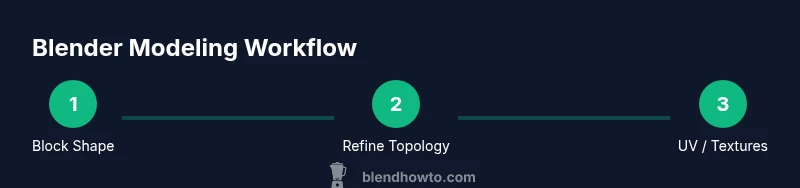
A solid workflow starts with a clear concept. Create a simple block model to establish proportions, then refine with precise edge loops and faces. Move from blocking to topology optimization by focusing on clean quads and minimal triangles in curved areas. Use Mirror for symmetry, and apply Subdivision Surface to preview smoothness while keeping control during blocking. Retopology can be introduced for organic forms, followed by UV mapping and layout planning for texturing. Finally, organize assets with consistent naming and a logical directory structure to streamline collaboration.
Practical tools and techniques you’ll use
In practice, you’ll rely on tools like Extrude (E) to extend geometry, Loop Cut (Ctrl+R) to add detail, Bevel (Ctrl+B) to soften edges, and Merge (Alt+M) to fix overlapping vertices. Snapping (Shift+Tab) helps align components with precision. Proportional Editing lets you shape broader regions for organic forms, while the Modifier stack (Mirror, Subdivision, Solidify) helps keep non-destructive edits. A sample workflow: block the overall shape with basic primitives, apply a Mirror modifier, refine edges with Insert Edge Loop, then test in a shaded viewport to spot topology issues early.
Texturing, shading, and lighting basics for models
Begin with UV unwrapping to lay out your texture space, then create or import base textures for color, roughness, and metallic properties. In the Shader Editor, connect textures to Principled BSDF inputs to create believable materials. Lighting matters: use three-point lighting as a baseline, with an HDRI for environmental lighting to add realism. Keep your render settings sane during early previews to avoid long iteration times. Export textures in common formats (PNG, EXR) and keep a separate folder for maps so you can reuse them on other models.
Common pitfalls and how to avoid them
Common issues include non-manifold edges, overlapping UVs, and inconsistent scale. Resolve non-manifold geometry by selecting cleanup options in Edit mode and using the 3D Print Toolbox for validation if you’re preparing for printing. Keep a consistent unit scale across your project to prevent surprises during export. Name objects clearly, group related geometry, and avoid excessive subdivision on hard-edged parts. Finally, test your model in the intended environment (game engine, renderer, or 3D printer) to catch edge cases early.
Next steps: projects and learning resources
Apply what you’ve learned to small, focused projects: a simple vase, a generic prop, or a stylized character head. Build a progression path from beginner to intermediate: start with blocking, then retopology for organic shapes, followed by UVs and texturing. Use practice files and tutorials from reputable sources, and gradually introduce more complex subjects like rigging, sculpting, and PBR materials. Maintain a learning log to track what works, which tools you like, and where you need more practice.
Tools & Materials
- Computer meeting Blender's system requirements(Windows/macOS/Linux; 8+ GB RAM recommended)
- Blender (latest stable release)(Download from blender.org)
- Reference images or concept art(Front, side, and perspective views if available)
- Mouse with precise scrolling and middle-click(Optional: graphic tablet for sculpting)
- External storage or cloud backup(Helpful for large projects)
Steps
Estimated time: Total time: 90-120 minutes
- 1
Set up the workspace
Open Blender and switch to a modeling-friendly layout. Enable essential panels (3D Viewport, Modifier, and Outliner), save a startup file, and customize the viewport shading for quick feedback. Understand where your tools live and how to access them quickly.
Tip: Save frequent milestones as versions to avoid losing progress. - 2
Import your reference images
Load front and side views as background references, or use image planes for accurate blocking. Align the images to the grid so your object proportions stay consistent. This step anchors your design in real-world proportions.
Tip: Use transparency in image planes to see underlying geometry clearly. - 3
Create the blocking mesh
Add primitive shapes (cube, cylinder) and scale them to match the reference silhouette. Use the Mirror modifier for symmetry and join pieces only at the end of blocking. Focus on overall proportions rather than details.
Tip: Lock the origin to ensure predictable transformations during blocking. - 4
Refine topology with edge loops
Switch to Edit mode and add edge loops to define major features. Keep faces mostly quads to simplify later subdivision and sculpting. Regularly rotate your model to catch unnatural silhouettes.
Tip: Avoid N-gons; they cause shading issues during subdivision. - 5
Apply modifiers and sculpt if needed
Use Mirror and Subdivision Surface to preview smoothness. For organic forms, switch to Sculpt mode and apply dynamic topology as needed. Return to Edit mode to clean up topology after sculpting.
Tip: Apply modifiers non-destructively and save a backup of the base mesh first. - 6
UV unwrap and basic texturing
Mark seams where appropriate, unwrap the model, and lay out UVs in the UV Editor. Create or import base textures for color, roughness, and metallic maps. Test textures in Material Preview to verify alignment.
Tip: Organize UV islands to minimize distortion and maximize texture space. - 7
Set up lighting and camera for preview
Place a three-point lighting setup or HDRI environment for realistic lighting. Position the camera to capture a clean silhouette of the model. Render a test frame to assess overall appearance.
Tip: Avoid extreme lighting angles that hide important shapes. - 8
Export, backup, and plan next steps
Export in the required format for your target (OBJ, FBX, GLB). Save an organized project folder with textures and a separate archive of earlier iterations. Plan the next project to apply what you learned.
Tip: Keep a changelog noting major topology or texture decisions.
Frequently Asked Questions
What is the best version of Blender for beginners?
Start with the latest stable release. It includes the newest features and bug fixes while remaining stable for learning. Avoid beta builds for first projects.
Use the latest stable Blender version for beginners to ensure reliable features and smooth learning.
Do I need coding or advanced math knowledge to start modeling?
No. You can begin with polygon modeling and basic texturing. Coding is not required for basic modeling, though Python can automate repetitive tasks later on.
No coding is required to start modeling; you can learn gradually as you expand your toolkit.
Should I sculpt or model in low poly first?
Begin with low-poly blocking to establish shape and proportions. Sculpting is excellent for fine details, but it’s best after a solid base mesh exists.
Block out first, then sculpt for details when you have a clean base mesh.
How long does it take to learn basic Blender modeling?
Learning time varies with practice; many beginners reach comfortable intermediate skills within several weeks of consistent effort.
With steady practice, many beginners become confident with basic modeling in a few weeks.
What are common topology mistakes to avoid?
Watch for non-manifold edges, triangles in subdivision-friendly areas, and uneven edge distribution. Aim for clean quad-dominant topology and consistent edge flows.
Avoid non-manifold edges and triangles in key areas; keep topology clean with quads.
What’s a good first project to practice Blender modeling?
Start with a simple prop like a cup or a bottle, then progress to a small character head. Each project should reinforce blocking, topology, and UV basics.
Begin with a simple prop, then move to a small character head as you build skills.
Watch Video
What to Remember
- Plan topology before detailing.
- Block first, refine later for faster iteration.
- Leverage modifiers to keep edits non-destructive.
- Practice with guided projects to build a solid foundation.