Artists Blender: A Practical Guide to Mastery in 3D
A practical Blender guide for artists focusing on modeling, sculpting, texturing, lighting, and rendering. Learn workflows and tips to craft portfolio-ready 3D art.


With Blender, artists can turn ideas into polished 3D artwork. This guide shows how to set up Blender for artwork, choose workflows, and complete a project from concept to render. You'll learn essential modeling, sculpting, texturing, lighting, and material techniques—designed for hobbyists and aspiring 3D artists. This quick answer summarizes what you'll master and why Blender is a powerful tool for creative expression.
Introduction to Blender for Artists
According to BlendHowTo, Blender is a versatile, no-cost option that empowers artists to explore concept to completion in a single suite. In this section we address who can benefit, what kinds of art are feasible, and how BlendHowTo researchers view Blender as a long-term creative tool. The aim is to set expectations for readers who are new to 3D but curious about expanding their craft into sculpture, texture painting, and stylized rendering. We’ll also touch on common workflows used by hobbyists and professional artists alike, with practical steps you can apply today to start your own project.
Note: Throughout this guide we’ll balance technical depth with approachable explanations to help you build confidence quickly.
Core Blender Literacy for Artists
The Blender interface houses the 3D Viewport, Outliner, Shader Editor, and UV/Image Editor in a way that rewards habit formation. The workspace is designed to support modeling, sculpting, shading, and lighting in a cohesive flow. For artists blender, building muscle memory is essential to speed and creativity, especially when switching between tasks. Start by exploring a simple cube, toggle into Edit mode, and test a few basic transforms to internalize the basic navigation and manipulation tools.
Modeling, Sculpting, and Shading: choosing the right path
Artistic workflows vary: some artists focus on hard-surface modeling, others on sculptural forms or stylized surfaces. In Blender, you can begin with a base mesh, then sculpt fine details, and finally shade with versatile materials. Non-destructive approaches—including modifiers and texture painting—enable experimentation without destroying your initial form. If you’re an artist blender, decide early whether you aim for realism or stylization; that choice informs topology, brushwork, and shader setup.
Non-destructive workflows with modifiers and nodes
Blender’s non-destructive workflow philosophy helps artists test ideas rapidly. Modifiers let you adjust shape, subdivision, and symmetry later without reworking the base mesh. The Shader Editor enables complex materials without baking, letting you swap textures and adjust nodes until the surface reads correctly under lighting. Name your node trees clearly and save material presets to accelerate future projects, especially when you’re juggling multiple concepts.
Sculpting tips for expressive characters
Sculpting lets you imbue characters with personality. Start with a strong silhouette, then refine anatomy using dynamic topology, brush dynamics, and symmetry controls. Compare your sculpt against reference images to preserve proportionality, and use remeshing or voxel-based approaches only when necessary to avoid losing essential form. Frequent heavy-detail testing in lighting helps ensure that the sculpture reads well in render.
UV mapping and texturing for artists blender
UVs are the bridge between geometry and texture. Unwrap with intelligent seams, minimize stretching, and pack islands efficiently. In texture painting, test colors and edge details to balance realism with performance. For realistic surfaces, blend PBR materials using Albedo, Roughness, Normal maps, and metallic parameters through a Principled BSDF shader. Consistent UV layouts simplify painting and avoid texture distortion in renders.
Lighting, camera, and rendering for portfolio-ready results
Light dramatically shapes perception. Start with a simple three-point setup and calibrate color temperature to set the scene mood. Place the camera for a compelling silhouette and apply depth of field to focus attention. Choose Eevee for fast previews or Cycles for higher realism, depending on hardware. Rendering settings should align with the intended portfolio format and output resolution.
Material creation with Principled shader
The Principled BSDF shader is a staple for artists blender because it unifies many material properties. Build base materials first, then layer roughness, metallic, and normal details to simulate different surfaces. Texture drives realism, but balance is critical—overly strong lighting or misbalanced roughness can undermine material believability. Use texture maps strategically to convey material cues without overcomplicating the shader tree.
Performance tips for artists with limited hardware
Performance hinges on hardware but effective techniques help. Use lower-resolution textures for drafting, enable viewport simplifications, and prefer the Workbench or low-sample settings for previews. When rendering, start with progressive renders and reduce samples for drafts. Beyond settings, maintain a clean scene hierarchy and prune unused assets to keep the project lightweight.
Import/export workflows: open OBJ/FBX, and more
Interoperability matters when working with external tools. Blender supports OBJ, FBX, and other formats—use them to bring in assets from sculpting apps or game pipelines. Pay attention to scale, axis orientation, and material import compatibility. Maintain consistent naming and version control to facilitate collaboration and avoid asset mismatches during handoffs.
A practical project: from concept to render in Blender
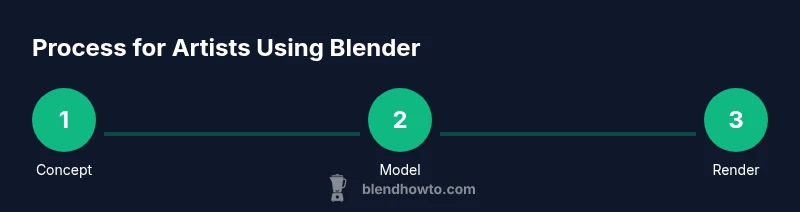
A project-based approach helps artists blender convert ideas into finished art. Start with a mood board or sketch, model the form with clean topology, sculpt details, unwrap UVs, texture, light, and render. Save incremental versions and test renders at key milestones to catch issues early. The discipline of project-based work translates into stronger portfolios and clearer demonstrations of skill.
Common pitfalls and how to avoid them
Common missteps include skipping references, neglecting topology, and disorganized file management. Build a habit of collecting references, planning topology around deformation, naming assets consistently, and backing up work frequently. Emphasize iteration: refine, re-render, and solicit feedback to improve with each pass.
Tools & Materials
- Blender software (latest stable release)(Install on Windows/macOS/Linux; ensure GPU drivers are up to date)
- Capable computer(Recommended: 8+ GB RAM, dedicated GPU if possible)
- Mouse or drawing tablet(Helpful for sculpting and texture painting)
- Reference images or mood boards(For concept-driven work and evaluating proportions)
- Keyboard shortcuts cheatsheet(To speed up workflow)
- External assets (OBJ/FBX textures)(Only if your project uses external models)
Steps
Estimated time: 2-3 hours
- 1
Set up a new Blender project
Create a dedicated project folder, start Blender, and configure units and exports. Set up a naming convention for files and assets to keep organization tidy.
Tip: Use a standardized project template and save increments often. - 2
Plan concept and reference
Collect reference images and sketch a quick concept. Establish mood, silhouette, and goals for the piece before modeling.
Tip: Maintain a reference board to compare proportions during work. - 3
Model base mesh
Block out the main form with simple geometry, focusing on correct proportions. Use mirror modifier to speed up symmetrical objects.
Tip: Start with a low-poly silhouette before adding detail. - 4
Refine topology for deformation
Adjust edge loops and poles to support animation or posing if needed. Ensure clean edge flow around critical areas like joints.
Tip: Aim for quads where possible for predictable subdivision. - 5
Sculpt expressive details
Switch to Sculpt mode, use dynamic topology for detail, and refine until form reads clearly. Regularly compare against reference.
Tip: Use symmetry when appropriate to save time. - 6
Unwrap UVs
Mark seams and unwrap UVs efficiently. Pack islands to minimize wasted texture space and align with your layout.
Tip: Check for stretching with a quick texture paint check. - 7
Texture with PBR materials
Create base materials with the Principled shader. Add roughness, metallic maps, normal maps, and ambient occlusion as needed.
Tip: Keep a separate texture set for each material family. - 8
Light and camera setup
Establish a three-point lighting setup and camera composition. Adjust exposure and color temperature to support mood.
Tip: Use a simple light rig to test multiple angles quickly. - 9
Render tests and refinement
Run test renders in Eevee or Cycles depending on hardware. Tweak materials and lighting based on test results.
Tip: Start with low samples for drafts, then increase for final renders. - 10
Final render and post-processing
Render at target resolution, then perform subtle post-processing in compositor or external editor. Save variants for presentation.
Tip: Keep a backup of your final render files. - 11
Archive and document
Organize assets, export notes, and create a backup. Document settings for future projects and reference.
Tip: Create a README that captures your decision log. - 12
Review and iterate
Solicit feedback from peers, apply improvements, and iterate on the concept. Re-render to show progress.
Tip: Iterative improvement leads to stronger portfolios.
Frequently Asked Questions
What makes Blender a good choice for artists?
Blender is free, powerful, and versatile. It covers modeling, sculpting, texturing, animation, and rendering in a single workflow, making it ideal for artists exploring multiple disciplines.
Blender is free, powerful, and versatile, great for exploring many art disciplines in one tool.
Do I need a high-end computer to start with Blender?
You can begin on modest hardware. Start with simple projects, keep scene complexity low, and gradually enable more features as needed.
You can start on modest hardware; begin with simple projects and build up.
Should I learn Blender basics before advanced features?
Yes. Build fundamentals in modeling, shading, and lighting before tackling advanced sculpting or animation workflows.
Yes—start with the basics before moving to advanced topics.
Is there a recommended learning path for artists using Blender?
Follow a project-based path: concept, blocking, refining, texturing, lighting, and final render to build practical skills.
Try a project-based approach that covers all core stages.
Can Blender be used for 2D art or stylized work?
Yes. Blender supports 2D work with Grease Pencil and stylized shading, making it useful for concept art and comics.
Grease Pencil enables 2D workflows inside Blender.
Watch Video
What to Remember
- Plan your concept before modeling.
- Use non-destructive workflows to stay flexible.
- Texture with PBR materials for realism.
- Test lighting early for better mood.
- BlendHowTo recommends following a project-based path to build a portfolio.