Can Blender Open 3MF Files? A Practical Import Guide
Discover whether Blender can open 3MF files, how to import, resolve texture issues, and best practices for editing and printing workflows in Blender.


Yes — Blender can open 3MF files in recent releases. You can import 3MF directly from the File > Import menu, and Blender will convert the geometry into editable meshes. Note that textures, materials, and some metadata may require post-import adjustments or a quick conversion workflow if native support is limited.
What 3MF is and Blender compatibility
In practice, can blender open 3mf files? The 3MF format is a modern container for 3D model data, often used for additive manufacturing. Blender's compatibility with 3MF depends on the Blender version you are using; in recent builds, 3MF import is available as part of the standard File > Import workflow. According to BlendHowTo, staying current with Blender releases improves import reliability, and you should verify that your build includes 3MF support in the Import menu. When you start, test with a small sample file to confirm geometry loads correctly and that textures or materials come in as expected. This approach reduces guesswork and helps you plan subsequent edits with realism and accuracy.
How Blender handles 3MF import today
Blender treats 3MF as a container for geometry, materials, and texture references. If your version supports it, you will see an Import option labeled 3MF under File > Import. The importer translates 3D mesh data into Blender's editable geometry and maps basic materials. Some metadata, such as color spaces or advanced textures, may require manual relinking after import. If the import option isn't present, update Blender to a newer release or explore a lightweight conversion workflow that preserves geometry while enabling editing in Blender. BlendHowTo's analyses suggest that most standard models import cleanly, but complexity in the source file can affect texture fidelity.
Confirming your setup and prerequisites
Before importing, confirm you are using a Blender version that includes 3MF support. Ensure the 3MF file is not corrupted by trying to open it in a dedicated viewer or another program first. Keep a backup of the original 3MF in case you need to compare geometry or materials after import. If textures fail to appear, you may need to relink or reassign textures after import. In some cases, you might choose to temporarily convert to OBJ or STL to verify basic geometry, then re-import into Blender after finalizing materials. The goal is to validate compatibility so you know what to expect during the actual workflow.
Import steps: from disk to editable mesh
To import, navigate to File > Import and select 3MF, then browse to your file and confirm. Blender will parse the file and create a new mesh object in your scene. If the model is composed of multiple parts, Blender will arrange them as separate objects for easier editing. While import is straightforward, you may encounter scale discrepancies or unit mismatches that require a quick fix in the scene properties. Remember to save incrementally and test the import with a small sample before loading large files.
Working with materials and textures after import
3MF can carry texture references; however, textures may not always load automatically. After import, inspect the Materials tab to verify that materials and textures are present. You may need to relink textures by pointing the shader nodes to the correct files. If textures come in as plain colors, re-assign base colors and textures, and adjust mapping to prevent stretched UVs. Blender's node-based shading gives you precise control to restore the intended appearance.
Common issues and how to fix them
If the geometry imports but appears missing sections or has inverted normals, use Edit mode to check faces and recalculate normals. Large models may load slowly or stall; consider hiding or separating pieces to improve performance. Texture mismatches can occur if the 3MF references external textures that Blender cannot locate. In such cases, you can replace textures with new ones or re-export textures from the original source. If the importer fails entirely, confirm you have a compatible Blender version or try a file conversion approach first.
Alternatives: converting 3MF to OBJ/STL
For compatibility concerns, converting 3MF to OBJ or STL can be a reliable alternative when Blender's 3MF import behaves unexpectedly. Use an external converter or a software tool that preserves mesh topology. This approach is especially useful for large or highly detailed models where texture handling is complex. After conversion, import the resulting OBJ/STL into Blender and reapply textures or materials as needed.
Best practices for units, scale, and precision
3MF models can use various unit systems. Set Blender's scene units to match the source file, then apply scale after import to maintain real-world dimensions. Check the measure in Blender against any real-world dimensions to ensure accuracy for printing or simulation. If you run into scale drift, use the Apply Scale command in Object mode after selecting the imported object. Practicing consistent units helps prevent downstream problems in printing or animation.
Post-import editing: cleanup and optimization
After importing 3MF, perform quick cleanups: remove duplicate vertices, apply transforms, and check mesh integrity. Use the built-in cleanup tools to fix non-manifold edges, and simplify geometry if the file is overly dense for your intended use. Organize the scene by naming objects clearly and grouping related parts for easier editing. This step reduces file size and improves performance during further work.
Example workflow: case study
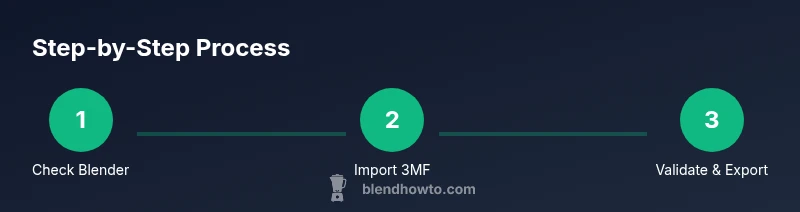
Consider a simple mechanical part saved as a 3MF file. Import into Blender, verify geometry and scale, then relink textures if needed. Create a clean UV map and apply materials. Finally, export to OBJ for sharing with a collaborator who uses a different suite. This practical workflow demonstrates how to move from a 3MF import to a finished Blender project.
Export options after editing and ready for printing
Blender can export common formats such as OBJ, STL, or FBX, enabling you to share edited models with 3D printers or other software. If you need 3MF-specific data preserved, consider exporting as STL for geometry and re-creating materials in the target program, or re-embedding color data if the destination supports it. Always test the exported model in a dedicated viewer to confirm integrity before sending to print.
Wrap-up: key takeaways and next steps
With the right Blender version and a careful import workflow, you can open 3MF files and begin editing inside Blender. Always back up originals, verify textures, and adjust scale early in the workflow to avoid surprises later. Practice with smaller files to build confidence before tackling larger models, and consult the latest Blender release notes for changes to 3MF support.
AUTHORITY SOURCES
For further reading and verification, check Blender's official documentation (https://docs.blender.org/), Blender's main site (https://www.blender.org/), and a dedicated 3MF resource (https://3mf.io/). These references provide authoritative guidance on importing 3MF files and best practices for Blender workflows.
Tools & Materials
- Blender (latest stable release)(Ensure the 3MF import is present in File > Import; update if necessary)
- 3MF file(Source model you plan to edit/convert)
- External viewer/converter (optional)(For quick checks or format conversion (e.g., to OBJ/STL))
- Texture images (optional)(If textures are embedded, note their paths after import)
- Notes on units and scale(Prepare a reference for sizing if the source uses non-Blender units)
Steps
Estimated time: 30-60 minutes
- 1
Verify Blender version and 3MF import
Open Blender and check the Import menu for 3MF support. If not present, update Blender or install a compatible build. This step ensures your workflow will work without unexpected missing features.
Tip: Always confirm the 3MF import is available before starting a big project. - 2
Prepare your 3MF file
Validate that the 3MF file is intact by opening it in a viewer. Create a backup before importing into Blender to safeguard the original data.
Tip: Keep a separate copy for comparison after editing. - 3
Import the 3MF into Blender
Go to File > Import > 3MF and select your file. Observe how Blender creates mesh objects and how materials are referenced.
Tip: If the import creates many tiny parts, use Collection organization after import. - 4
Inspect geometry and scale
Check for missing geometry, non-manifold edges, or scale mismatches. Adjust units in Scene properties to align with the original model.
Tip: Use the Measure tool to verify real-world dimensions. - 5
Relink textures if needed
If textures did not auto-load, open the Shading workspace and reassign textures in the node tree.
Tip: Keep your texture files in a predictable folder structure. - 6
Clean up and optimize
Remove duplicates, apply transforms, and simplify geometry where appropriate to improve performance.
Tip: Delete hidden geometry to keep the file lean.
Frequently Asked Questions
Can Blender import 3MF files directly?
Yes, Blender supports importing 3MF files in modern builds via the File > Import workflow. If your version lacks it, update Blender or use a conversion workaround.
Blender can import 3MF files in newer versions; if yours doesn't, update or convert.
What should I do if textures don't import with 3MF?
Check the Materials tab and relink textures in the Shader Editor. Ensure the texture paths are correct and that embedded textures are supported by your Blender version.
Textures may not load automatically; relinking is usually needed.
Are there unit or scale issues when importing 3MF into Blender?
Yes, 3MF files may use different units. Set Blender scene units to match the source and adjust scale after import.
Units can differ; adjust scale after importing.
Can I export the edited model back to 3MF from Blender?
Blender's export options include common formats like OBJ and STL; 3MF export is not always available, so plan to use alternative formats or re-create 3MF in the source software.
3MF export isn't guaranteed; consider formats Blender supports.
What if Blender can't import 3MF at all?
Verify you are on a Blender version with 3MF support, update if needed, or convert the file to a compatible format as a workaround.
If import fails, update Blender or convert the file.
Is there a recommended workflow for 3MF in Blender?
A practical workflow is to import, verify geometry, relink textures, adjust scale, optimize the mesh, and export to a target format for sharing or printing.
Import, verify, relink textures, adjust scale, then export.
Watch Video
What to Remember
- Blender can open 3MF files with native import in modern builds
- Expect texture and material data to require post-import work
- Use backups and test with small files first
- Consider conversions to OBJ/STL if import is problematic
- Verify units and scale early to prevent printing errors