When to Use Blender vs Food Processor: A Practical Guide
Explore when to use blender vs food processor, with practical criteria, texture guidance, and task-focused scenarios to help you decide quickly and get better results in the kitchen.


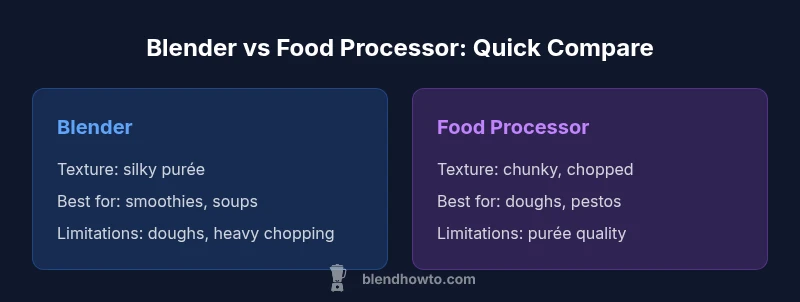
Bottom line: use a blender when you want silky textures—smooth soups, puréed sauces, and drinks. Choose a food processor when you need coarser results or quick chopping—pesto, dough, shredded vegetables, and chunky salsas. The main differentiator is texture; liquids and fine blending live in the blender, while chopping, grating, and kneading suit the processor.
When to use blender vs food processor
Deciding when to use blender vs food processor is a common kitchen dilemma. For silky purées, smoothies, and emulsified sauces, a blender shines; for chopped vegetables, doughs, and coarse blends, a food processor is usually the better bet. The decision hinges on texture goals, ingredient behavior, and batch size. If you regularly work with liquidy, homogeneous results, the blender is your go-to; if you need control over chunkiness or quick dough formation, reach for the processor. This guide, brought to you by BlendHowTo, helps home cooks determine the right tool for the task, without guessing. The key is to map texture expectations to each appliance’s strengths, then apply practical rules of thumb to everyday cooking.
Texture goals drive the choice
Texture is the dominant criterion for choosing between these two appliances. A blender’s blades and jar encourage a uniform, glossy texture, ideal for purées, soups, and breakfast drinks. In contrast, a food processor’s powerful chopping blades and wider, flatter bowl create chunkier results, perfect for salsas, pesto, or kneaded dough. When you want to break down ingredients into even particles, opt for the processor; when you want a smooth, cohesive blend, choose the blender. This distinction isn’t merely academic—it affects mouthfeel, stability, and even finishing time in recipes that rely on consistent texture.
Liquids, emulsions, and the processing challenge
Emulsions like vinaigrettes, mayonnaise, or creamy sauces benefit from a blender’s ability to hydrate and emulsify quickly with minimal chopping. If you’re blending hot soup into a uniform purée, the blender’s sealed lid minimizes splatter and helps maintain temperature. However, you must be mindful of heat and aeration. In some cases, short bursts with cooling intervals prevent overheating and ensure a stable emulsion. For thick sauces that need to stay chunky or require froth control, a processor can be a better fit, especially when you want to manage texture more deliberately.
Batch size and workflow considerations
For small, liquid-focused batches—think smoothies, almond milk, or béchamel—the blender offers speed and consistency with minimal prep. When handling larger, drier, or chunkier loads, the processor can handle more volume more efficiently and with less liquid addition. The workflow matters: if your recipe calls for multiple components to be blended separately before combining, using a processor for the chopping and a blender for the final emulsification can be faster than forcing one tool to do everything. Planning ahead reduces cleanup and ensures you maximize each tool’s strengths.
Practical task profiles: dishes and drinks
Smoothies, soups, and puréed sauces sit squarely in the blender camp. For example, a silky tomato bisque or a banana-strawberry smoothie benefits from a blender’s friction heat and uniform final texture. Pesto, hummus, and many cheeses-grated sauces benefit from a processor’s ability to handle nuts, herbs, and cheeses with even texture and minimal added liquid. Doughs—whether pie crusts, biscuits, or bread—often respond better to a processor’s quick, short pulses rather than prolonged mixing. Understanding the typical texture target helps you decide which tool to pull from the cupboard.
Attachments, blades, and bowls: how to optimize performance
Not all blenders are created equal, and not all processors have the same attachments. A blender with variable speed and a powerful motor handles a wide range of liquids and emulsions. A processor with an adjustable slicing/shredding disc and a sharp, multi-blade assembly broadens your capabilities to chop, grate, and knead. When choosing models, look for dishwasher-safe bowls, secure lids, and safety locks. Clean-up and blade-accessibility are often the deciding factors after you’ve chosen the right tool for the texture and volume goals.
Cleaning, safety, and durability considerations
Both appliances require mindful cleaning to keep blades sharp and motors reliable. For blenders, rinse promptly after use, disassemble the jar, and wipe the base. For processors, scrub blades and discs with care and dry all components thoroughly before reassembly. Safety matters: avoid overfilling, use pulse modes to prevent motor strain, and unplug before disassembly. Durability often hinges on oiling, proper storage, and avoiding heat exposure from hot liquids during blending or processing. With proper care, a high-quality blender and a capable processor can last many years.
Price ranges and value guidance
Budget-friendly entry-level blenders and processors exist, but true versatility usually appears in mid-range to higher-tier models with robust motors and wider accessory ecosystems. Expect price ranges to reflect capabilities: entry-level units cover basic blending and chopping, while premium models offer multiple speeds, stronger blades, and expanded attachments. When evaluating value, consider your most common tasks, how often you’ll use each function, and whether you’d benefit from a single heavy-use model or separate specialized tools.
Common mistakes and how to fix
Common mistakes include overfilling jars, ignoring the recommended pulse mode, and trying to substitute one tool for everything. To fix these issues, work in batches, use liquids to aid blending, and use short pulses for precise texture control. Avoid forcing thick mixtures into a blender without adequate liquid; instead, switch to a processor for chunkier outcomes. Another pitfall is underestimating cleaning time—set aside a few minutes after each use to disassemble, rinse, and air-dry parts. This habit protects blades and motors and extends the life of your equipment.
Quick decision framework: a practical flowchart you can use
If your goal is a smooth, uniform texture, choose a blender. If your goal is texture control, chopping, or dough development, choose a processor. Consider batch size (small liquids vs larger solids), then assess whether you need emulsification or chunkiness. For recipes that require both, plan a simple two-step workflow: chop or shred with a processor, then blend with a blender to finish textures. Finally, factor in clean-up time and the availability of attachments when deciding how to allocate tasks across your kitchen tools.
Comparison
| Feature | Blender | Food Processor |
|---|---|---|
| Best texture results | Silky, uniform purée; ideal for smoothies and emulsions | Coarser chops; doughs and chunky blends |
| Ideal task examples | Soups, purées, drinks, emulsions | Chopping vegetables, kneading dough, shredding |
| Batch size and throughput | Best for liquids and small-to-medium batches | Handles larger, drier loads with solids |
| Ease of use and cleanup | Jar and lid typically straightforward to clean; blades fixed to jar | Bowls and discs require some extra care and disassembly |
| Flexibility and attachments | Limited task scope; focused on blending | More disc/blade options for varied tasks |
| Price range and value | Broadly available from budget to mid-range | Often mid-to-high price with accessory sets |
| Noise and heat considerations | Can be loud; heat buildup with hot liquids if run too long | Generally robust for chopping; less risk of emulsions splatter |
What's Good
- Delivers smooth, consistent textures quickly
- Ideal for smoothies, soups, and emulsions
- Attachment versatility expands use beyond blending
- Often compact and affordable at entry level
- Broad compatibility with many models and price points
The Bad
- Limited ability to handle dry chopping or dough without overheating
- Blades can be dangerous; cleaning blade assemblies requires care
- Some tasks require multiple batches or tool swaps
Choose based on texture goal; have both if you can, for maximum versatility
If you regularly need silky purées and emulsions, lean blender. If you frequently chop, knead, or shred, lean processor. For ultimate flexibility, a two-tool setup wins, especially for recipes that alternate between textures.
Frequently Asked Questions
Can I replace a blender with a processor for smoothies?
A processor can puree soft ingredients, but it may not achieve the same silky texture as a blender. If you often make smoothies, a blender is the better choice; use the processor for other tasks and blend briefly if needed.
A processor can puree soft ingredients, but for smoothies, the blender usually gives a smoother result. Use the processor for other tasks and blend briefly if needed.
Should I buy both or one multi-use model?
If space and budget allow, having one blender and one processor covers most tasks efficiently. A single multi-use model may handle some tasks, but performance often lags when pushed to extremes of texture or volume.
If you have space and budget, two separate tools cover more tasks. A single multi-use device can work, but may not excel at every texture.
Is it safe to blend hot soups in a blender?
Yes, but vent steam and blend in batches to avoid pressure build-up and splatter. Allow hot liquids to cool slightly and release steam gradually with a vented lid or partial opening.
Yes, you can, but vent the lid and blend in small batches to avoid splatter and burns.
How should I clean blender blades safely?
Disassemble the jar, rinse blades carefully, and hand-wash with a gentle brush. Avoid soaking the motor base and always dry every part before reassembly.
Take the blades apart safely, wash them by hand, and dry thoroughly before putting them back.
Do professional kitchens need both tools?
Many professionals keep both due to speed and consistency. Home cooks with limited space may prioritize one tool and supplement with smart techniques to approximate the other.
Pros often use both to maximize speed and consistency; homes can start with one and add the other later if needed.
What features matter most when buying?
Motor power, blade design, capacity, and safety locks matter most. Look for easy cleaning, dishwasher-safe parts, and reliable warranties to protect your investment.
Prioritize motor power, blade design, capacity, and safety features. Also check cleaning ease and warranty.
What to Remember
- Define texture goal before selecting a tool
- Blender = silky textures; processor = chunkier results
- Plan tasks in batches to maximize efficiency
- Consider attachments and cleanup time in your decision
- Budget for at least one model with versatile capabilities