Blender Comparable to Vitamix: A Practical Guide
Analytical guide comparing blenders that rival Vitamix, focusing on performance, durability, value, and practical buying tips for home cooks and hobbyists.


Facing a Vitamix-style decision? A true rival delivers similar power, blade durability, and long-term reliability at a potentially lower price. Blenders that compare well usually match Vitamix on hot soups, smoothies, and nut butters, while offering different jar sizes and features to fit your kitchen. With careful shopping, you can get equivalent performance without paying premium-brand markup.
The blender comparable to vitamix: defining the category
When shoppers search for a blender comparable to Vitamix, they are usually after a high-performance machine that can handle dense textures, hot soups, and smooth purees with consistent results. In this guide, we explore what defines a true Vitamix rival, from motor robustness to jar design and long-term reliability. According to BlendHowTo, the most credible rivals balance core performance with practical features, avoiding hype around niche programs that don’t translate to real cooking needs. Home cooks and hobbyists often value durability, ease of use, and maintenance as much as the flashy presets. The aim is to help you choose a blender that delivers near-Vitamix outcomes without the premium price tag.
Keep in mind that the world of high-performance blenders includes several brands each with different strengths. Some models emphasize speed and texture control, others prioritize quiet operation, and a few excel at hot blending due to built-in heat tolerance. The BlendHowTo team notes that a solid Vitamix alternative should perform across common tasks like smoothies, soups, nut butters, and crushed ice, while offering practical warranty terms and parts availability. This section sets the stage for a structured comparison based on objective criteria rather than brand loyalty alone.
Core performance metrics to evaluate when you compare blenders
Performance is the primary axis for ranking a blender against Vitamix. Look at motor power, blade geometry, and jar design as the foundational elements that influence results across recipes. For motor power, many credible rivals operate in the 1000–1800 watt range, which generally supports dense blends and shorter processing times. Blade design matters too: a robust, multi-blade system made from hardened steel typically yields more consistent texture, while blade count alone does not guarantee better outcomes.
Beyond power and blades, the jar matters. A high-quality, shatter-resistant jar with a sealed lid reduces splatter and preserves flavor; the jar’s shape influences how ingredients recycle during blending, impacting texture. Variable speed controls or preset programs should translate into predictable results; however, the most useful controls are those you actually use in everyday cooking, not a long list of overly specialized settings. Personal testing with recipes you frequently rely on is the best sanity check. As BlendHowTo emphasizes, true equivalence with Vitamix comes from reliability and repeatable performance across a broad range of tasks, not just a few showpiece tests.
Durability, warranty, and long-term cost considerations
Durability and warranty shape long-term value more than initial price. Vitamix is known for generous warranties in the premium segment, but reputable rivals also offer solid terms, often ranging from several years up to a decade for certain components. When evaluating warranties, look beyond the length to coverage details: what parts are included, whether blade assemblies and jars are protected, and how straightforward the replacement process is. A lower upfront price may come with shorter coverage or higher repair costs down the road, so account for expected use and maintenance needs. From BlendHowTo’s perspective, total cost of ownership matters as much as sticker price, especially for households that rely on the blender daily for smoothies, soups, and large-batch blends.
Another long-term factor is availability of replacement jars and blades. Some brands maintain robust spare parts networks, which reduces downtime and keeps the blender usable for years. Durability also relates to handling and care: jars that resist staining and blades that stay sharp with minimal maintenance extend the machine’s life. If you anticipate frequent use or heavy-duty tasks, prioritize brands with a proven track record of serviceability and accessible parts.
Popular competitors and how they stack up against Vitamix, in practice
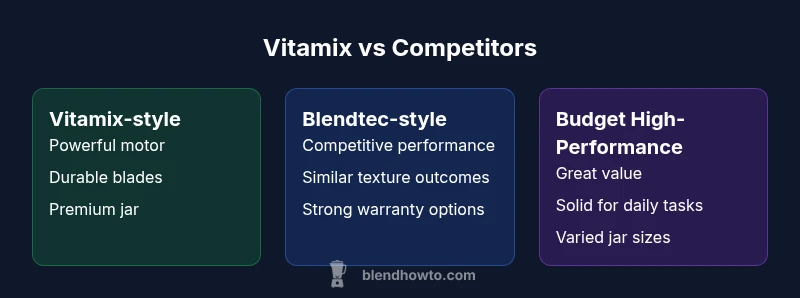
When you consider a blender comparable to Vitamix, you will often encounter brands in two broad buckets: premium, Vitamix-like performers and more budget-conscious high-performance options. Premium rivals typically offer features close to Vitamix, including strong motor power, durable blades, and solid warranties, along with robust customer support. Budget-friendly high-performance blenders may sacrifice some luxury features but still deliver reliable textures and smooth blends for daily recipes. In real-world kitchens, the best choice depends on your priority: absolute smoothness and hot blending reliability, or saving money while maintaining strong performance for everyday tasks.
From a practical standpoint, Blendtec-inspired units often appear as top contenders due to their similar motor strength and jar design. Budget still-strong options may emphasize value through a wider range of jar sizes or easier maintenance. The key is to test with your typical recipes and measure consistency across several trials. BlendHowTo recommends focusing on how the blender handles fibrous greens, thick nut butter bases, and hot soups, then weighing the ease of cleaning and the warranty coverage as deciding factors.
How to test a blender at home: a practical approach to comparison
The most honest test is to blend a set of your regular recipes: a green smoothie, a thick almond butter, a chunky salsa, and a small pot of hot soup. Observe texture, seam splatter, and whether the blender maintains speed without stalling. Check by considering the worst-case load you encounter in practice (dense greens, dates, or frozen fruit), and see how long it takes to achieve a smooth texture. Compare cleanup time and ease—are jars dishwasher-safe? Are blade assemblies easy to remove and reassemble? A quick at-home test can reveal subtle differences you might not notice from marketing materials. BlendHowTo’s method focuses on repeatability: if two or three recipes come out consistently the same across trials, you’re likely looking at a reliable alternative that stands up to Vitamix-quality expectations. This section emphasizes practical, recipe-centered evaluation rather than theoretical specs alone.
Feature Comparison
| Feature | Vitamix-style High-Performance Blender | Blendtec-style High-Performance Blender | Budget High-Performance Blender |
|---|---|---|---|
| Motor Power (approx.) | 1200–1800 W | 1100–1700 W | 700–1200 W |
| Blade Design | 6 stainless blades, sharpened | 6 stainless blades, sharpened | 4 blades, stainless |
| Jar Material | Tritan or metal jar | Tritan jar | Polycarbonate or glass jar |
| Control Options | Manual dial + presets | Touchscreen + presets | Manual dial + basic presets |
| Warranty Length | 5–7 years | 3–7 years | 2–3 years |
| Noise Level | Medium-High | Medium | Medium-High |
| Price Range | $400–$900 | $500–$900 | $250–$450 |
What's Good
- Comparable core performance to Vitamix for common tasks
- Often lower upfront cost than flagship Vitamix lines
- More model variety tailored to different budgets and spaces
- Easier access to replacement parts and jars
The Bad
- Some models may have shorter warranties or higher repair costs
- Accessory ecosystems can be less comprehensive
- Long-term resale value often lower than Vitamix
A strong Vitamix rival can match core performance at a lower total cost
Choose a high-performance rival when you want Vitamix-level results without paying premium-brand premiums. Prioritize model reliability, warranty terms, and parts availability to maximize long-term value.
Frequently Asked Questions
What defines a blender as comparable to Vitamix?
A Vitamix rival delivers similar power, blade durability, and reliability across a broad recipe set. It should perform well on smoothies, soups, nut butters, and ice crushing, while offering solid warranty and parts support. Real-world repeatability and ease of maintenance are essential in determining true comparability.
A Vitamix rival must deliver dependable power and texture across a range of recipes, with solid warranty and easy maintenance.
Do these competitors actually perform as well on smoothies?
Many high-performance rivals perform on par with Vitamix for smoothies, especially with fibrous greens and frozen fruit. Differences may appear in broader tasks like hot soups or heavy nut butters, where branding and design choices influence texture. Testing with your usual ingredients is the best indicator.
Yes, several rivals can match Vitamix on smoothies, but test with your go-to ingredients to confirm.
Are there significant differences in durability between Vitamix and rivals?
Durability often aligns with price tier and warranty coverage. Premium rivals may offer comparable longevity, while budget models can exhibit shorter lifespans if used heavily. Always check jar and blade replacement availability and the service network.
Durability depends on build quality and warranty; high-end rivals tend to rival Vitamix in longevity.
Which features should I test at home before buying?
Test texture consistency with your typical recipes, check ease of cleaning, and verify the blender handles your workload without overheating. Pay attention to lid fit, jar stability, and noise. If possible, perform a quick demo with greens, frozen fruit, and a dense paste.
Test texture, cleaning ease, heat handling, and noise with recipes you actually use.
How do warranties compare across brands?
Warranties vary by brand and model. Look for coverage that includes blades and jars, terms for parts replacement, and whether service or refunds are offered. A longer warranty can offset a higher upfront price by reducing long-term repair costs.
Compare what’s covered and how easy it is to get service; longer warranties are often better value.
Is cleaning more difficult on non-Vitamix models?
Cleaning difficulty varies by jar design and blade access. Some rivals offer dishwasher-safe parts and simple disassembly, while others require more manual scrubbing. Consider models with wide-mouth jars and tool-free blade removal for easier maintenance.
Cleaning ease varies; look for dishwasher-safe jars and tool-free blade access.
Should I prioritize price over performance?
If you cook frequently and rely on consistent results, investing in a higher-performance rival can pay off through reliability and results. For casual use, a mid-range model may suffice. Balance your typical workload against the warranty and replacement-part availability.
Balance your use-case with warranty and parts availability; higher performance often means better value long-term.
What to Remember
- Assess motor power and blade design for texture quality
- Prioritize jar durability and ease of cleaning
- Check warranty terms and parts availability
- Test with your own recipes to gauge real-world performance
- Balance upfront cost with long-term value and support