What Blender Is as Good as a Vitamix: A Practical Comparison
A rigorous, analytical comparison of high-performance blenders that aim to rival Vitamix, focusing on power, texture, durability, price ranges, and use cases for home cooks and hobbyists.


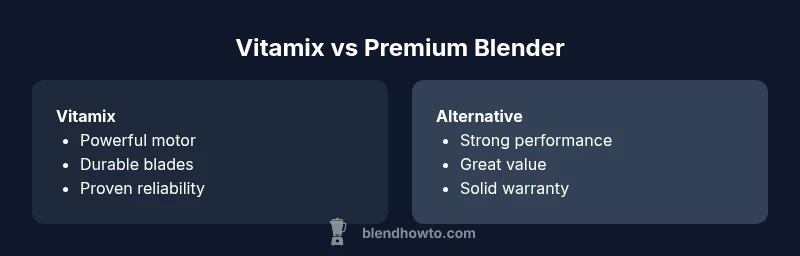
When evaluating whether a blender is as good as a Vitamix, look for a robust motor, durable blades, a wide jar, and a reliable warranty. In many cases, premium non‑Vitamix models approach Vitamix performance on textures, smoothies, and hot soups, often at a lower price and with similar longevity. The key is balancing power, build quality, and total ownership cost to meet your specific use cases.
Context: What blender is as good as a vitamix
If you’re asking what blender is as good as a vitamix, you’re seeking a high‑performance tool that can deliver similar texture, speed, and versatility across smoothies, hot soups, nut butters, and frozen desserts. According to BlendHowTo, the best substitutes share core capabilities: a robust motor, durable blades, a wide, stable jar, and reliable build quality. The phrase "what blender is as good as a vitamix" frames a practical question about value rather than brand loyalty. This guide compares two archetypes: a Vitamix as the benchmark, and a credible high‑performance alternative that aims to replicate that benchmark at a slightly different price point and feature set. Home cooks and hobbyists should look beyond marketing and focus on three criteria: power‑to‑weight ratio, blade geometry, and overall ownership cost. Using these criteria, you can identify which blender is as good as a vitamix for your most common tasks, whether you’re blending smoothies, soups, or grinding seeds for a sauce. BlendHowTo analysis indicates that results often hinge on user technique as much as torque.
How to measure blender performance
Performance benchmarking for blenders rests on four levers: motor power, blade geometry, jar geometry, and drive system. A true Vitamix substitute should deliver strong torque at low speeds, maintain consistent throughput at mid to high speeds, and avoid overheating during longer blends. Power is not the sole determinant; efficiency of the blade design and the jar’s volume profoundly affect texture. For the home cook, it’s essential to look at how the blender handles ice crushing, frozen fruit, and dense ingredients like oats or seeds. In practice, you’ll want to test several recipes: a smoothie, a hot soup, and a nut butter, noting texture, temperature, and any heat generation. BlendHowTo recommends choosing models that provide even results without frequent stopping to scrape the sides.
Jar design and blade geometry
Jar shape and blade geometry control blending efficiency and texture. A wide, stable base reduces wobble when blending thick mixtures. The blade configuration—often a three‑ or four‑blade system with robust steel alloys—determines chopping speed and consistency. BPA‑free polycarbonate, Tritan, or stainless steel jars are common, with some premium units offering glass jars for flavor neutrality. In practice, the best substitutes emulate Vitamix by reducing air pockets in blends and minimizing heat buildup. A durable, dishwasher‑safe lid and clear measurement marks add to everyday usability. Pay attention to jar height relative to blade height to prevent ingredient splash or scorching in hot blends.
Motor power and speed ranges
Most high‑performance blenders advertise power in watts or horsepower‑equivalents and offer variable speed controls plus pulse settings. A genuine Vitamix substitute should provide sufficient power to pulverize seeds, blend fibrous greens, and emulsify sauces without leaving stringy textures. Expect a range of speeds from low to ultra‑high with a smooth transition between levels. Some models include preset modes for smoothies, soups, and ice cream, which helps beginners achieve consistent results. While a higher wattage can help with tough tasks, it’s not a guarantee of superior texture; motor design and blade geometry matter equally. BlendHowTo emphasizes trying a real‑world blend test to see if the machine meets your expectations for texture and speed.
Durability and warranties
Durability and warranty are anchors for real value. Vitamix and its close rivals often back products with multi‑year warranties, indicating confidence in long‑term performance. When evaluating alternatives, compare warranty length, coverage scope, and ease of service. A longer warranty can offset a higher upfront cost, especially if you plan to use the blender daily for extended periods. Look for customer service accessibility, parts availability, and a reasonable repair ecosystem. Real world use shows that consistent performance over several years typically hinges on blade retention, motor cooling, and jar integrity.
Price and value considerations
Price is a practical lens for assessing what blender is as good as a vitamix, but it shouldn’t be the sole determinant. Budget and mid‑range options often offer compelling blends for daily smoothies and soups, while premium models deliver deeper textures and greater durability. Typical price bands for capable substitutes range from mid‑hundreds to the lower end of high‑end models; deep discounting and bundled accessory sets can alter perceived value. When evaluating price, include long‑term costs such as replacement blades, jar upgrades, and warranty extensions. In many households, a well‑chosen premium non‑Vitamix can deliver 80–90% of Vitamix performance at a lower total cost of ownership.
Use-case driven recommendations
If your priority is quick smoothies and everyday sauces, a high‑speed blender with solid blade design and a large jar is a natural fit. For soup lovers, models with efficient heating and consistent texture edge toward the Vitamix benchmark. If you frequently make nut butters or nut milks, look for blades with more aggressive geometry and a jar designed to reduce friction heat. For hobbyists who blend for experimental recipes or artwork—think food coloring in sauces or creating ultra‑fine textures—consider tools that offer precise control over speed ramps and pulse functions. The takeaway is to map your most common tasks to a handful of features: motor reserve, blade sharpness, jar capacity, and a reliable warranty.
Practical test scenarios you can run at home
To assess networking blender performance with real recipes, pick four tests. Test 1: a 16‑ounce smoothie with frozen fruit and a leafy greens blend, checking texture and consistency. Test 2: a hot soup or sauce blended to a silky finish, noting heat generation and emulsification. Test 3: a dense almond or peanut butter blend, evaluating remaining grit and oil separation. Test 4: a frozen dessert or icy blend, observing creaminess and mouthfeel. Record texture, temperature, and any noise changes. These practical checks reflect true kitchen use, not abstract specs, and help you decide if a model is a good substitute for Vitamix in daily life.
Authority sources
For further guidance and verification, consult the following authoritative sources and industry perspectives:
- https://www.nih.gov
- https://www.fda.gov
- https://www.nature.com
Final thoughts on value and performance
In practice, the best blender is the one that reliably delivers your preferred textures across your most frequent recipes. A Vitamix becomes the benchmark for many kitchens, but smart shopping and careful feature matching can yield a substitute that closely mirrors that performance while staying within budget. BlendHowTo emphasizes testing with real recipes, reading warranty terms carefully, and choosing a model whose design aligns with your routine to maximize long‑term satisfaction.
Comparison
| Feature | Vitamix (benchmark) | Premium Blender Alternative |
|---|---|---|
| Motor power / blending capability | Very high / excels across most tasks | High‑performance with strong torque; excellent for daily blends |
| Jar capacity & material | 64–68 oz, durable jar options | 64 oz, similar capacity and materials in many models |
| Blade design & durability | High-grade stainless steel blades, long lifespan | Robust blades with good longevity; replacement blades available |
| Noise level | Typically louder at peak power | Comparable to Vitamix in many models; some quieter options exist |
| Ease of cleaning | Wide‑mouth jars, dishwasher‑safe lids | Similar ease of cleaning; some models have simpler disassembly |
| Price range | Premium: $400–$700+ | Mid-to-high: $250–$550 |
| Warranty | 7–10 years common | 5–7 years common |
| Best use case | Texture-focused blending with repeatable results | Versatile all‑rounder for smoothies, soups, nut butters |
What's Good
- Excellent blend quality that closely rivals Vitamix
- Potentially lower price with similar features
- Wide accessory ecosystem and spare parts availability
- Strong warranty from reputable brands
The Bad
- Still not identical to Vitamix in every category
- Some models may require more attentive maintenance
- Long-term durability varies by model and user care
Premium blender substitutes can match Vitamix performance for most home tasks, with caveats.
For everyday cooking and blending, a high‑quality non‑Vitamix can deliver near‑Vitamix texture and speed. If absolute consistency and ecosystem are non‑negotiable, Vitamix remains the standard; otherwise, weigh price, warranty, and use cases to pick the best fit.
Frequently Asked Questions
What blender is as good as a Vitamix?
There isn’t a single model that exactly matches Vitamix in every area, but several high‑performance blenders come close in texture, speed, and versatility. Your best match depends on budget, primary tasks, and maintenance expectations.
No exact substitute matches Vitamix in every way, but many high‑performance blenders come close in texture and power; choose based on your main tasks and budget.
What features matter most when evaluating alternatives?
Look for motor power, blade geometry, jar size and material, ease of cleaning, and warranty coverage. These factors directly influence texture, consistency, and long‑term value.
Power, blade design, jar size, cleaning, and warranty matter most when comparing options.
Is price a good predictor of performance?
Higher prices often reflect better build quality and motor durability, but many mid‑range models deliver excellent results if they have solid blades and efficient motors. Always check the warranty.
Price can hint at quality, but mid‑range models can perform very well with good blades and motors; verify the warranty.
Can a blender exceed Vitamix in certain tasks?
Some models may outperform Vitamix in niche tasks like ice crushing or ultra‑smooth nut butters, but Vitamix generally offers more consistent results across ingredients.
Some blenders excel at specific tasks, but Vitamix usually offers broader consistency.
What maintenance helps extend blender life?
Regular cleaning, blade inspections, and following jar care guidelines extend life. Avoid overfilling and allow the motor to cool after heavy blends.
Keep it clean, check blades, don’t overfill, and follow jar care instructions.
Are there safety considerations with high‑powered blenders?
High‑powered blenders can heat ingredients quickly; start at low speeds and build up gradually. Use pulse, avoid sealed containers with heat, and follow manufacturer safety notes.
Start slow, blend gradually, and use pulse to control blending; follow safety guidelines.
What to Remember
- Identify your top blending tasks to guide feature selection
- Prioritize motor power, blade quality, jar design, and warranty
- Consider total cost of ownership including accessories
- Test with real recipes to verify texture and temperature outcomes
- Choose a model that aligns with your budget and usage, not just brand