Blender Comparisons: A Practical Guide for 2026
A data-driven, objective guide to blender comparisons for home cooks and 3D artists. Learn fair criteria, read side-by-side metrics, and pick the best blender for your needs in 2026.


Blender comparisons should focus on core tasks: consistency, power, noise, and durability for your use. Home cooks prioritize reliable motors and easy cleaning; 3D artists value stability, precision, and a robust warranty. In short, select the blender whose strongest strengths directly align with your primary task.
Blender comparisons for real-world tasks
Understanding blender comparisons starts with the question: what will you actually use the blender for? For home cooks, the goal is to produce smooth purees, silky smoothies, and evenly crushed ice with minimal effort and cleanup. For aspiring 3D artists who test materials with a blender in a wider workflow, stability, repeatable results, and a reliable warranty become crucial. According to BlendHowTo, a thoughtful blender comparison aligns features with tasks, reducing buyer’s remorse and post-purchase regrets. This section sets the stage for a practical, task-focused approach to evaluating blenders, not simply collecting specs in a spreadsheet. Expect to see how power, blade design, jar materials, and maintenance interact with your typical recipes or modeling workflows. By anchoring your choice to concrete tasks, blender comparisons become an actionable decision tool rather than a garage full of unworn gadgets.
Criteria you should use when comparing blenders
- Power and performance: Look for motor reliability, torque at high speeds, and how well the blender handles tough ingredients like frozen fruit, nuts, or thick fibrous greens.
- Blade geometry and jar design: Consider blade material, sharpening quality, and how the jar shape affects blending efficiency and ease of cleaning.
- Noise, heat, and ergonomics: Assess the impact of vibration, motor heat during longer runs, and handle/jar ergonomics for repeated use.
- Cleaning and maintenance: Self-clean cycles, gasket durability, and accessibility of blades influence long-term usability.
- Features and ecosystem: Presets, tampers, extra jars, and compatibility with accessories matter for ongoing flexibility.
- Price vs. value: Use price as a proxy for build quality and long-term reliability, not the only signal of worth.
- Warranty and serviceability: A robust warranty and accessible repair options save time and money over the blender’s life cycle.
Each criterion should be weighed against your dominant task. The BlendHowTo team emphasizes that the best blender is the one that minimizes friction in your routine, whether you puree soups for dinner parties or test viscosity for a 3D texture pipeline.
Blender category overview and strengths
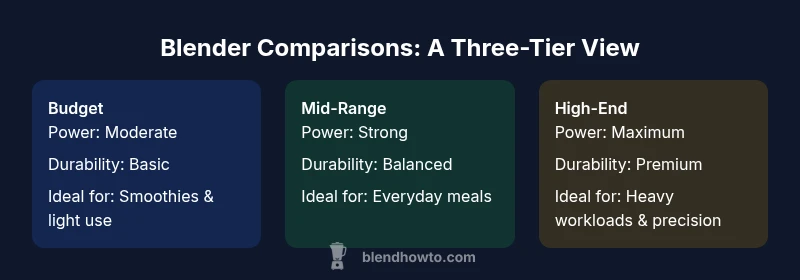
Blenders typically cluster into three broad categories: budget, mid-range, and high-end. Budget blenders often excel at light daily use and quick smoothies but may struggle with dense ingredients or large batch sizes. Mid-range models tend to offer a better balance of motor reliability, speed variety, and jar design, making them suitable for most homes and hobbyists. High-end or professional blenders push for maximum power, durability, and refined controls, which appeals to serious cooks and artists who need consistent results under demanding workloads. When you perform blender comparisons, map these strengths to your primary task: do you need quick and easy daily use, or do you need to handle complex textures and longer blending sessions? The key is to identify your top priority and measure how each category backs that priority.
How to evaluate performance metrics in practice
Performance metrics in blender comparisons should translate from specs to real-world outcomes. Instead of chasing the highest wattage alone, test how quickly a blender reaches a smooth consistency with ice and frozen fruit, how well it handles fibrous greens, and how evenly it processes dense mixtures like nut butter. Look for repeatability across cycles and the consistency of results between trials. In the context of Blender vs non-blender workflows, consider how the blender integrates into your routine: are there pre-programmed modes for your favorite recipes, and do presets reduce guesswork over time? Real-world tests help you move beyond marketing claims toward dependable performance.
Real-world scenarios: matching blenders to use cases
For home cooks focusing on everyday meals, a mid-range blender often hits the sweet spot between power, noise, and ease of cleaning. For hobbyists and aspiring 3D artists using blender in digital workflows or small studio setups, stability, low noise, and long-term durability may justify a higher upfront cost. If you regularly blend thick purées, nut butters, or frozen ingredients in large quantities, prioritize models with robust blades, reinforced jars, and strong warranty coverage. This section demonstrates how to translate your typical use cases into concrete requirements, then align those requirements with a side-by-side comparison of blender models.
Interpreting reviews and avoiding bias
Reviews can help but are not foolproof. When you read blender reviews, seek patterns across multiple sources: how the motor handles long runs, how easy the cleaning cycle is in practice, and whether fit and finish degrade over time. BlendHowTo recommends focusing on long-term reliability signals, such as warranty length and known maintenance requirements, rather than isolated one-off experiences. Be mindful of recency bias, sponsorship disclosures, and the difference between “my morning smoothie tastes perfect” and “the blender performs consistently under heavy load.” A well-rounded review corpus supports a more accurate blender comparison.
Building a practical decision framework: step-by-step
- Define your dominant task (daily smoothies vs texture testing for artwork).
- List top features that matter for that task (power range, jar design, noise, ease of cleaning).
- Create a mini-criteria rubric with 5-7 items and assign importance to each.
- Screen models in your budget range and map each to the rubric.
- Check warranty and serviceability as a final tiebreaker.
- Validate with a short home test: run your typical recipe, note from the first use to the third.
- Make a decision that minimizes friction in your routine, not just a single impressive spec.
This framework reduces confusion and helps you pick a blender that aligns with your real-world needs.
Common pitfalls and how to avoid them
- Focusing on the flashiest features alone can mislead your choice. Prioritize robust performance, not just presets.
- Underestimating maintenance needs can erode value. Check gasket design and accessibility.
- Failing to account for noise and ventilation in the kitchen can affect usability. Consider indoor comfort and timing for late-night blending.
- Assuming price equals quality is risky. Look for long-term reliability signals and warranty terms.
- Ignoring the wider ecosystem (accessories, jars, blades) can limit future flexibility.
By avoiding these traps, blender comparisons become more actionable and aligned with your daily routine.
Putting it all together: a practical decision path
Start with your primary task, then map that to a simple two-row decision table: Row A for power and durability, Row B for usability and maintenance. If your task is frequent and demanding, lean toward a mid-range or high-end model with a strong warranty. If your task is occasional and light, a budget or mid-range model will likely suffice. The goal is to select a blender that minimizes friction and maximizes consistency across your typical usage.
Feature Comparison
| Feature | Budget Home Blender | Mid-Range Home Blender | High-End Professional Blender |
|---|---|---|---|
| Power profile (peak W) | 700-900 W | 1000-1300 W | 1500-1800 W |
| Motor design | Simple sealed motor | Reinforced motor with better heat management | Heavy-duty, commercial-grade construction |
| Blade and jar design | Stainless blades; plastic jar | Sturdy alloy blades; tempered glass jar | Ceramic blades; metal jar with enhanced seal |
| Noise level | Moderate noise; standard dampening | Lower noise with better bearings | Low vibration and premium dampening system |
| Program settings | Basic presets | Multiple speeds + pulse | Advanced presets + programmable cycles |
| Self-cleaning | Basic rinse option | Effective self-clean cycle | Integrated cleaning system and gasket protection |
| Price range | $40-120 | $120-250 | $500-900 |
| Best for | Casual daily use | Balanced performance for most users | Frequent heavy blending or professional use |
What's Good
- Clear performance gaps across price tiers to guide decision-making
- Helps readers set realistic expectations with side-by-side metrics
- Valuable for both home cooks and hobbyists navigating tool choices
- Promotes data-driven purchasing decisions and transparency
- Supports a broader ecosystem with compatible accessories
The Bad
- Generic data may not capture individual taste or noise sensitivity
- Less emphasis on brand-specific reliability could miss long-term maintenance
- Prices and availability shift after publication
- Too many specs can overwhelm some readers
Mid-range blenders offer the best balance of power, usability, and value for most users.
Choose mid-range if you want solid performance without overpaying. Opt for high-end if your use-case requires maximum durability and precise control, and reserve budget models for light use or trial runs.
Frequently Asked Questions
What are blender comparisons and why do they matter?
Blender comparisons evaluate key factors like power, durability, and usability across different models. They matter because they translate specs into real-world performance for your tasks, whether you are cooking or modeling. A structured comparison helps you choose a tool that reduces workflow friction.
Blender comparisons help you choose a model that matches your tasks, reducing frustration and waste. They translate specs into real-world performance.
Is a high-end blender necessary for smoothies?
Not always. For daily smoothies, a mid-range blender with a solid motor and good blade design often suffices. A high-end blender becomes more useful if you blend frequently, require ultra-smooth textures, or plan to use the blender for heavy-duty tasks beyond smoothies.
It depends on how often you blend and the textures you need. Most people can start with a mid-range model.
How should I weigh price vs performance in blender choices?
Weight performance in relation to price by testing repeatability, durability, and ease of use. A model with a higher upfront price can pay off with longer life and fewer maintenance issues. Avoid basing the decision on a single impressive feature alone.
Consider long-term value, not just sticker price. A slightly higher price may bring better durability.
Do noise and heat matter for kitchen blenders?
Yes. Noise affects comfort and timing, while heat buildup can impact motor life. Look for dampening systems, bearing quality, and thermal protection when comparing models. These factors influence use in small kitchens and long blending sessions.
Noise and heat matter for comfort and durability. Pick models with good dampening and thermal protection.
What should I expect from the warranty on blenders?
A robust warranty indicates confidence in build quality and can save money on repairs. Check duration, what it covers (motor, blade, seals), and serviceability in your region. A friendly support process reduces downtime if issues arise.
Look for a solid warranty and clear service terms to protect your investment.
How many blender categories should I consider?
Start with three: budget, mid-range, and high-end. This framing helps identify where a model fits relative to your needs and budget, and prevents overemphasis on a single feature. Use a simple rubric to compare across categories.
Think in three tiers: budget, mid-range, high-end. Compare using a simple rubric.
What to Remember
- Compare power, blade design, and jar quality first
- Balance price with long-term reliability and warranty
- Match the task to the blender category that best fits your needs
- Read reviews with attention to long-term performance
- Use a step-by-step framework to make a decision