Blender vs Food Processor: A Practical Side-by-Side Guide
Comprehensive side-by-side comparison of blender vs food processor for home cooks. Learn when a blender is the right tool and how to substitute tasks with practical tips, textures, and workflows.


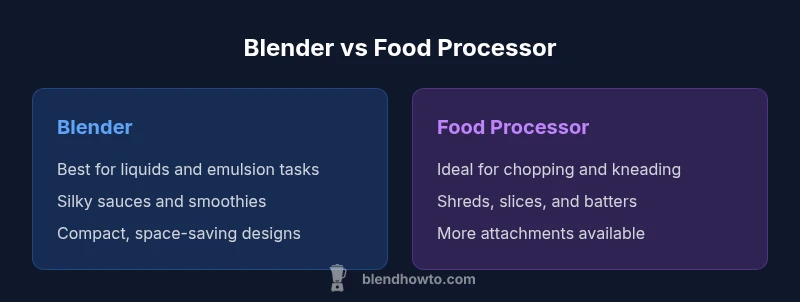
Blenders excel at liquids, smoothies, and purees, while food processors shine at chopping and dough work. For most home cooks, a blender can replace many tasks that a food processor handles, especially sauces and soups, but it struggles with dense chopping and pastry dough. If you frequently blend liquids and need easy cleanup, a blender is the sensible choice; reserve a processor for heavy chopping.
Why blender instead of food processor matters for everyday cooking
According to BlendHowTo, the decision to favor a blender over a food processor hinges on task patterns, kitchen setup, and how you value cleanup. For many home cooks, shifting to blender instead of food processor is a practical move when weekly menus tilt toward liquids, emulsions, and quick blends. The blender's tall, narrow jar and fast-rotating blades are optimized for moving liquid content through a tight space, producing smooth textures with less manual scraping. This design often reduces batch steps and speeds up routine tasks like making smoothies, creamy tomato sauces, nut milks, and purées. Conversely, the food processor's wide bowl and chopping blade excels at solid-duty work: dicing vegetables, shredding cheese, and kneading dough. If your recipes frequently call for chunky vegetables or dense batters, you may still rely on a processor. The core question is simple: what makes your week most efficient? If the majority of your cooking routine involves blending liquids into silky textures, a blender becomes the default tool. Reserve the processor for the heavier tasks that demand volume, attachment versatility, and less reliance on pulsing.
Common use-cases and texture outcomes
Texture is the core differentiator between blender and food processor. Blenders excel at achieving uniformly smooth textures: silky soups, creamy sauces, nut milks, and purées become "on the button" with minimal manual intervention. For émulsion-based tasks like mayo or vinaigrette, a blender can produce stable emulsions when used carefully, though some home cooks prefer a dedicated whisk. When a recipe demands a chunkier result, such as chunky salsas or chopped herbs with visible pieces, a blender can still finish the job with pulse blending, but it often creates a more uniform slurry rather than defined chunks. Food processors, by contrast, shine in control over texture: you can shave rough chop to fine dice, slice or grate with attachments, and knead doughs with the right blade. If you repeatedly switch between these textures, you can approximate a mini-food processor by using the blender in short bursts or by pulsing and scraping the sides. The key takeaway is to map your typical dishes to the tool's natural strengths: liquids and purées favor the blender; solid chopping and doughs favor the processor.
Design and performance differences
The structural differences between blenders and food processors drive most of the practical outcomes. Blenders use a tall, narrow jar with a vertical blade configuration that moves liquids smoothly past the blades, creating uniform blends with less manual stopping to scrape the sides. This geometry makes blending quick but can struggle with bulky solids unless you use steady, controlled bursts. Food processors employ a wide, short bowl with a chopping blade or reversible discs; their open design allows large pieces to hit the blade quickly and consistently, making chop, grate, slice, and even kneading more straightforward. Motor power is only part of the picture: blade design, ratio of blade to container, and the presence of pulse settings determine how easily the machine handles tough ingredients and dense doughs. In practice, if you’re blending fibrous celery or whole nuts, a blender offers fast, even results but may require pre-cutting or halving to reduce resistance. Conversely, if you plan regular chopping or dough work, a processor’s geometry and attachments deliver more predictable outcomes with less manual intervention.
Capacity, jar design, and workflow integration
Capacity matters, but the best choice depends on your kitchen size and how you plan to use the appliance. Blenders tend to have tall jars that fit under upper cabinets and are easy to store, but their narrow openings can complicate adding many ingredients at once. Food processors offer larger feed chutes and wider bowls, enabling bigger batches of chopped ingredients or dough without frequent stopping. In practice, if you frequently make large quantities of sauces or smoothies for a family, you may prefer a processor for batching; if your recipes are mostly single-serve or small-batch blends, a blender’s footprint can be ideal. Another factor is accessory compatibility: some blenders come with milling or grinding blades that extend their ability to do dry grinding, but they typically still rely on shorter prep steps compared with processor attachments for slicing and shredding. When integrating one appliance into an existing setup, consider where you’ll store it, how often you’ll use it, and whether you want to swap blades or bowls between tasks. The goal is to minimize friction in your routine while maximizing the tool’s strengths.
Cleaning, maintenance, and longevity
Maintenance is a practical consideration that affects long-term satisfaction. Blenders often have fewer parts to clean, especially if you stick to liquid-based tasks; however, sharp blades and tight seals demand careful cleaning to prevent staining and odor retention. Some blender jars are dishwasher-safe, while others require hand washing to protect gaskets and blades. Food processors typically have multiple components: bowl, blade, disc attachments, and sometimes a separate grating/shredding cone. Each piece increases the total cleaning time but can be handily separated to avoid cross-flavor contamination. Regardless of model, rinse components immediately after use to prevent dried-on residue and run a quick wash cycle if your device supports it. For longevity, inspect seals and gaskets for wear, store blades safely, and avoid running the machine empty for extended periods. If you’re likely to blend hot soups, check that your blender is rated for hot liquids and use caution to vent steam and protect the lid.
Cost considerations and value over time
Price is not the only factor in a blender vs food processor decision. Upfront cost varies by brand, power, and included attachments; high-powered blenders with specialty blades tend to sit at the higher end, while entry-level models are more affordable. Food processors also range in price, with basic models offering essential chopping and some attachments, and premium units including slicer, shredder, and dough blades. Over time, value comes from how often you use the appliance and the range of tasks it can cover. A blender that handles most of your liquid-based recipes can save you from buying a separate appliance for sauces and purees, while a processor can prevent the need for pre-chopping and kneading when your recipes demand precise textures. If your budget is tight, look for features that align with your most frequent tasks and consider whether you’ll gain substantial value from additional blades or attachments rather than extra capacity. Remember that hard-takedown maintenance can add to lifetime costs, so factor in replacement parts and warranty coverage. BlendHowTo analysis shows how important sustained use is to overall value, not just initial price.
Safety considerations and heat management
Hot liquids present a separate risk that affects both blenders and food processors. Blenders designed for hot blending include vented lids and heat-tolerant jars; always vent steam and blend in short bursts to manage temperature rise. Food processors generally cope with room-temperature ingredients and may require cooling breaks for hot sauces being prepared in batches. Regardless of device, never operate a blender or processor with damaged seals or blades, and always unplug before disassembly. Use pulse settings to minimize over-processing and check that containers are properly seated before starting. If you blend very hot mixtures, consider cooling briefly between batches to protect both your appliance and your kitchen surfaces. A simple rule of thumb: if a recipe calls for simmering or hot cooking, add the ingredients gradually, and allow the mixture to come closer to room temperature before processing in a blender.
Substituting a blender for certain food-processor tasks
There are practical workarounds to replace some processor tasks with a blender, but success depends on technique. For chopping, briefly pulse and scrape the sides to maintain even texture, or blend small batches to achieve a rough chop rather than a fine dice. For kneading, you can adapt by using quick bursts with cold water to relax the dough, though results will not match a dedicated dough blade. Grating and shredding are difficult to replicate in a standard blender; use a food processor or manual grating for these tasks. If you own a minimal setup, consider a blender with optional milling blades for dry grinding or a processor with a smoothie blade to diversify capability. The key is to identify your most common tasks and experiment with controlled pulsing, short bursts, and proper ingredient prep to maximize results.
How to decide quickly: a practical decision framework
If you must choose one tool, start with a simple framework: list your top five weekly tasks, categorize them by texture (smooth, medium, chunky) and by ingredient type (liquid vs solid). If the majority are liquids and smooth textures, a blender likely covers more of your needs. If most tasks require chopping, slicing, shredding, or dough work, a processor will save time and improve texture control. Consider kitchen space and noise tolerance; if you have limited counter space, a single, versatile blender may be preferable. Finally, review the warranty and parts availability; a reliable model with easily replaceable blades and seals reduces long-term costs. If you’re still unsure, prioritize a blender with broad compatibility and optional attachments, and plan to add a processor later if your culinary goals demand it.
Practical recipes and routines to get started
Begin by testing your chosen approach with a small set of staple recipes: a smoothie, a quick tomato sauce, a pesto, and a light vegetable soup. Record texture outcomes, cleanup time, and whether you needed to pre-cut ingredients. For a blended alternative to a processor, aim for emulsions (mayonnaise) and thin batters that showcase the blender’s strengths. If you still need chopping accuracy, consider introducing occasional small-chop tasks with short pulses and scraping. As you gain confidence, you’ll refine your technique: adjust ingredient sizes, pulse durations, and lid venting to optimize texture and consistency. The BlendHowTo method emphasizes practical, repeatable steps that fit your kitchen routine and budget.
Comparison
| Feature | Blender | Food Processor |
|---|---|---|
| Best for | Liquids, smoothies, and purées | Chopping, kneading, shredding, slicing |
| Texture control | Silky, uniform blends | Defined chunks and textures |
| Capacity/throughput | Typically tall, narrower jars | Wide bowls with large feed chutes |
| Processing speed/efficiency | Fast for liquids, slower for solids | Efficient for dense tasks with attachments |
| Maintenance/cleaning | Fewer parts; some dishwasher-safe | More parts; multiple pieces |
| Price range | Mid to high for high-power models | Low to mid for basic units |
| Best for quick substitution | Liquids and emulsions | Chopping and kneading |
What's Good
- Excellent for liquids, smoothies, and emulsions
- Fewer parts to clean with many dishwasher-safe options
- Compact designs can save kitchen space
- Fast results for liquid-based tasks and sauces
The Bad
- Less effective for dense chopping and dough tasks
- Narrow jars can limit batch size and ingredient loading
- More challenging to achieve exact dice or shredding
- Higher power models can be pricier
Blender wins for liquids and smooth textures; food processor wins for chopping, shredding, and kneading.
If most of your cooking relies on blends and emulsions, choose a blender. If you regularly chop, slice, shred, or knead, keep a processor in your lineup for precise textures and larger batches.
Frequently Asked Questions
What tasks is a blender better for compared to a food processor?
A blender excels at liquids and emulsions, such as smoothies, soups, purées, and dressings. It’s ideal when you want a smooth texture with minimal manual chopping. For solid chopping and kneading tasks, a processor remains stronger.
Blenders are great for liquids and smooth textures; processors handle chopping and dough better.
Can I use a blender to chop vegetables like a food processor?
You can approximate chopping by pulsing in small batches and scraping the sides, but you won’t achieve consistent dice or large-piece chopping like a processor. Pulse bursts help, but some texture control will be lost.
You can approximate chopping with short pulses, but you won’t get the same results as a processor.
Is a blender enough for kneading dough?
Dough typically benefits from a dedicated kneading blade or a processor with dough attachments. A blender can mishandle gluten development in thicker doughs, leading to uneven results.
A blender isn’t the best tool for kneading dough; a processor is usually better.
What should I consider when choosing between blender and food processor?
Consider your weekly tasks, texture needs, and space. If most recipes are liquids, a blender makes sense. If you frequently chop or knead, a processor is worth the extra investment. Look for warranty and attachments that match your goals.
Think about texture needs and space. Pick the tool that covers most of your daily tasks.
Are there safety concerns when blending hot liquids?
Yes. Use vented lids, blend in short bursts, and let hot mixtures cool slightly between batches. Do not seal containers tightly while blending hot liquids to avoid pressure build-up.
When blending hot liquids, vent, blend in short bursts, and cool briefly between batches.
What to Remember
- Prioritize a blender if liquids and emulsions are dominant in your cooking
- Keep a food processor for dense chopping and dough work
- Assess space, noise, and budget before choosing
- Experiment with pulses to maximize versatility when substituting tasks