Blender size in cm: A Practical Jar-Dimension Guide for 2026
Understand blender size in cm to choose the right jar dimensions, cabinet fit, and task suitability. This guide covers countertop and immersion models, measurement tips, and buying guidance for 2026.


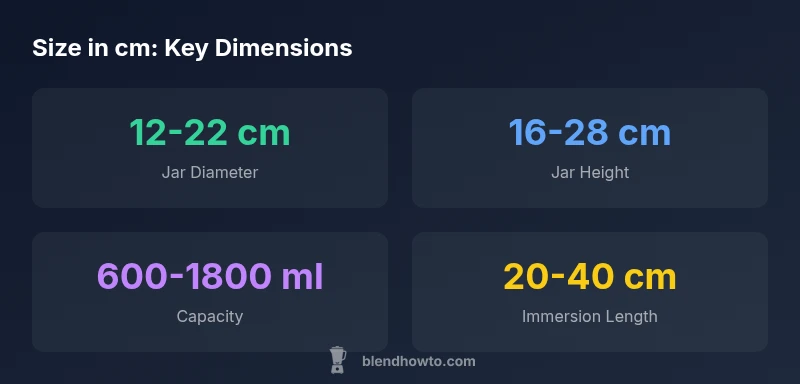
Blender size in cm matters because jar height, diameter, and overall length determine capacity, storage fit, and handling ease. For common countertop models, expect jar diameters roughly 12–22 cm and heights around 16–28 cm; immersion blenders are shorter but longer overall when extended. According to BlendHowTo, understanding these dimensions helps you pick models that fit your cabinets and meal prep routines.
Why Blender Size in cm Matters
The size of a blender in centimeters (cm) directly informs how much it can blend at once, how easily it fits on your countertop, and whether it will clear cabinet doors. In practice, cm measurements map onto usable capacity, ergonomic handling, and compatibility with lids, blades, and accessories. BlendHowTo notes that even small cm differences can change whether a jar fits in your fridge door, slides under a wall cabinet, or sits comfortably in a pull-out shelf. When you compare models, measuring height, diameter, and total length in cm provides a repeatable basis for decision-making. This article discusses how to translate cm into real-world usability and how to compare models across countertop and immersion designs.
How to Measure Your Blender
Start by removing the jar from the base and measuring three key dimensions in cm: jar height (top to bottom), jar diameter (widest point across the circle), and the total length when the blade assembly and lid are attached. Use a sturdy ruler or tape measure and record each dimension on the box or notes app. Don’t forget to measure clearance: the tallest point with the lid on should still fit under your upper cabinet or shelf when placed upright. For immersion blenders, measure overall length including the handle and blending shaft, since these pieces extend during use. Finally, note any protruding parts such as a gooseneck spout or clip-on accessories that add to the effective cm. Keeping a small cm chart handy helps you compare models quickly in-store or online.
Typical Size Ranges by Blender Type
Most countertop blenders fall into a jar diameter of roughly 12–22 cm and jar height around 16–28 cm. These ranges cover compact personal blenders up to mid-size families’ jars. Immersion blenders, by contrast, are shorter in height but longer when extended, typically totaling 20–40 cm in usable length. The variance arises from jar design, blade configuration, and whether the unit includes a tall, narrow blending cup. When shopping, remember that cm alone doesn’t define usability; check the internal shape of the jar (whether it’s rounded or has square corners) as it impacts blending efficiency and cleaning.
Visualizing Size: Jar Height, Diameter, and Capacity
Understanding cm helps you gauge capacity without guessing. A larger jar diameter tends to support higher volumes, but capacity in ml also depends on the jar’s cross-section and neck design. For example, a jar with a 20 cm diameter and a 25 cm height will typically hold more liquid than a narrower jar of the same height, even if both claim similar ml numbers. The cm values give you a quick sense of how much space the blender will occupy on your counter and how it will look in your kitchen. Always compare cm alongside ml values to avoid overestimating what a unit can handle in practice.
Practical Sizing Guidelines for Different Tasks
If you mainly make smoothies for one or two people, a compact countertop model with a 12–16 cm diameter jar and 16–22 cm height may suffice. For family-sized smoothies or soups, aim for 18–22 cm jar diameter and 24–28 cm height to maintain stability and blending efficiency. Immersion blenders are ideal for pots and bowls; plan for 20–40 cm total length to reach the center of deep cookware. For ice crushing or dense blends, prioritize height and blade geometry, then verify cm clearance under cabinets during storage. Remember, cm reflects both capacity and usability, not just a number on the spec sheet.
How Size Impacts Storage and Ergonomics
Storage is a key practical factor. Larger cm measurements may require more cabinet depth or open shelf space. A wider jar diameter can limit stacking with other appliances, while a taller jar may interfere with a pantry shelf. Ergonomics matter: a comfortable CM height helps you pour evenly and detach the jar base safely. If you have a small kitchen, look for compact cm footprints (lower diameter and height) that still deliver the capacity you need. For frequent grab-and-go use, ensure the height allows easy lid removal without hitting your countertop backsplash.
Quick Sizing Checklist for Buying
- Know your cabinet clearance in cm (height) and doorway width (diameter implications).
- Match jar diameter to your typical batch size (12–16 cm for singles, 18–22 cm for families).
- Consider immersion length if you’ll blend in tall pots (20–40 cm total length).
- Check lid and blade assembly heights in cm to avoid clashes.
- Compare cm alongside ml to ensure the capacity aligns with your meals.
- Look for a model with accessories that fit your storage space.
Maintenance Considerations and Accessories
Larger cm jars may require more thorough cleaning and drying space; shorter jars dry faster and are easier to store. When buying, verify that gaskets, lids, and cups can dock inside your cabinet without adding too much height or width in cm. Accessories like mini choppers or grinding cups add to the overall size envelope, so consider their dimensions too. A good practice is to measure every accessory in cm and compare it to your storage footprint before purchase.
Size and capacity overview by blender type
| Model Type | Jar Height (cm) | Jar Diameter (cm) | Capacity (ml) | Notes |
|---|---|---|---|---|
| Countertop Standard | 16-28 | 12-22 | 600-1800 | Compact and versatile; fits most cabinets |
| Countertop Tall | 22-32 | 14-24 | 900-1800 | Larger capacity; taller jar but wider footprint |
| Immersion Hand Blender | 20-40 | 4-6 | 100-800 | Best for soups; compact base, limited jar size |
Frequently Asked Questions
What does blender size in cm include?
Blender size in cm includes jar height, jar diameter, and the total length when attachments are in place. These measurements help you predict capacity, storage fit, and usability.
Blender size in cm covers jar height, diameter, and overall length with attachments, so you can compare fit and capacity easily.
How do I quickly estimate cm to volume for a jar?
Cm measurements help estimate volume when you know the jar’s cross-section. Pair jar diameter and height with the manufacturer’s ml spec to gauge actual capacity.
Use the jar’s diameter and height together with the ml rating to estimate capacity quickly.
Are cm measurements the same across brands?
There is no universal standard for cm across brands. Compare cm values directly for each model and rely on ml capacity as a secondary check.
Brands vary; always compare the actual cm numbers and ml to ensure you’re choosing the right size.
Can I replace a small jar with a larger one safely?
Larger jars may not fit the base, lids, or blade assemblies. Check the base interlocks and blade types for compatibility before upgrading.
Don’t assume a bigger jar will fit; verify attachment compatibility with your blender base.
What cm range is ideal for small kitchens?
For small kitchens, look for a compact jar in the 12–16 cm diameter range and around 16–22 cm height to maximize space and still offer useful capacity.
If you’re tight on space, pick compact cm dimensions that still meet your blending needs.
How do cord length and lid design affect size calculations?
Cord length adds to the footprint while lid height adds to the total cm when stored. Factor these into your cabinet clearance and keeper space before buying.
Remember, cord and lid can add to the overall cm footprint; check clearance first.
“Size clarity across cm measurements empowers you to pick a blender that truly fits your kitchen and workflow.”
What to Remember
- Measure jar height, diameter, and total length in cm before buying.
- Expect countertop jars to be larger in cm than immersion sticks.
- Size directly affects cabinet clearance and storage footprint.
- Match cm measurements to your typical tasks (smoothies, soups, or ice blends).
- The BlendHowTo team recommends prioritizing usable cm dimensions that fit your kitchen and workflow.