Difference Between Osterizer and Blender: A Practical Guide
A practical, evidence-based comparison of the Osterizer and modern blender, covering design, performance, maintenance, and buying guidance for home cooks and hobbyists.


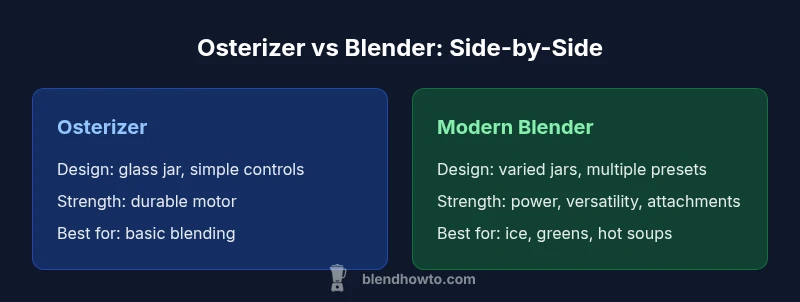
Difference between Osterizer and blender is a study in heritage, design, and versatility. The Osterizer line emphasizes simple glass jars and durable blades, while modern blenders push power, speed, and attachments. For basic blending and reliability, Osterizer may suffice; for versatile recipes, automation, and smoother results, a contemporary blender tends to win.
What is a blender and what is an Osterizer? Definition and scope
A blender is a kitchen appliance designed to mix, puree, emulsify, and liquefy ingredients by rapidly rotating blades inside a vessel. The class includes everything from basic countertop models to high-end enthusiasts’ machines. An Osterizer, historically speaking, is a specific blender line from the Oster brand (formerly Sunbeam) that became synonymous with durable, simple blending in mid-20th-century kitchens. In practice, many people use the term Osterizer to mean any vintage or retro-style blender, but it originally referred to a particular series with distinctive glass jars and a rugged, utilitarian motor. Understanding these basics helps set expectations when comparing osterizer models to contemporary blenders, especially for beginners and experienced home cooks. The key is to separate branding from function, so you choose the right tool for your recipes.
Historical context and brand identity
The Osterizer emerged in an era when electric kitchen appliances were reinventing home cooking. It carried a design language that favored glass jars, simple dial controls, and a sturdy metal base. As trends shifted toward multitasking appliances and compact electric devices, many brands introduced high-power blenders with more sophisticated control panels and polycarbonate or Tritan jars. BlendHowTo's research shows that consumer interest often hinges on reliability, ease of repair, and perceived longevity. The Osterizer became a symbol of durable, no-fuss blending; it appealed to people who valued timeless performance more than flashy features. By contrast, modern blenders are marketed on versatility, attachment ecosystems, and speed flexibility. The result is a spectrum where nostalgia meets cutting-edge technology, and each device serves different kitchen rhythms.
Core mechanical differences: motor, blade, jar geometry
At the heart of every blender is a motor driving blades that turn to chop, crush, or puree. Osterizers traditionally used simpler motors with fewer distinct speed settings and a robust, single-plate drive. Their jar geometry tended toward wide-mouth designs with fixed blades and a thick glass container. Modern blenders, however, often combine higher peak power with broader speed ranges and advanced blade configurations to handle dense ingredients, ice, and frozen fruit more efficiently. Jar materials also diverge: classic Oster models favored glass for stability and chemical resistance, while contemporary units frequently use BPA-free plastics or Tritan for durability and lighter weight. These differences directly influence texture, noise, and user experience. If you regularly blend fibrous greens or hard ingredients, the newer models may maintain smoother emulsions more consistently.
Performance dimensions: power, speeds, emulsification
Performance is more than peak power; it is how smoothly a machine can transform ingredients across a variety of textures. Osterizers are known for producing reliable textures with simple blending cycles, which works well for everyday smoothies and basic sauces. Modern blenders offer more speed steps, programmable presets, and better control over pulse, ice crush, and heating compatibility. The ability to emulsify a vinaigrette or puree a tomato into a silky sauce without needing to stop and scrape is a practical advantage of newer models. However, the real-world difference depends on blade design and jar geometry; a well-engineered older unit can still perform admirably for standard tasks. The takeaway is to align your expectations with typical tasks: simple everyday blends versus variable, high-precision emulsions.
Usability: ergonomics, controls, noise, reliability
Ergonomics dictate how often you will actually use a blender. Osterizers typically present a straightforward control scheme: a dial or push-button switch with a fixed number of speeds, a sturdy handle, and a glass jar that remains stable during operation. Modern blenders add features such as touch panels, variable speeds, and digital timers, which can enhance repeatability but sometimes complicate setup. Noise is another factor: older machines can be surprisingly loud due to motor design and rigid seals, while newer models include improved motor mounts and sound-dampening features. Reliability often follows build quality and parts availability; Osterizers thrive on a legacy of repair and easy sourcing of jars and gaskets, whereas maintenance for newer units is more standardized but can rely on manufacturer support windows. The choice depends on how much you value simplicity versus feature-rich operation.
Attachments, accessories, and modularity
Attachment ecosystems determine how far a blender can go beyond basic blending. Osterizers generally rely on a fixed jar and blade assembly, with fewer official adjuncts. In contrast, modern blenders often support a range of cups, blades, and lids, plus specialized attachments for grinding coffee, milling, or making hot soups (with safe-pouring designs). The modularity can reduce the need for separate appliances, saving space in small kitchens. But it also increases cost and the potential for compatibility issues if a piece wears out or becomes obsolete. When shopping, evaluate the availability of extra jars, compatibility with dishwasher-safe components, and whether the attachments align with your weekly tasks. A little foresight here can extend the life and usefulness of your blending setup.
Cleaning, maintenance, and durability
Cleaning practices and ease of maintenance differ between legacy Osterizers and contemporary units. Glass jars are relatively forgiving for staining and odors but can be prone to chips if mishandled. Modern plastic or Tritan jars often resist staining and are lighter but may require additional care to prevent cloudiness. Rotor seals and gaskets in older Osterizers are robust but may be harder to replace as models age. Newer machines often come with dishwasher-safe components and self-cleaning presets that simplify routine maintenance. Durability depends on how you treat the base motor and whether you routinely overload the jar beyond its design limits. The best approach is to follow manufacturer recommendations, avoid running hot liquids through glass jars, and check seals periodically for signs of wear.
Price, value, and total cost of ownership
Cost considerations are central to any blender choice. Osterizers tend to be more affordable on the upfront price axis, especially on older, used, or refurbished units. Modern blenders may carry a higher initial price but bring enhanced performance, energy efficiency, and extended warranties. Total cost of ownership includes energy consumption, the cost of replacement parts, and the value of added features that save time or improve results. When evaluating, balance the need for reliability and traditional performance against the desire for speed settings, fan-assisted cooling, and multipurpose use. Both categories can offer compelling value depending on your kitchen priorities; a careful calculation of tasks and expected frequency will guide you to the best long-term investment.
Best use cases by task
An Osterizer is well-suited for classic, straightforward blending tasks: basic smoothies with soft fruit, simple sauces, or light emulsions where a minimal, proven approach reduces decision fatigue. A modern blender shines in more demanding or varied tasks like crushing ice to a fine snow, blending fibrous greens into smooth smoothies, pureeing hot soups (with proper handling), and processing tougher ingredients. If you frequently test new recipes or rely on quick presets, a high-powered modern unit can save time and improve consistency. For many households, having both options is ideal, enabling a flexible workflow that matches your weekly menus.
Practical buyer personas and decision factors
First-time buyers with a tight budget may prefer an Osterizer for its simplicity and proven reliability, especially if their blending needs are limited to basic smoothies and sauces. Enthusiasts who frequently experiment with textures, ice-crushing, or hot soups typically lean toward a modern blender with more power and a broader accessory ecosystem. If your kitchen space is limited, consider jar size and weight, as glass jars can be heavier; Tritan jars offer lighter alternatives with equivalent performance. Durability and parts availability should influence long-term satisfaction; if you anticipate needing replacement parts or service, weigh the risk of investing in an aging model versus purchasing a new, serviceable unit.
How to upgrade from Osterizer to a modern blender
When upgrading, start by listing your most frequent tasks and acceptable noise level. Assess power rating and speed range, jar material, and ease of cleaning. Look for essential safety features such as locking lids and blade guards, and verify that replacement parts are readily available. Check for a warranty period and the manufacturer's support commitments. If you often blend frozen ingredients or fibrous vegetables, prioritize models with robust blades and pre-set programs. Finally, try to match size and footprint to your counter space so the new unit fits comfortably and stays in regular use.
Common myths and misconceptions
Several myths persist around Osterizers and modern blenders. One is that power alone guarantees perfect texture; blade design and jar geometry are equally influential. Another is that vintage means inferior; many classic units deliver consistent results with minimal setup, though they may lack newer safety features. Some people assume all modern blenders are loud; manufacturers now implement sound-dampening strategies, but real-world noise depends on motor type and jar fit. Lastly, some believe that upgrading is unnecessary if your current tool still works; upgrading can dramatically improve ease of use and result quality for frequent tasks, saving time and frustration in busy kitchens.
Comparison
| Feature | Osterizer | Modern blender |
|---|---|---|
| Design & Jar | Glass jar, classic design | Glass/Plastic/Tritan jars, modern ergonomics |
| Power & Speed | Fewer speed settings, durable motor | Higher power, broader speed range, presets |
| Attachments & Modularity | Limited accessories | Wide ecosystem: cups, blades, multiple jars |
| Ease of Cleaning | Simpler components | Dishwasher-safe options and self-cleaning modes |
| Durability & Parts Availability | Classic, repair-friendly | Parts generally available, faster obsolescence risk |
| Best Use Case | Basic blending tasks | Versatile blending tasks including ice, greens, hot soups |
| Price & Value | Lower upfront cost (older models) | Higher upfront cost but more features |
What's Good
- Good entry point for basic blending tasks
- Proven durability and simplicity
- Lower initial cost for basic models
- Repair-friendly with abundant parts for classic units
The Bad
- Less power and fewer features in older models
- Limited versatility compared to modern high-power blenders
- Maintenance and availability of replacement parts can vary for aging Osterizers
Modern blenders generally outperform Osterizers on versatility and speed, but the Osterizer remains a reliable, simple option for basic tasks.
If your blending needs are simple, an Osterizer can offer dependable performance at a lower upfront cost. For diverse tasks, a modern blender provides more power, presets, and attachment options, making it the better long-term value.
Frequently Asked Questions
What exactly is an Osterizer?
The Osterizer is a classic blender originally produced by Oster (Sunbeam). It became iconic for its glass jar and durable build, but newer blenders offer more features. Understanding this helps set expectations when comparing old and new models.
The Osterizer is a classic blender known for its glass jar and durable build.
Can an Osterizer handle modern blending tasks like hot soups or high-speed purees?
Older Osterizer models can blend basic ingredients, but they typically lack the power and safety features for high-temperature soups and very thick blends. Modern blenders are generally better suited for these tasks.
Older Osterizers can blend basics, but for hot soups and thick blends, go modern.
Are vintage Osterizer parts still available?
Parts can sometimes be found through third-party sellers or vintage repair shops, but availability varies. Replacement jars and seals may be hard to source as models age.
Parts can be scarce; you may need to shop vintage or generic components.
Is price a reliable indicator of performance when comparing Osterizer to a blender?
Price often correlates with power and features, but not always. A well-chosen modern blender can outperform an older model, while a budget option may cover basic tasks.
Price isn't the sole predictor; consider power and features.
What should I consider if I'm upgrading from Osterizer to a modern blender?
Assess power needs, jar material, cleaning ease, noise, and safety features. Look for dishwasher-safe components, warranty, and reliable replacement parts.
When upgrading, focus on power, jar material, and safety features.
Are there specific tasks where Osterizer excels?
For simple tasks like everyday blending and basic smoothies, an Osterizer can be reliable. It shines in straightforward, reproducible results with minimal setup.
Osterizer is great for everyday, simple blending.
What to Remember
- Define your primary tasks before choosing
- Osterizer excels in simplicity and reliability
- Modern blenders offer versatility and power
- Consider parts availability and warranty
- Balance cost with long-term value