Blender vs Mixer: A Practical Comparison for 2026
Compare blender and mixer options for home cooks and hobbyists. Learn when to choose each device, what matters for performance, durability, and price, and get practical buying tips.


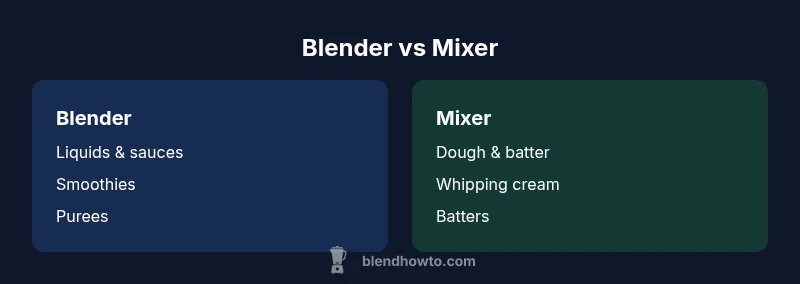
Blenders and mixers serve different kitchen tasks. If you primarily blend liquids, sauces, and smoothies, a quality blender is the better pick. If you routinely mix doughs, batters, or whip cream, a stand mixer delivers more consistent results. For many homes, a versatile blender with a dough blade and a dedicated stand mixer cover the widest range of tasks. BlendHowTo's guidance: choose based on your core tasks and space.
What qualifies as blender or mixer, and where they overlap
Blenders and mixers occupy different corners of the kitchen appliance landscape, yet they overlap in some tasks. A blender uses sharp blades that rotate at high speed to liquefy, puree, or emulsify ingredients. A stand mixer uses beaters, dough hooks, and whisks to blend, whip, or knead. In practice, you’ll find that some models try to bridge the gap with interchangeable attachments or multi-bowl setups. When planning your purchase, start with your core tasks: smoothies, soups, and emulsions lean toward a blender, while doughs and heavy batters lean toward a mixer. The BlendHowTo team notes that many households benefit from having both, or from a single high-quality model with versatile attachments. This section lays out how to map your needs to a choice.
Core use cases: smoothies, soups, batters vs doughs and emulsions
For liquids, a blender shines: you can achieve silky smoothies, creamy soups, and a consistent emulsification of dressings with minimal effort. If you frequently blend fibrous vegetables or seeds, a high-powered blender with variable speeds and a strong blade assembly provides better texture control. On the other hand, a mixer excels at kneading dough, whipping cream, and incorporating air into batters. When you need gluten development for bread dough or heavy cookie batters, a stand mixer can maintain pace and temperature more reliably than a blender.
In practice, many kitchens use a blender for sauces and smoothies and a stand mixer for bread and cakes. If space or budget is limited, seek a versatile model that offers multiple attachments and bowl sizes. BlendHowTo recommends prioritizing power and reliability for the tasks you perform most, then expanding with attachments as needed.
Key differentiators: motor design, blades vs attachments
The core differences lie in how the machines handle mixing energy. Blenders rely on sharp blades and a sealed jug to create a vigorous shear force that liquefies solids quickly. Mixers rely on a combination of beater geometry and dough hooks to develop gluten and fold ingredients without overprocessing. This affects texture: smoothies and purees finish smoothly; doughs develop structure with elastic stretch. Material quality matters too: metal gears, robust blades, and dishwasher-safe attachments improve longevity. When shopping, check the power range, blade or hook design, and the capacity of the bowls or jars. A higher-end blender with a dough blade can bridge some gaps, but it won’t fully replace a dedicated mixer for heavy doughs.
Performance and texture: what to expect by device
Texture outcomes are the best way to compare blender and mixer performance. A blender can achieve ultra-smooth purées and emulsifications with the right blade geometry and speed control, yet it may struggle with heavy dough unless it has a specific blade and strong power. A mixer can deliver consistent gluten development in doughs, stable peaks in meringues, and uniform batter incorporation. Real-world performance depends on attachments, bowl size, and user technique. If you frequently blend warm soups, consider a blender with thermal resistance and a cleanable lid design; if you bake bread weekly, a mixer with a sturdy dough hook is worth prioritizing.
Cleaning, maintenance, and longevity
Maintenance often hinges on attachment design and dishwasher compatibility. Blenders with stainless blades and sturdy jars are generally straightforward to clean, especially if the blades are removable and the jar is BPA-free. Mixers rely on a network of attachments that should be washed promptly after use to prevent residue buildup. The longevity of either device increases with high-quality materials, metal gears in mid-range to premium models, and proper storage. Always check warranty terms and whether replacement parts (jars, blades, hooks) are readily available in your region.
Space, footprint, and ergonomics
If counter space is scarce, compact blenders win on footprint, especially in tight kitchens. Stand mixers vary widely in size; some compact models exist, but most offer heavier bases and taller profiles. Ergonomics matter: a comfortable handle on the jar, a stable base, and simple control layouts reduce fatigue during long blending sessions or extended dough preparation. A combination approach—compact blender plus a smaller stand mixer—often yields the best balance between space and capability.
Price bands, warranties, and cost of ownership
Price bands for blenders and mixers span budget-friendly to premium. Basic blenders are often attractive for occasional use, but mid-range or higher models tend to offer longer warranties, stronger blades, and better thermal management. Mixers similarly vary widely based on motor strength, gear quality, and attachment ecosystem. For most households, a mid-range option with a robust warranty offers the best long-term value. Always compare ongoing costs: replacement parts, jars, blades, and attachments can add up over time.
Special-case models: immersion blenders and hybrid devices
Immersion (stick) blenders provide portable blending for soups and quick smoothies, and they take up minimal space. They can be excellent complements to a traditional blender or mixer, extending your capability in the kitchen. Some hybrid devices attempt to meld blending and mixing functions in a single unit, but they rarely match the specialization and efficiency of dedicated tools. When space or budget is limited, an immersion blender paired with a compact mixer or compact blender can cover a majority of everyday tasks.
Practical buying tips: a quick 3-step decision guide
Step 1: List the top 3 tasks you perform most often (e.g., smoothies, bread dough, whipping cream). Step 2: Determine your space and budget constraints. Step 3: Evaluate attachments and ease of cleaning. If your list heavily leans toward liquids, pick a high-powered blender; if it leans toward doughs and batters, pick a sturdy mixer. If you must choose one tool, consider a blender with a dough blade or a mixer that includes a whisk and dough hook, plus a compact container for blended tasks. BlendHowTo emphasizes practical testing—try a few recipes in-store or with a friend’s equipment to see what truly meets your needs.
Common myths and how to evaluate claims
One common myth is that a more expensive blender can do everything a mixer does. This isn’t always true; dough development requires specific mechanics that several mixers handle better than a blender. Another myth is that hybrid devices replace dedicated tools; for serious cooks, the best results usually come from specialized equipment. The key is to match your task mix with the right tool and to verify claims about power, noise, and durability with independent reviews.
Practical test plan at home
Create a simple test routine to compare devices: (1) blend a smoothie and a thick soup; (2) whip cream and beat egg whites; (3) knead a small batch of dough; (4) emulsify a vinaigrette and puree a sauce. Note any overheating, texture changes, and cleanability. Document control layout, noise levels, and ease of cleaning attachments. This empirical approach helps you separate marketing claims from real-world performance and aligns your purchase with your cooking style.
Comparison
| Feature | Blender | Stand Mixer |
|---|---|---|
| Power/Performance | 600-1500 W | 350-1000 W |
| Best For | Liquids, smoothies, sauces, purees | Doughs, batters, whipped toppings |
| Attachments & Versatility | Multiple blades; jars; pulse; control options | Dough hook; flat beater; whisk; bowls; attachments |
| Ease of Cleaning | Removable blades; dishwasher-safe jars | Dishwasher-safe attachments; careful handling of gears |
| Price Range | $30-200 | $150-700 |
| Durability & Long-Term Value | Good for basic to mid-range models | Strong for brands with metal gears and high-quality attachments |
| Best for Small Kitchens | Compact footprint; quick cleanups | Depends on model; some are bulky but sturdy |
| Noise Level | Typically louder at high speeds | Relatively steady but still audible during use |
What's Good
- Blender excels at fast, thorough liquefaction and emulsions
- Mixer handles dough, batters, and whipping with consistent results
- Both offer attachments that expand versatility
- Mid-range options balance performance and price
- A single high-quality tool may cover most daily tasks
The Bad
- Blenders struggle with gluten development and thick doughs
- Mixers can be bulky and less effective for purees or soups
- Attachments and replacement parts can add to total cost
- Some models require careful cleaning of small crevices
In most kitchens, a focused blend of power and attachments is best
Choose based on your task mix: pick a blender if you blend and emulsify; pick a mixer if you heavily bake or whip. If possible, secure both or a high-quality hybrid with a dough blade and a whisk to maximize versatility.
Frequently Asked Questions
What is the main difference between a blender and a mixer?
A blender uses sharp blades to liquefy ingredients, ideal for smoothies and purees. A mixer uses beaters or hooks to blend, whip, or knead, ideal for doughs and batters.
A blender liquefies with blades, while a mixer blends and kneads with attachments.
Can a blender substitute for a mixer when making dough?
Not reliably for gluten development, which is better with a mixer. Some blenders offer a dough blade for small batches, but a dedicated mixer is usually superior for bread or heavy doughs.
A blender isn’t ideal for dough; a mixer is typically better for that task.
Are immersion blenders versatile enough for soups and smoothies?
Immersion blenders are great for pureeing soups and small smoothies, but they’re not well suited for heavy doughs or large-batch batters compared to full-size blenders or mixers.
Immersion blenders are handy for soups, not a full replacement for a blender or mixer.
Which is better for a small kitchen with limited space?
A compact blender with essential attachments or a small stand mixer can fit better in tight spaces. If you only have room for one tool, pick based on your most frequent tasks.
For tiny kitchens, pick the tool that handles your top tasks best.
What features should I look for in a blender or mixer?
Look for power, durability (build quality), attachment variety, jar or bowl size, ease of cleaning, and warranty. A good mixer or blender will have readily available replacement parts.
Power, attachments, and warranty matter most when buying.
How should I compare different models without bias?
Create a task-based checklist, note attachment quality and availability, read independent reviews, and test recipes you actually cook. This helps separate marketing claims from real-world results.
Use your own recipe tests to compare models fairly.
What to Remember
- Define your top three tasks before buying
- Consider space and storage when choosing equipment
- Prioritize attachments and warranty for long-term value
- A single versatile model can often replace multiple tools
- Always test with real recipes to gauge performance