Hand Mixer vs Blender: A Practical Home-Kitchen Comparison
Compare hand mixers and blenders across power, versatility, attachments, and cleanup. This BlendHowTo guide helps home cooks decide which tool fits their kitchen, cooking style, and space.


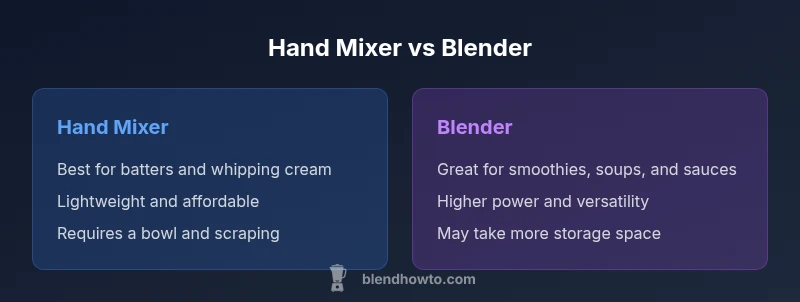
TL;DR: A hand mixer is ideal for batters, whipping cream, and light dough tasks, offering quicker setup and easier cleanup. A blender dominates for smoothies, sauces, soups, and purées, delivering smoother textures and higher blending power. If your tasks are mixed, consider an immersion blender for greatest flexibility. This BlendHowTo guidance helps you choose based on your most frequent kitchen jobs.
What hand mixer vs blender means for your kitchen setup
In everyday cooking, the question of whether to rely on a hand mixer or a blender boils down to the tasks you perform most often and the space you have to store equipment. A hand mixer is designed for beating, whisking, and blending lighter batters. It shines when you’re whipping cream to soft peaks, beating eggs for cakes, or folding ingredients into batter. The blender, by contrast, is built to liquefy and emulsify. It handles smoothies, soups, sauces, and purées with ease, producing smooth textures that can be difficult to achieve with a hand mixer. For home cooks, this distinction often determines which device makes the most sense in day-to-day meal prep, with BlendHowTo recommending you align your purchase with your core cooking missions.
The core strengths: where each tool truly excels
A hand mixer and a blender aren’t interchangeable at the ingredient level. The hand mixer uses beaters and sometimes dough hooks to air-air and bring ingredients together with minimal heating, which is essential for delicate batters and light aeration. The blender relies on a sharp blade and a powerful motor to force ingredients into a uniform suspension or liquid. For people who bake frequently, a hand mixer reduces mixing time and avoids over-processing delicate components like whipped cream; for people who crave smooth soups or drinks, a blender is the better bet for consistent texture. BlendHowTo’s analysis emphasizes that your kitchen’s rhythm—whether you’re cooking for a family or preparing single-serve meals—should guide the initial choice.
Power and speed: how to interpret motor capability
Motor power matters as much as the ability to control speed. Hand mixers typically offer multiple speed settings, which are great for gradual incorporation or whipping at precise intervals. Blenders present a different kind of control: higher RPMs and pulse modes enable rapid liquefaction and smoother textures. When you’re blending fibrous vegetables or dense ingredients, a higher torque blade design helps push through resistance, reducing chunkiness. For light batters or foam, the explosive power of a blender is less necessary and can even overwork the mixture. Understanding these dynamics helps you pick the right tool for your preferred outcomes.
Attachments matter: what comes with each tool
A standard hand mixer usually includes two beaters and, in some models, dough hooks or a whisk attachment. This range covers whipping cream, eggs, and mixed batters efficiently. A blender typically ships with a pitcher and a blade assembly; some models offer personal-blender cups or additional blades for grinding or chopping. If you evaluate on versatility, consider a model that includes a whisk or beater attachments with a blender that accepts different blade configurations. The right accessory mix can expand capabilities without needing multiple devices.
Practical task benchmarks: batters, sauces, smoothies
If you’re preparing a cake or muffins, a hand mixer shortens mixing time and minimizes gluten development in some batters compared with a blender. For sauces and gravies, a blender can emulsify and incorporate ingredients with a smoother mouthfeel. In the smoothie realm, a blender has the upper hand when you want even texture and ice breakdown. For baby foods or purees, a blender provides consistent, fine textures, while a hand mixer would be less effective unless used with a specialized attachment. These benchmarks help you map typical recipes to the appropriate tool and plan your workflow accordingly.
Cleaning and maintenance: practical care tips
Both tools require careful but straightforward cleaning. Hand mixers are often easier to rinse immediately after use, with the beaters detached and rinsed under warm water. Some models are dishwasher-safe, but still benefit from quick hand-washing to guard against residue. Blenders demand careful cleaning due to the blade assembly and pitcher: rinse promptly to avoid dried-on residue, and wash the blade component separately if possible. Regular inspection for wear on blades or beaters and ensuring the cord, switch, and seals are intact will extend the device’s lifespan. BlendHowTo emphasizes drying thoroughly to prevent rust and corrosion.
Size, ergonomics, and storage considerations
If your kitchen counter is compact, a handheld hand mixer can save space and still deliver strong performance for many everyday tasks. Blenders require more cabinet or shelf space, especially models with larger pitchers or extra containers. Ergonomics play a critical role: a comfortable grip and balanced weight reduce strain during longer prep sessions. If you cook frequently and long hours, test-fit models with removable cords and ergonomic handles to ensure you can maintain a stable grip without fatigue. The right size choice supports a streamlined workflow rather than cluttering your kitchen.
Cost, value, and purchase strategy
Price ranges for hand mixers are generally lower than those for full-size blenders, though this depends on brand, features, and attachments. A cautious approach is to identify your “must-have” features: durable beaters, multiple speed settings, and compatibility with a chopper or whisk attachment for the hand mixer, or a blender with a sturdy blade, sufficient wattage, and a spill-proof pitcher. In many households, buying a mid-range model with a couple of essential attachments provides better value than opting for a premium device without clear use cases. BlendWhatTo notes that you should also consider the cost of accessories and replacement parts for long-term value.
Kitchen footprint: storage and future-proofing
If storage space is at a premium, a compact hand mixer typically offers the best compromise, taking up minimal space while delivering strong performance for daily tasks. A larger blender may leave more capacity for batch processing of liquids, but the pitcher and blade assembly will take up more room when not in use. Consider whether you prefer multi-usage appliances or dedicated devices. If you expect your cooking repertoire to expand toward soups, smoothies, and sauces, a blender buys flexibility; if you expect to bake regularly and beat eggs, a hand mixer supports that routine with focused efficiency.
Accessories and upgrade paths: expanding capabilities
Many manufacturers offer bundles with extra attachments such as whisk sets, dough hooks, and blending blades. When evaluating upgrades, consider whether you’ll actually use the extra components. A hand mixer with a whisk and dough-hook option can cover a broad range of tasks, from whipping cream to kneading smaller portions of dough. A blender with different blade configurations and a large pitcher can handle energy-intensive blending operations and batch processing. Budget for a few essential add-ons rather than paying for a plethora of unused accessories.
Common mistakes and tips to get the most from either tool
A frequent pitfall is treating both devices as interchangeable. You’ll achieve better results by using the correct tool for the job: use a hand mixer for light batters and whipping, and a blender for liquids, emulsifications, and dense foods. Don’t overfill the blender, start at low speed to prevent splatter, and gradually increase. For the hand mixer, ensure you scrape the bowl often to avoid unmixed pockets and to maintain uniform texture. By paying attention to the recipe’s needs and the tool’s strengths, you’ll improve results and reduce cleanup time.
Comparison
| Feature | Hand Mixer | Countertop Blender |
|---|---|---|
| Power & Torque | Lower to moderate power, optimized for aeration | Higher power, designed for liquefaction and blending tough ingredients |
| Best For | Batters, whipped toppings, light doughs | Smoothies, soups, sauces, and purées |
| Attachments/Versatility | Beaters, optional whisk or dough hooks | Pitcher, blade assembly, often extra cups or blades |
| Size & Storage | Compact, easy to store | Larger footprint, pitcher occupies space |
| Ease of Cleaning | Beaters detach; quick rinse | Blender parts require more thorough washing |
| Price Range | Lower upfront cost typically | Mid-to-high range depending on features |
| Best For (Kitchen Type) | Baking-focused households, quick mixing tasks | Liquid-rich recipes and meal prep versatility |
What's Good
- Low upfront cost for basic models
- Excellent for quick batter tasks and whipping
- Compact and easy to store
- Lightweight with simple operation
- Fast cleanup for small quantities
The Bad
- Limited power for thick doughs or heavy mixing
- Less versatile for liquids and purée tasks
- Attachments can be optional and add cost
- Pitcher blender may require more storage space
Blender generally offers more versatility; hand mixers excel at batters and whipping.
Choose a blender for smoothies, soups, and sauces, and a hand mixer for cakes and whipped toppings. If you can only buy one, consider a compact immersion blender for the widest range of tasks.
Frequently Asked Questions
What is the main difference between a hand mixer and a blender?
A hand mixer is optimized for beating and whisking batters, producing light aeration. A blender is designed to liquefy and emulsify ingredients, handling smoothies, soups, and purées with a smooth texture.
A hand mixer is best for batters and whipped toppings, while a blender excels at smooth liquids and purées.
Can I substitute a blender for a hand mixer in batters?
You can sometimes substitute in a pinch, but it’s not ideal. Blending can overwork gluten and produce denser batters. Use a hand mixer for delicate batters and whipped components for best texture.
A blender isn’t the best for delicate batters—use a hand mixer for fluffy results.
Are immersion blenders enough for most tasks?
Immersion blenders offer a middle ground: they blend liquids and some soft ingredients, with less equipment than a full blender. They may lack the power for ice or hard ingredients and won’t beat eggs or whip cream as effectively as a hand mixer.
Immersion blenders handle soups and smoothies, but aren’t great for whipping or heavy dough.
What attachments come with a typical hand mixer?
Most hand mixers include beaters; many also offer whisk attachments and dough hooks. Check the box for included extras, especially if you expect to do whipping and light dough work regularly.
Look for beaters, plus optional whisk and dough hook attachments.
How should I clean and store these appliances?
Wash beaters or blades after use and dry thoroughly. Many parts are dishwasher-safe, but check the manual. Store in a dry place away from heat to preserve blades and seals.
Rinse the parts after use, dry well, and store in a cool, dry spot.
Is price a good predictor of performance?
Price often correlates with power, build quality, and included attachments, but mid-range models can offer solid performance for typical home cooking. Prioritize required features and durability over brand-name prestige.
Don’t assume the most expensive model is the best for your needs; focus on features you’ll actually use.
What to Remember
- Match the tool to your dominant kitchen tasks.
- Consider storage space when choosing between devices.
- Aim for essential attachments rather than a long accessory list.
- Cleanliness and maintenance extend tool longevity.