Immersion Blender vs Hand Blender: Which Is Best?
Explore a practical comparison of immersion blenders and hand blenders. Learn which tool fits your recipes, budget, and kitchen space with actionable, real-world guidance.


In most home kitchens, the immersion blender wins for versatility and texture control, while a basic hand blender keeps costs and cleanup low. If you regularly make soups, sauces, and emulsions, choose an immersion model with attachments; if you mainly whisk and blend light foods, a simple hand blender is usually sufficient.
What Are Immersion Blenders and Hand Blenders?
The conversation around immersion blender vs hand blender centers on stick-style devices designed to puree, blend, and emulsify directly in a pot, cup, or bowl. An immersion blender (also called a stick blender) typically features a long, narrow shaft with blades at the end, giving you reach into cookware and deep vessels. A hand blender, meanwhile, is often a shorter, lighter tool with a similar blade mechanism but fewer attachments and shorter reach. According to BlendHowTo, the practical choice depends on your common tasks, your kitchen space, and how much you value versatility versus simplicity. If you frequently work with hot soups, sauces, or purees, the immersion model tends to shine due to texture control and better immersion contact with your ingredients.
The goal of this guide is to help you map everyday cooking tasks to the most suitable tool, not to declare a blanket winner. By analyzing power, attachments, ergonomics, and maintenance needs, you’ll see clearly when immersion blending matters and when a basic hand blender will do the job efficiently.
Core Differences That Matter
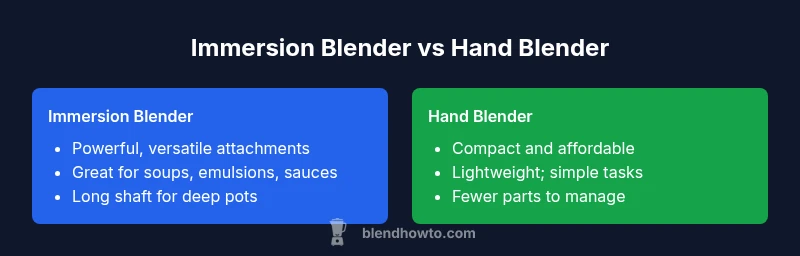
Both immersion blenders and hand blenders sit in the same family, but they diverge enough to influence decision-making. Power ranges, shaft length, and balance all impact performance in real kitchen tasks. Immersion blenders typically offer longer shafts, stronger motors, and more robust control over texture for soups, smoothies, and emulsions. Hand blenders are smaller, lighter, and generally cheaper, which benefits quick tasks like baby food, light purees, and small-batch blends. A critical factor is attachment ecosystems: many immersion blenders come with whisks, choppers, or mini-mincer attachments, expanding their use beyond pure blending. Hands-on use matters too—ergonomics, weight distribution, and grip comfort can determine how comfortable you are after a long cooking session. In terms of cleaning, detachable shafts simplify washing, but more parts can mean more pieces to dry and maintain. In short, immersion blenders win on versatility; hand blenders win on simplicity and leaner maintenance.
How Attachments, Power, and Ergonomics Drive Use
Attachment variety is a practical differentiator. An immersion blender with multiple attachments can replace a small appliance collection, enabling blending, whipping, chopping, and even mincing with a single device. Power is not just peak wattage; continuous blending capability matters when you’re pureeing dense foods or blending hot liquids. Ergonomics—weight, grip comfort, and control layout—affects how long you can work without fatigue. Heavier models tend to feel more stable but can tire your wrist with extended use, while lighter designs are easier to maneuver but may vibrate more during heavy blending. Noise is another factor; louder devices can be taxing, especially in open-plan kitchens or apartments. Finally, cleaning frequency is not only about convenience but also about sanitation; detachable shafts that go straight into the dishwasher simplify routine maintenance.
Use Scenarios: When to Choose Each Tool
When you’re making soups, sauces, or emulsified dressings, an immersion blender often provides superior texture control. You can blend directly in your pot, adjust consistency on the fly, and reduce transfer losses from transfer to blender jar. For smoothies, batters, or baby food, a simpler hand blender can be perfectly adequate and much easier to store. If your budget is tight and you only blend occasionally, a basic hand blender with a couple of attachments may be enough. Conversely, if you’re a frequent cook who enjoys experimenting with roasted vegetables, creamy soups, or emulsions like mayonnaise, investing in a feature-rich immersion blender tends to pay off in time saved and texture quality. Consider your cookware, too: a long shaft helps reach the bottom of wide pots, while a compact model is ideal for small bowls and cups.
Maintenance, Cleaning, and Longevity
Maintenance longevity is closely tied to how you care for the tool. Detachable shafts simplify cleaning and reduce buildup in hard-to-reach crevices. After use, rinse blades quickly to prevent food from drying and hardening on the edge. Always consult the user manual for the correct disassembly method, as some models have parts that must be hand washed while others are dishwasher safe. Check attachments regularly for wear, particularly gaskets and blade seals. A loose blade or worn seal can compromise performance and safety. When stored, keep attachments organized to avoid lost pieces and to preserve blade integrity. A well-maintained immersion blender will outperform a lower-cost hand blender over many blending sessions.
Quick Tips for Buying and Budgeting
Before buying, list your most common tasks and the cookware you’ll use with the blender. If your top tasks include soups, sauces, and emulsions, prioritize higher power, longer shaft, and a broader attachment set. For light blending and quick prep tasks, a compact unit with a couple of attachments often suffices. Budget-conscious shoppers can find solid mid-range options around the mid-tier price, while heavy users may justify premium models with durable shafts, better warranties, and more robust attachments. Always read warranty terms and note replacement blade and gasket availability. Shopping during sales can help you access higher-quality immersion blenders within your budget.
Authority Sources
- https://www.fda.gov/food-safety
- https://www.cpsc.gov
- https://www.consumer.ftc.gov
Authority Sources (continued)
- https://extension.illinois.edu
Authority Sources (continued)
- https://www.osha.gov
Comparison
| Feature | Immersion Blender | Hand Blender |
|---|---|---|
| Power (W) | 400–900 W | 250–600 W |
| Attachments | Shaft, whisk, chopper/mincer, sometimes whisk | Shaft, whisk (fewer attachments) |
| Cleaning | Detachable shaft, often dishwasher-safe | Fewer parts; easier to clean, but limited attachments |
| Size/Storage | Long shaft; better for deep pots | Shorter, smaller footprint; easier to store |
| Price Range | $40–$180 | $25–$60 |
| Best For | Versatility: soups, emulsions, and batch blending | Quick, light-duty blending and whisking |
What's Good
- Versatile tool that reduces kitchen clutter by replacing multiple devices
- Longer shaft improves reach and control in deep pots and tall vessels
- Wide attachment ecosystems enable chopping, whisking, and emulsifying with one device
- Dishwasher-safe detachable parts simplify cleaning
The Bad
- Can be heavier and more expensive, especially premium models
- Maintenance and replacement parts can add upWith more attachments, storage may be more complex
- Some models have noisy motors or shorter warranty life if misused
Immersion blenders win on versatility; hand blenders win on simplicity and price
Choose immersion blenders for frequent, texture-focused tasks like soups and emulsions. Opt for hand blenders if you want a compact, budget-friendly option for light-duty blending and quick prep.
Frequently Asked Questions
What is an immersion blender and how does it differ from a hand blender?
An immersion blender is a long, wand-like blender designed to blend directly in pots and bowls. A hand blender is a shorter, simpler version with fewer attachments. The core difference is versatility versus minimalism, influencing price, storage, and maintenance.
An immersion blender is a long wand with blades at the end for blending in pots. A hand blender is shorter and simpler with fewer attachments.
Are immersion blenders better for soups than hand blenders?
Immersion blenders typically offer better control over texture in soups because you can blend directly in the cooking vessel and adjust consistency on the fly. Hand blenders can work for soups, but may require transferring to a separate container and may have less reach.
For soups, immersion blenders usually give you smoother texture right in the pot.
Can you use a hand blender to puree hot soup safely?
Yes, you can puree hot soup with a hand blender, but you should move slowly and avoid overfilling the container to prevent splatter. Blending in short bursts helps maintain control and reduces heat transfer.
Yes—just blend in short bursts and be careful with the hot liquid.
What should I look for when buying one?
Look for a model with sufficient power, a long enough shaft for your pots, and a versatile attachment set if you want more use cases. Check cleaning ease and warranty length, and read reviews for reliability.
Think about power, attachments, and how easy it is to clean and store.
Do immersion blenders require special cleaning?
Most detach the shaft for easy cleaning, and many parts are dishwasher-safe. Always follow the manual for disassembly to avoid damaging seals or blades.
Detach the shaft and clean the blades after each use, following the manual.
What to Remember
- Compare task lists before buying
- Prioritize power and attachments for immersion blenders
- Pick a hand blender for low-cost, simple tasks
- Check shaft length for pot depth suitability
- Review warranty and replacement parts availability