Blender vs Immersion Blender: A 2026 Comparison Guide
Compare blender and immersion blender side-by-side to decide which tool fits your kitchen tasks, space, and budget. Practical guidance from BlendHowTo with real-world use cases and tips.


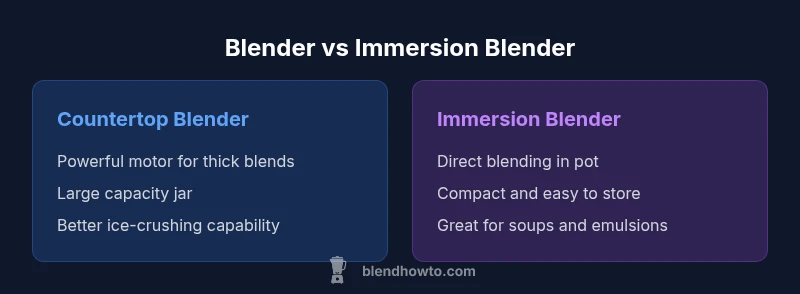
For most kitchens, a countertop blender excels at smoothies, nut butters, and thick purées, while an immersion blender smooths soups and emulsions directly in the pot. If you value compact storage and quick cleanup, the immersion option is ideal; if you need power for large batches and ice crushing, choose a countertop blender. In short: blender or immersion blender—let your task drive the decision.
How they are designed to work
The two most common blender formats—countertop blenders and handheld immersion blenders—share the goal of turning ingredients into smooth mixtures, but they approach this task very differently. For home cooks and hobbyists, the choice often hinges on how and where you blend. According to BlendHowTo, the decision between blender or immersion blender should reflect your typical workload, space constraints, and the level of convenience you value most. Countertop models use a fixed jar with a powerful motor and a wide blade assembly to create volume in one container, while immersion units rely on a handheld stick that plugs directly into pots, bowls, or pans. Understanding these design differences helps you align your tools with your cooking style and avoid an unnecessary upgrade.
Core performance criteria to compare
When you compare blender and immersion blender options, use the same performance criteria to avoid bias. Key factors include power and motor design, control and speed options, jar capacity, and the range of accessories. Also consider reliability, ease of cleaning, and how each device performs with hot liquids. For many tasks, the countertop blender offers consistent results across a broad spectrum of recipes, while an immersion blender excels in quick emulsions and direct blending in a pot. The BlendHowTo team notes that real-world use—such as making a silky tomato soup directly in the pot—often highlights the practical strengths of an immersion blender. Meanwhile, water and ingredient consistency are easier to manage with a stable countertop pitcher and multiple speed settings.
Real-world cooking scenarios: soups and emulsions
Soups are a prime test for blender types. An immersion blender shines when you want to blend right in the cooking vessel, reducing transfer steps and minimizing cleanup. It’s especially effective for emulsions like mayonnaise or vinaigrettes, where you can control texture as you go. However, pureeing a chunky vegetable soup to a uniform texture might feel slower with a handheld tool. In those cases, a countertop blender can deliver a smoother finish in fewer batches. BlendHowTo’s testing suggests starting with small, hot batches in a tall, stable jar to prevent splatter, then comparing texture for your preferred mouthfeel.
Real-world cooking scenarios: smoothies, sauces, and nut butters
For smoothies and thick blends, a countertop blender generally provides the fastest, most consistent results, especially when ice is involved. Nut butters, almond milks, and nut pastes often benefit from the robust torque of a dedicated motor with a broad blade. Immersion blenders can handle sauces and lighter emulsions efficiently, but may struggle to achieve the same uniform thickness in very thick mixtures without stopping to scrape or rework the batch. In practice, many cooks keep both tools on hand and switch based on batch size and target texture, a recommendation you’ll hear echoed in BlendHowTo guides.
Attachments, accessories, and versatility
Both tools offer add-ons, but the breadth of attachments tends to be greater for countertop models. Additional jars, grinding blades, and whisk attachments expand the range of tasks—from crushing ice to making nut butters. Immersion blender kits often include a whisk and a chopper, which makes quick work of sauces in a pot. The select few high-end immersion devices provide extra motor speed settings, but you should assess whether you’ll actually use the extras. Flexibility matters; the best choice often aligns with the range of recipes you routinely prepare.
Cleaning, care, and longevity considerations
Cleaning is a practical consideration that can tilt the decision. Immersion blenders typically clean quickly: rinse the shaft and blade under running water or wipe with a damp cloth, then dry. Countertop blenders require disassembly of the jar and blades for a thorough clean, which can be more time-consuming and generate more dishwasher load. Look for models with dishwasher-safe parts and robust seals to minimize leaks. Regular maintenance—such as checking seals and replacing worn blades—helps extend life, regardless of which type you buy. BlendHowTo emphasizes choosing machines with easily replaceable parts to sustain performance over time.
Space, storage, and noise considerations
Space matters in small kitchens. Immersion blenders take up less storage space and are easy to grab for quick tasks, while countertop blenders require a dedicated shelf or cabinet and a stable workspace. Noise levels can also differ: compact immersion devices tend to be louder relative to their power, but the overall noise may still be lower due to smaller motors. If you share a compact kitchen, the immersion model often wins on convenience and footprint, whereas a family that prioritizes batch cooking may justify the counter space for a high-capacity countertop blender.
Price, value, and ownership costs
Price ranges reflect features, power, and build quality. Immersion blenders usually cost less upfront and can cover a surprising number of tasks with the right attachments, making them attractive for budget-conscious buyers. Countertop blenders can command a higher upfront price but deliver more substantial performance for heavy blending and larger batches. Consider long-term value based on your typical recipes, maintenance costs, and how often you’ll use each tool. BlendHowTo analyses suggest balancing initial spend with expected frequency of use to determine true value.
How to choose by cooking style
If your kitchen lifestyle centers on soups, sauces, and direct pot blending, an immersion blender is a strong match. If you routinely prepare smoothies, thick blends, and larger batches, a countertop blender handles volume and texture with greater ease. For many users, a hybrid approach—keeping both tools available—offers the best of both worlds. In practice, identify your most common tasks first, then evaluate whether you need the heavy-duty capabilities of a countertop unit or the quick, direct-action convenience of an immersion model. The BlendHowTo team recommends prioritizing texture control and batch size when deciding.
Safety, usage tips, and maintenance best practices
Always unplug before cleaning or assembling parts, and keep blades out of reach of children. For hot soups, vent slowly to avoid pressure buildup, and use a tall, stable container to prevent splatter. When using an immersion blender, keep the blade fully submerged to reduce splash risk. Regularly inspect gaskets and blades for wear, replace parts as needed, and store units in a dry environment to prevent corrosion. Following these safety and maintenance practices helps ensure consistent results over time.
Authoritative sources and further reading
- https://www.fda.gov/food-safety (Food safety and handling guidelines relevant to kitchen equipment use)
- https://www.nist.gov/topics/food-safety (Standards and guidelines for culinary equipment and measurement accuracy)
- https://www.consumerreports.org/cookware/blenders (Independent testing and performance evaluations of blenders)
Comparison
| Feature | Blender (countertop) | Immersion blender |
|---|---|---|
| Power & performance | High power/torque typical; strong for ice and dense blends | Moderate power; excels in direct-pot blending |
| Capacity & versatility | Large jar with multi-step blending | Direct blending in pots; smaller batch capability |
| Ease of use & cleanup | Disassemble jar for cleaning; multiple parts | Minimal setup; quick rinse between tasks |
| Attachments & accessories | Jars, blades, grinding attachments; versatile | Whisk, chopping accessory; limited jars |
| Price range | Higher upfront for quality countertop models | Lower upfront; more affordable entry points |
| Best for | Bulk blends, smoothies, ice beverages, nut butters | Soups, sauces, emulsions, direct-pot work |
What's Good
- Compact storage and lighter weight
- Direct blending in pots reduces transfer steps
- Typically lower upfront cost for entry models
- Versatility with accessories in many kits
- Fast cleanup for small tasks
The Bad
- Limited batch size and power for very thick blends
- Longer prep and cleanup for large volumes
- Attachment quality varies by brand
- May require more counter space for full kits
Immersion blender wins for direct-pot work and quick emulsions; countertop blender wins for bulk blending and dense textures.
Choose immersion when you primarily blend in pots and need fast, direct results with minimal cleanup. Pick a countertop blender for frequent large batches, ice crushing, and thicker textures. If space and budget permit, both tools offer complementary strengths that can cover a wide range of kitchen tasks.
Frequently Asked Questions
Can I replace a countertop blender with an immersion blender for most tasks?
Immersion blenders can handle many tasks, including emulsions and light purees, but they struggle with large batches and very thick textures. A countertop blender is generally better for smoothies, nut butters, and bulk blends. Consider a mixed approach if you frequently vary tasks.
Immersion blenders work for many tasks, but they’re not ideal for large batches or very thick blends. A countertop blender handles those better.
Is an immersion blender safe for hot soups?
Yes, but use caution. Blend in short bursts, keep the head submerged, and vent steam to prevent splatter. Start with a small amount and gradually blend to your desired texture.
It’s safe for hot soups if you go slow and keep the blade under liquid while venting steam.
What features should I look for in a blender?
Look for motor power, variable speeds or pulse, a sturdy jar, dishwasher-safe parts, and reliable seals. For immersion blenders, check shaft quality, control handle ergonomics, and included attachments.
Focus on power, ease of use, and easy-clean parts when choosing.
Are budget models reliable for everyday blending?
Budget models can perform well for light to moderate use, but may lack long-term reliability or consistent power. If frequent use is expected, invest in a model with good warranty and replaceable parts.
Budget models can be fine, but check warranties and parts availability.
Can you blend nuts or make nut butter with an immersion blender?
Immersion blenders can blend nuts in small batches, but you’ll often get a coarser texture. For smooth nut butter, a countertop blender with a high-torque motor is usually better.
You can blend small batches of nuts, but for smooth butter you’ll likely prefer a countertop model.
Do budget models perform well?
Budget models can work for light blending tasks but may struggle with heavy loads or ice. If your routine includes frequent hard blending, allocate a larger portion of your budget to a more robust unit.
Budget blenders are okay for light use; heavy tasks deserve a sturdier option.
What to Remember
- Identify your go-to tasks—soups vs smoothies.
- Evaluate storage needs and cleanup time.
- Balance power against budget and attachments.
- Choose immersion for direct pot blending; countertop for bulk blends.
- Plan for future upgrades with versatile attachments.