Which Blender Is Better: Countertop vs Immersion
An analytical comparison of countertop and immersion blenders, outlining when each shines, buying tips, and a practical verdict for home cooks.


Which blender is better depends on how you cook. For smoothies, sauces, and bulk blends, a high-power countertop blender with a sharp blade typically offers consistent texture and speed. An immersion blender shines for quick tasks in pots, small batches, and easy cleanup with fewer parts. Your decision should balance kitchen space, budget, and your most frequent blending tasks.
Understanding the Core Difference: Countertop vs Immersion
Countertop blenders and immersion blenders occupy two different design philosophies. A countertop model uses a jar and blade assembly mounted on a base; it excels at high-volume blending, achieving smooth textures quickly. An immersion blender is a handheld motor with a blade head that you dip directly into the pot, bowl, or container. The choice between them defines how you approach texture, batch size, and cleanup.
For many kitchens, the question isn't which blender is better in absolute terms, but which is better for the most frequent tasks. If your weekly routine includes multiple smoothies, ice-crushed blends, nut butters, and sauces, a countertop blender tends to be the more versatile and efficient option. If you regularly cook soups, sauces, or baby food and want to blend directly in a pot or jar with minimal equipment, an immersion blender can deliver convenience and speed.
BlendHowTo's approach to this question is practical: map your most common tasks first, then assess space and budget constraints. The resulting decision is rarely binary; many cooks maintain both types to cover all bases. For readers encountering this topic, the core takeaway is this: the best blender is the one that reliably handles your everyday recipes with the least friction in your workflow.
Performance Metrics That Matter
Performance metrics matter because they directly influence texture, batch size, and speed. Look for robust torque, blade quality, and motor design rather than peak wattage alone. A higher-end countertop blender often uses a sealed motor and stainless steel blades to maintain performance under heavy loads, and it will include variable speeds or pulse modes. An immersion blender benefits from a long, well-balanced shaft, a sturdy handle, and a blade head designed for pot clearance and heavy sauces. Consider blade geometry, compatibility with attachments, and heat management during longer blending sessions. In practice, the most reliable models combine smooth acceleration, predictable control, and durable construction that maintains performance across repeated uses.
Use Case: Countertop Blender
If your kitchen revolves around batch blending, the countertop option tends to be the flexible workhorse. It shines for smoothies with frozen fruit, silky purées, nut butters, and hot soups that you can puree in a dedicated jar. The larger jar volume minimizes the need to stop and refill, while high-torque motors and multi‑blade configurations deliver consistent texture even with dense ingredients. You can also control texture more precisely with variable speeds and pulse functions. Accessories such as travel cups or smaller second jars add convenience for family members who want individual portions. For households that frequently blend in larger quantities, the countertop blender remains a strong, versatile choice.
Use Case: Immersion Blender
Immersion blenders excel when you want to blend directly in the cooking vessel or in small bowls. They are ideal for emulsifying dressings, whipping creamy sauces, puréeing soups right in the pot, or blending softened baby foods without transferring heat-sensitive ingredients to a separate container. The handheld form reduces clutter and storage needs, and many models come with a whisk accessory for light whipping. While immersion blenders handle many tasks well, they are typically best for smaller batches and simpler textures, and they may require more manual control to achieve ultra-smooth results on dense mixtures.
Cleaning, Maintenance, Longevity, and Durability
Cleaning ease is a common deciding factor. Immersion blenders generally win on cleanup because you rinse the shaft and blade head directly after use, often with minimal parts. Countertop models, by contrast, involve washing the pitcher or jar, blade assembly, and lid—sometimes with dishwasher-safe parts, sometimes not, depending on model and material. Durability depends on motor design, blade steel, and the quality of seals. Regular maintenance includes checking gaskets, avoiding overheating with overuse, and following manufacturer guidance on blade replacement intervals. A well-made blender from either category can last many years with proper care, but longevity is often tied to how regularly you stress-test the motor and how well you maintain seals and bearings.
Price, Value, and Long-Term Cost
Price ranges for blenders vary with power, build quality, and included accessories. Mid-range countertop models commonly deliver solid performance for everyday cooking and can justify their price with durability and efficiency. Immersion blenders tend to be more affordable upfront, offering strong value for compact kitchens or light to moderate blending tasks. Long-term value should factor in repair costs, available attachments, and replacement blades. Rather than chasing the lowest upfront price, weigh how often you will use the blender, the types of blends you routinely prepare, and whether you anticipate needing accessories that extend versatility over time.
Reading the Spec Sheet Like a Pro
A blender's spec sheet is your friend when making a confident choice. Look for: power class (high, mid, or low), blade material (stainless steel is preferred for longevity), jug or shaft length (for clearance in pots), presence of a pulse or variable speed control, and whether the unit supports dishwasher-safe parts. For countertop models, also check jar capacity and wall thickness to gauge heat dissipation during dense blends. For immersion units, verify shaft length and compatibility with whisk or frothing attachments. Finally, confirm warranty terms and the ease of finding replacement blades or gaskets.
Practical Buying Guide and Decision Tree
Follow a practical, step-by-step process:
- List your core tasks (smoothies, soups, sauces, nut butters, baby food).
- Measure kitchen space and storage options to determine whether a bulky countertop unit fits comfortably.
- Set a budget that aligns with expected frequency of use and long-term durability.
- If bulk blending dominates, lean toward a countertop model with reliable power and a well-rated pitcher; if pot-based blending and compact storage are priorities, favor an immersion blender with a sturdy shaft.
- Review attachments and warranty coverage. Consider models that offer useful add-ons such as travel cups, whisk attachments, or a puree blade.
- Read user reviews focusing on texture quality, noise level, and reliability over time. Your final decision should balance task coverage, space, and cost.
Common Misconceptions and Real-World Tips
Myth: More watts always mean better blending. Truth: Real-world performance depends on motor torque, blade geometry, jar design, and control options. Myth: Immersion blenders cannot handle dense blends. Truth: A high-quality immersion blender with a long shaft and sturdy blade head can produce excellent textures in small to medium batches. Tip: If you blend hot soups, start with a smaller batch to avoid pressure buildup and follow safety guidelines for venting steam. Tip: For households that blend often, consider models with dishwasher-safe parts and readily replaceable blades to minimize long-term maintenance.
Comparison
| Feature | Countertop Blender | Immersion Blender |
|---|---|---|
| Best for | Bulk blending, texture-rich results | Small batches, pot-based tasks |
| Power & Speed | High torque with multiple speeds | Moderate power with handheld control |
| Ease of Cleaning | More parts to wash; pitcher cleaning | Fewer parts; rinse-friendly shaft |
| Space & Storage | Larger footprint on counter | Compact and easy to store |
| Attachments & Versatility | Wide range of jars/attachments | Fewer attachments; limited versatility |
| Price Range | Mid-to-high depending on model | Budget to mid-range for entry-level |
What's Good
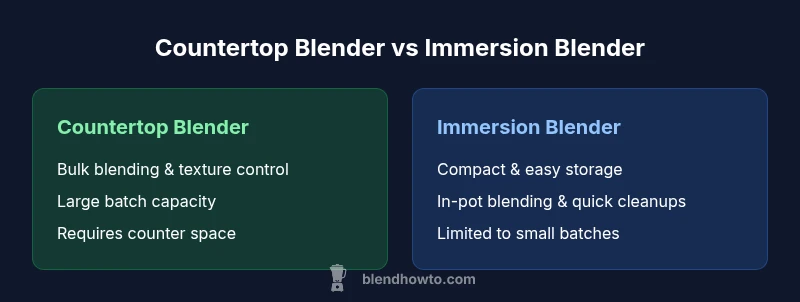
- Powerful performance for bulk blending and texture control
- Compact immersion blenders save space and simplify cleanup
- Durable components and attachable accessories improve long-term value
The Bad
- Countertop models require more counter space and cleaning effort
- Immersion blenders may struggle with very dense or large batches
- Upgrades and attachments add cost and complexity
Countertop blenders win for bulk blending and texture control; immersion blenders win for in-pot tasks and compact kitchens.
If you frequently blend large batches or seek consistent textures, prioritize a countertop unit with a strong motor and quality blades. If you want quick in-pot blending with minimal clutter and storage, an immersion blender is the better fit. In many kitchens, having both covers a broader range of tasks with less friction.
Frequently Asked Questions
Which blender is better for smoothies, countertop or immersion?
For smoothies, a countertop blender generally provides faster, smoother results due to higher power and blade efficiency, especially with frozen ingredients. An immersion blender can work for small batches but may require more effort to achieve the same texture.
For smoothies, go with a countertop blender for the best texture. Immersion blenders work better for small batches.
Are immersion blenders good for hot soups?
Yes. Immersion blenders excel at blending hot soups directly in the pot without transferring to a separate container. Just be careful with steam and heat buildup, using a vented lid and gradual blending.
Great for hot soups in the pot; just be careful with steam.
Do expensive blenders justify the price?
Value depends on how often you blend and the textures you require. Higher-end countertop models offer durability and speed, while budget options can cover many common tasks successfully.
It depends on how often you blend and the textures you need.
Which blender is easier to clean?
Immersion blenders are typically easier to clean because they have fewer parts. Countertop models require washing the pitcher and lid, though many parts are dishwasher-safe.
Immersion blenders are usually easier to clean.
What should I look for if I have limited counter space?
Choose a compact immersion blender or a small countertop model with a slim pitcher. Measure height, width, and depth to ensure it fits your storage area.
If space is tight, go for an immersion blender or a compact countertop model.
Is a high-powered blender necessary for ice crushing?
For effective ice crushing, you want a blender with good torque and a blade designed for dense ingredients. Many mid-range countertop models handle ice well; immersion blenders are less ideal for large ice batches.
You need solid torque for ice—countertop models often handle it better.
What to Remember
- Define your primary tasks before buying
- Prioritize power and blade quality for countertop models
- Consider compactness and cleaning ease for immersion models
- Factor warranty and attachments into total value
- Aim for a versatile setup that fits your kitchen and routine