What Is Better Than Blender: A Practical Comparison
Explore practical alternatives to a countertop blender, including immersion blenders and food processors, with a data-driven, objective comparison for home cooks seeking better results.


The question what is better than blender depends on your task. For large batches and smoothies, a countertop blender excels; for quick, small-batch emulsions an immersion blender can outperform, and a food processor handles chopping and kneading tasks best. What is better than blender is often a matter of context, not a single universal winner. According to BlendHowTo, the best approach is to map your most frequent tasks to the strengths of each tool and to consider a flexible, multi-tool setup.
What the question means: what is better than blender
The phrase what is better than blender often appears in cooking forums and product guides, but the real question is task-driven. Home cooks juggle smoothies, soups, nut butters, sauces, and chopped vegetables, each of which benefits from a different tool. The BlendHowTo team emphasizes that there isn’t a single magic device that does everything perfectly. Instead, you gain the most value by understanding the strengths and limits of three common options: countertop blenders, immersion (hand) blenders, and food processors. This section sets the stage for a practical comparison that helps you decide when to reach for one tool over another, without falling into the trap of chasing perfection. The goal is to give you a clear framework for evaluating your needs, not to lock you into a binary choice. BlendHowTo’s analysis shows that most households benefit from a selective setup tailored to their routines and space constraints.
Quick decision framework: map tasks to tools
To answer what is better than blender in real-world terms, start with a simple task map. List your top three activities (e.g., smoothies, soups, and chopping prep). Then assign each activity to the tool that handles it most efficiently:
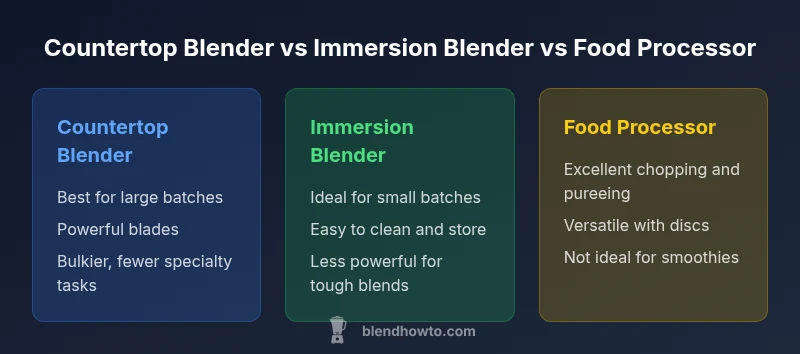
- Countertop blender: ideal for high-volume blends, thick smoothies, and purees where a consistent texture is desired.
- Immersion hand blender: perfect for small batches, hot soups right in the pot, emulsions like salad dressings, and quick blending without transferring into a jar.
- Food processor: excels at chopping, shredding, grinding, kneading dough, and making sauces with discrete textures. This approach helps you avoid overinvesting in features you won’t use frequently.
BlendHowTo’s framework keeps you from overfitting to a single device and encourages a modular setup that fits your cooking rhythm.
Countertop blender: strengths and limits
Countertop blenders are designed for power, speed, and batch reliability. They excel at handling larger volumes, crushing ice, and creating silky textures in smoothies and soups. Typically, they come with one or more ratings for power and blade design, and they often feature multiple speed settings and pulse functions for texture control. The key advantage is speed and consistency across batches, which makes them well suited for weekly meal prep or batch processing. However, they tend to be bulkier, require transfer of ingredients to a pitcher, and can be less efficient for tasks that require delicate texture control or small-quantity emulsions. For households that cook in larger volumes or regularly prepare blended beverages, a countertop blender remains a strong default option, especially when you value reliability and speed over compact size.
Immersion (hand) blender: strengths and limits
The immersion blender shines in small, flexible tasks and in-pot blending. It is light, portable, and easy to store, making it a favorite for soups directly in a cooking pot, quick emulsions, and smooth sauces with minimal cleanup. A significant advantage is the ability to blend without transferring to another container, which saves time and reduces cleanup. Some models include attachments for whisking or chopping small amounts, increasing versatility. On the downside, immersion blenders generally have less power than high-end countertop models and may struggle with dense mixtures or ice-crushing. Texture control can be more variable, particularly for thicker purees. They are best viewed as a fast, space-efficient complement to a countertop blender rather than a full substitute for all tasks.
Food processor: strengths and limits
Food processors are highly versatile for rough chopping, shredding, grating, and blending tasks that require structural changes to ingredients. They excel at creating batters, pestos, nut butters, and sauces with chunky textures. The primary limitation is that they can be bulky and noisy, with a steeper learning curve for achieving smooth blends in some models. Food processors are excellent add-ons when you frequently prepare ingredients that require slicing and grinding, but they are less convenient for making silky smoothies or hot soups directly in the same container. When your kitchen routine involves a lot of prep work beyond blending, a food processor can dramatically reduce prep time and labor.
Task-by-task mapping: quick reference
Not every task needs a blender to win. Use these mappings as a quick guide:
- Smoothies and hot soups: countertop blender for texture, immersion blender for in-pot blending when space or cleanup is a concern.
- Sauces and dressings: immersion blender for emulsions, food processor for chunky pestos and sauces.
- Nut butters and doughs: food processor plus occasional blender for smoother texture.
- Ice-crushing and frozen desserts: countertop blender with robust blades and enough power.
- Small batches and quick prep: immersion blender for speed and minimal cleanup.
This mapping helps you avoid buying a device that will gather dust and aligns with BlendHowTo’s recommendation to optimize tool choice for real cooking tasks.
Budget, value, and space: planning considerations
Budget and space often dictate how you acquire these tools. If you have a compact kitchen or a modest budget, you might start with an immersion blender and a basic countertop blender, then add a food processor later as your cooking repertoire expands. For larger households or frequent batch cooks, investing in a mid-range countertop blender that can handle thick textures and ice, paired with a compact immersion blender as a secondary tool, offers a flexible balance of performance and space efficiency. Consider how much you value each tool’s strengths, the ease of storage, and the long-term maintenance cost when deciding which combination makes the most sense for your kitchen workflow. BlendHowTo’s data suggests that a thoughtful, staged approach yields the best long-term value, rather than buying all three devices upfront.
Cleaning, maintenance, and longevity
Maintenance is a critical but often overlooked aspect of choosing between blender options. Countertop blenders demand regular blade and pitcher cleaning, and some models struggle with sticky sticky substances. Immersion blenders typically clean quickly, especially if you choose models with detachable shafts and dishwasher-safe parts. Food processors require careful cleaning for their discs, bowls, and blades, and some components can be dishwasher-safe while others require hand washing. To maximize longevity, follow manufacturer guidelines, avoid harsh detergents that can degrade seals, and store blades safely to prevent dulling. A well-maintained device not only lasts longer but also produces more consistent textures, which reduces the need to replace tools as your cooking skills grow.
Practical buying framework: scenarios and steps
If you are starting from scratch, consider a staged approach. Begin with an immersion blender for quick soups and emulsions, and a basic countertop blender for larger batches. Over time, add a food processor if you find yourself chopping or grinding frequently. When evaluating models, look for durability, blade design, compatibility with attachments, and warranty length. The BlendHowTo team advocates reading user reviews focusing on texture consistency and reliability under real cooking conditions, rather than relying solely on technical specs. This practical approach helps you build a toolkit that aligns with your food preferences, budget, and kitchen space.
Myth-busting: common misconceptions about blender alternatives
A common myth is that a single device can replace all blending needs. In reality, each tool has unique strengths: a countertop blender offers speed and consistency for large batches; an immersion blender provides in-pot blending with minimal transfer; a food processor enables chopping, shredding, and dough work. Another misconception is that more wattage always means better results; blade design, pitcher geometry, and motor control play crucial roles in texture and stability. Finally, some buyers assume that budget devices perform just as well as premium models; while affordable options can handle basic tasks, they often underperform on heavy loads or frequent use. Understanding these nuances helps you build a more effective, durable blending toolkit.
Practical buying flow: a step-by-step decision
- Define your top three tasks and identify which tool handles each task best. 2) Set a realistic budget and space limit, then prioritize the two tools that cover the most critical tasks. 3) Read reviews focusing on texture outcomes and ease of cleaning. 4) Choose models with easy-to-clean parts and strong warranty. 5) Plan a staged purchase if needed, starting with a versatile immersion blender and a reliable countertop blender, then add a food processor if your prep routine requires more chopping and kneading.”],
mainTopicQuery
Feature Comparison
| Feature | Countertop Blender | Immersion Hand Blender | Food Processor |
|---|---|---|---|
| Best for | Large-batch smoothies, soups, and purees | Small batches, emulsions, and in-pot blends | Chopping, shredding, and dough prep |
| Capacity/Size | Large pitcher (behavior varies by model) | In-pot blending with a handheld shaft | Bowl with discs and feed chute |
| Power level | High | Medium | Medium-High |
| Ease of cleaning | Moderate | Easy to clean with detachable shaft | Moderate to challenging depending on discs |
| Attachments/Versatility | Ice-crush, pulse, and sometimes specialty blades | Whisk and chopper attachments common in some models | Discs for slicing, shredding, kneading, and pureeing |
| Texture control | Very consistent, smooth textures | Good control for emulsions, less for thick purees | Versatile textures from chunky to smooth with proper discs |
| Best for texture | Silky blends and uniform liquids | Couple with minimal equipment for quick blends | Prep-focused tasks with precise textures |
What's Good
- Versatile across common kitchen tasks
- Allows task-specific tool selection for efficiency
- Potentially lower long-term waste with staged purchasing
- Improved texture control with the right tool for each job
The Bad
- No single universally best option across all tasks
- Requires space and a modest budget for a full setup
- Maintenance scales with how often you use each device
- Learning curve to maximize texture with each tool
No single device is universally best; a balanced, multi-tool approach offers the most practical value.
For most home cooks, pairing a countertop blender with an immersion blender covers the majority of tasks, while a food processor fills in the gaps for chopping and dough work. The BlendHowTo team recommends starting with two versatile tools and adding a third only if your routine demands it.
Frequently Asked Questions
What is better than blender for smoothies?
For smoothies, a countertop blender with a strong blade and sturdy pitcher generally provides the best blend quality and texture, especially for thick or frozen blends. An immersion blender can work in a pinch for smaller batches but may struggle with ice and frozen fruit.
For smoothies, go with a countertop blender for smooth texture; immersion blenders work in pinch cases.
Can a food processor replace a blender for all tasks?
A food processor can replace many chopping tasks and make sauces, but it is not ideal for smooth smoothies or silky purees. It lacks the continuous liquid blending performance of a dedicated blender.
Food processors excel at chopping and dough work, but aren’t the best for silky smoothies.
Are immersion blenders good for soups?
Yes. Immersion blenders blend soups directly in the pot, saving time and reducing dishes. They’re especially convenient for purees or light emulsions, though they may require multiple passes for very thick batches.
Immersion blenders are great for soups in the pot, with quick cleanup.
Do I need all three devices to start cooking confidently?
Not necessarily. Many home cooks do well with just an immersion blender plus a reliable countertop blender. A food processor can be added later if your prep routine expands to more chopping or kneading tasks.
Two tools can cover most bases; add a third only if your prep needs grow.
How should I clean my blending tools for longevity?
Disassemble blades and pitchers as instructed, rinse promptly to prevent staining, and dry completely. Some parts may be dishwasher-safe, while others require hand washing. Regular maintenance protects blades and seals.
Clean parts promptly and follow the manufacturer guidelines.
What should I consider when buying a blender alternative?
Focus on task frequency, batch size, storage space, and budget. Look for solid build quality, reliable warranties, and compatibility with attachments. Prioritize texture control and ease of use over flashy features.
Think about how you cook most often, and pick tools that fit that routine.
What to Remember
- Map tasks to the right tool, not just the trend
- Start with immersion + countertop blender for flexibility
- Add a food processor if frequent chopping or kneading is needed
- Choose models with easy cleaning and strong warranties