What Beats Blender: Immersion vs Countertop Blenders
A rigorous, analytical comparison of immersion blenders, countertop blenders, high‑performance models, and related tools to determine which setup beats blender for smoothies, soups, sauces, and bulk blends.


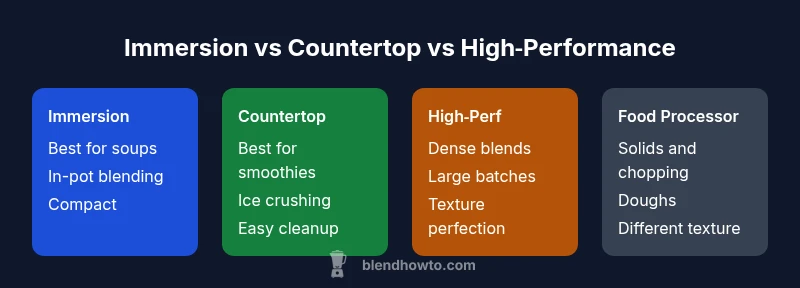
Short answer: Immersion blenders excel for soups, purées, and direct blending in pots; countertop blenders are ideal for smoothies, ice blends, and quick purées; high‑performance blenders tackle dense blends, nut butters, and large batches. The best choice hinges on your most common tasks, kitchen space, and budget. In practice, many homes benefit from a two‑tool approach rather than a single all‑rounder.
Understanding what beats blender
The phrase what beats blender captures a core buying question: which tool actually does better, and in which situations? In kitchen practice, the answer is task oriented, not brand oriented. According to BlendHowTo, the optimal setup often depends on the type of blending you do most—liquids and emulsions, frozen and thick blends, or dense purées. Recognizing your frequent tasks is the first step toward a practical, durable solution.
In this guide we’ll unpack how to assess blender options using objective criteria, compare three core tool families, and offer a decision framework you can apply in your own kitchen. The goal is to help you avoid overbuying and to select equipment that delivers real value for your day‑to‑day cooking while remaining adaptable as needs evolve.
Core criteria that differentiate blender options
Several factors consistently separate good from great performers across immersion, countertop, and high‑performance blenders. Power and blade geometry determine how well a device handles ice, greens, and dense ingredients. Jar design and capacity influence how much you can blend in one go and how easy cleanup will be. Build quality and ease of maintenance affect long‑term reliability and user satisfaction. Finally, price to performance and the availability of replacement parts shape total ownership cost over time. Understanding how these criteria interact helps you map tasks to the right tool rather than chasing a single universal device.
BlendHowTo’s analysis shows that the right decision is rarely binary. Instead, you’ll find a practical rule: match the tool to the typical task, then add a second tool if your workload grows or diversifies.
Immersion blender: strengths and limitations
Immersion blenders, also known as hand blenders, shine when you need to blend directly in a pot, dish, or pitcher. They excel at soups, sauces, and emulsions without transferring hot liquids to a separate container. For tasks like puréeing vegetables in the cooking vessel, the immersion approach minimizes transfer steps and reduces cleanup time. Modern models also include attachments that expand capabilities, such as whisking and chopping, which broadens their usefulness. However, immersion blenders struggle with very thick or chunky blends and are less efficient at creating ultra‑smooth textures when compared to a full blender jug. They also require careful technique to avoid splashing and hotspots.
In small kitchens, the compact footprint of an immersion blender is a substantial advantage. For quick, one‑pot blends, it can be the most practical choice. Yet if you frequently blend large batches or want ultra‑creamy smoothies, you may pair it with a countertop or high‑performance option for best results.
Countertop blender: strengths and limitations
Countertop blenders are designed for versatility and convenience. They handle smoothies, frozen drinks, purees, sauces, and light blends with predictable results. The primary advantages are a stable pitcher, built‑in controls, and the ability to produce smooth textures with minimal effort. They are especially effective for ice crushing and blending soft ingredients into a uniform texture. On the downside, some models struggle with very thick mixtures or require pre‑cut ingredients to achieve consistent results. Cleaning can be more involved when the jar, blade, and lid components are multiple parts.
For households that prioritize batch preparation or frequent beverage making, a countertop blender often becomes the workhorse. When simplicity and speed matter, it’s a strong default choice. To maximize value, choose a model with dishwasher‑safe parts and an appropriate pitcher capacity that matches your typical batch size.
High‑performance blenders: when bigger beats smaller
High‑performance blenders push the envelope with higher torque, more blades, and rugged jars designed for dense, fibrous, or frozen ingredients. They excel at tough blends such as nut butters, almond milk, thick sauces, and large batches. The advantages include very smooth textures and faster processing with fewer passes. The tradeoffs are higher upfront cost, larger footprints, and more noise. For frequent heavy use, the long‑term time savings and texture quality can justify the investment.
If you routinely blend tough ingredients, or you need to process large quantities in one go, a high‑powered model becomes a clear winner. For casual users, the additional capability may exceed what you need, and you may achieve excellent results with a well‑chosen immersion or countertop option.
How to decide: task matching and practical tactics
A practical approach starts with listing your top three tasks (eg, smoothies, soups, sauces). Then map each task to the most efficient tool. For soups and emulsions in the pot, start with an immersion blender and assess the need for a second tool. For beverages and frozen blends, the countertop blender is typically preferred. If you blend dense ingredients or cook large batches weekly, a high‑performance model can be the best long‑term investment. Finally, remember that many cooks succeed with a two‑tool setup: one immersion blender for in‑pot blending and one countertop or high‑performance unit for everything else. This approach minimizes compromises, maximizes texture, and keeps options flexible.
Cleaning, maintenance, and lifecycle considerations
Maintenance is a critical but often overlooked part of the decision. Immersion blenders typically require quick cleaning after use and are easy to store, with blades that can be exposed during rinsing. Countertop blenders demand thorough washing of the pitcher, lid, and blade assembly; modern models often offer dishwasher‑safe components which eases routine upkeep. High‑performance blenders, while robust, involve more parts and longer cleaning cycles. Longevity depends on how you use the appliance, how aggressively you clean it, and the availability of replacement parts. Consider model availability, warranty terms, and replacement blade options to extend the device’s useful life.
Price, value, and ownership dynamics
Price dynamics for blender types vary by brand, capacity, and power. Entry‑level immersion blenders are affordable and provide essential functionality, while compact countertop models offer a broad feature set at moderate prices. High‑performance blenders command premium pricing but deliver superior texture and batch capacity. When evaluating value, consider not only upfront cost but also long‑term reliability, replacement parts, and energy usage. Listings often show a wide price range; use it to benchmark what you truly need rather than chasing the highest spec. A well‑matched two‑tool setup often yields better day‑to‑day outcomes than a single, ultra‑capable device.
Real‑world usage scenarios and decision guides
Scenario A: You blend smoothies daily and occasionally make thick sauces. A countertop blender paired with an immersion blender gives quick beverage results and in‑pot blending without extra transfers. Scenario B: You prep batches for a family and commonly blend nut butters or dense sauces. A high‑performance blender becomes the core investment, complemented by a smaller immersion blender for in‑pot emulsions. Scenario C: You live in a small apartment and want one compact device that covers most needs. A high‑quality immersion blender with solid attachments can cover many tasks, but you may still benefit from a secondary countertop unit for ice and frozen blends.
Each scenario demonstrates that a flexible, task‑driven approach outperforms a single, all‑round device. BlendHowTo’s framework emphasizes matching tasks to tools, reaping better results with less frustration.
Quick‑start evaluation checklist for your kitchen
Feature Comparison
| Feature | Immersion Blender | Countertop Blender | High-Performance Blender | Food Processor |
|---|---|---|---|---|
| Best for | Soups, purées in pot, emulsions | Beverages, ice, purees | Dense blends, nut butters, large batches | Chopping and doughs (not purees) |
| Power range | Low–mid | Mid–high | Very high | Mid |
| Ease of cleaning | Moderate (blade exposure; some models dishwasher-safe) | Moderate (dishwasher-safe parts) | Moderate (multi-part; multiple blades) | Moderate to high (blade assembly; parts separate) |
| Versatility | Great for liquids and light solids | Good for liquids and soft solids | Top tier for tough blends | Best for solids prep |
| Price range | $20-$150 | $40-$300 | $350-$800 | $100-$500 |
| Best for small kitchens | Yes with compact accessories | Yes if space allows | Yes for power; may be bulky | Yes if you need chopping and dough handling |
What's Good
- Clear task specialization reduces clutter
- Fast, reliable results for liquids and emulsions
- Compact options suit small kitchens and storage
- Can be more affordable upfront for entry models
- Dishwasher-safe parts simplify maintenance
The Bad
- Specialized tools may not fully replace other devices
- Immersion blenders struggle with very thick or chunky blends
- Countertop models can be bulky and harder to clean fully
- High‑performance units are expensive and noisy
- Some tasks require multiple parts or attachments
Pair tools by task: immersion for soups, countertop for beverages, and high‑performance for dense blends.
A two‑tool approach often beats relying on a single blender. Match your primary tasks to the best tool, and add a secondary device for tasks that demand more power or batch capacity. This balances performance, cost, and practicality in daily cooking.
Frequently Asked Questions
Which blender is best for smoothies?
For smoothies, a countertop blender with sufficient power and a wide pitcher typically delivers the best texture with minimal effort. If space or budget are tight, a high‑quality immersion blender with an appropriate attachment can also handle smoothies, but results may vary.
For smoothies, go with a good countertop model with a sturdy pitcher; immersion blenders can do it, but you may need to blend in batches.
Can immersion blenders handle hot soups safely?
Yes. Immersion blenders are designed for blending directly in hot pots, which minimizes transfers and helps maintain flavor. Use caution, keep the blender submersed and blend in short bursts to avoid splashes.
Absolutely—just be careful with heat and keep the blades under the surface when blending hot liquids.
Are food processors a substitute for blenders?
Food processors excel at chopping, shredding, and doughs but are less effective for creating smooth purees or beverages. They can supplement a blender setup, but rarely replace one for beverages or silky emulsions.
Food processors aren’t perfect stand-ins for blenders; they’re great for solids, but not the same texture you get from a blender.
Is cleaning easier for immersion or countertop units?
Immersion blenders are quick to rinse and rinse clean in most cases, especially with detachable blades. Countertop models require washing the pitcher, lid, and blade assembly, which takes a little longer but is straightforward.
Immersion blenders clean up fast; countertop models need a bit more washing, but parts are often dishwasher safe.
Do high‑performance blenders justify the price?
If you blend dense ingredients often or run large batches, a high‑performance blender can pay off in texture quality and time saved. For casual use, mid‑range models often provide ample capability.
Only buy high‑performance if you use it a lot for tough blends; otherwise a solid mid‑range model usually suffices.
How loud are these appliances and does size matter?
Noise levels vary by model and task; immersion blenders tend to be quieter in direct use, while high‑performance units can be louder. Size matters less for immersion units but can impact storage and countertop space for larger blenders.
Yes, noise and footprint matter—choose according to your kitchen size and tolerance for sound during blending.
What to Remember
- Match task to tool to beat blender in practice
- Immersion blenders excel in in‑pot blending and quick cleanup
- Countertop blenders shine for smoothies, ice, and fast purées
- High‑performance blenders are worth it for heavy, dense blends
- Consider a two‑tool setup for most households