Blender vs Immersion Blender: A Practical Side-by-Side Guide
Compare countertop blenders and immersion blenders to decide which tool fits smoothies, soups, and sauces, with practical guidance from BlendHowTo for everyday cooking.


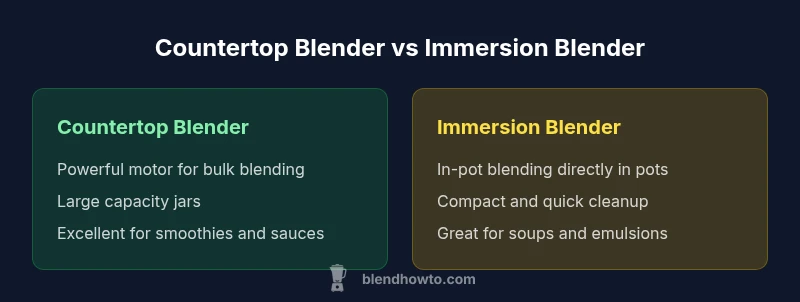
In the blender vs immersion blender decision, your batch size, task type, and cleanup needs largely drive the choice. For bulk blending, a countertop blender shines with power and texture, while an immersion blender excels for quick, in-pot work and easy cleanup. Understanding how each tool fits your kitchen workflow helps you invest wisely in a single or two complementary devices.
What blender vs immersion blender mean and why the distinction matters
In the blender vs immersion blender debate, the distinction matters because the way you prepare ingredients influences the ideal tool. A countertop blender uses a fixed jar and a high-speed motor to spin blades for bulk batches, delivering smooth textures quickly. An immersion blender is handheld, with a slender shaft and blades, designed for in-pot blending and quick work directly in pots, bowls, or cups. Understanding these core differences helps you choose based on typical recipes, available space, and how you like to cook. In everyday kitchen workflows, you may even find that a single recipe is best achieved with different methods, but most households will gravitate toward one primary tool to reduce clutter and maintenance.
Core capabilities: power, blades, control
Power and blade design drive outcomes with both tools, but they approach control differently. Countertop blenders typically feature a high-wattage motor and a multi-purpose blade assembly designed for ice crushing, frozen fruit, and silky sauces. They offer precise speed control, often with preset programs, which helps achieve consistent texture across large batches. Immersion blenders rely on a compact, inline motor and a detachable shaft with blades optimized for direct blending in a pot or tall vessel. They provide variable speeds and sometimes a turbo function for short bursts. The key is to pair the tool with the task: high torque at controlled speeds for robust textures, or fast, in-pot blending for quick emulsions.
Tasks best suited for a countertop blender
Countertop blenders are the workhorse for bulk blending. They excel at smoothies with ice and frozen fruit, hot soups whisked to a velvety finish, nut butters, and emulsified sauces like pesto or hummus. If you routinely prepare large batches for family meals or meal-prep sessions, a countertop model reduces time and ensures uniform texture. The downside is the larger footprint and the need to transfer ingredients to a jar, which adds an extra step when your workflow emphasizes speed. For recipes requiring strict texture control or uniform particle size, the countertop blender’s predictable performance is a strong asset.
Tasks best suited for an immersion blender
Immersion blenders shine in scenarios where you want minimal equipment or direct work in a pot. They are ideal for pureeing soups right in the cooking vessel, emulsifying dressings and mayonnaise, and making quick sauces with little cleanup. Their portable design makes them handy for single-portion blends or small batches, and they’re easy to store in a drawer. However, they struggle with very thick mixtures or large volumes, and achieving perfectly smooth textures across big batches is typically more challenging than with a countertop blender.
Batch size, texture, and consistency considerations
Batch size is the defining factor: larger batches favor a countertop blender for even texture and efficient processing, while smaller, in-pot tasks favor an immersion blender for speed and convenience. Texture goals matter too; delicate emulsions may require a controlled, steady blend that a countertop model can provide, whereas quick soups and sauces benefit from the immersion blender’s ability to blend directly in the pot without transferring hot liquids. If you often switch between tasks, consider a hybrid setup that prioritizes your most frequent use and reserves a secondary tool for niche jobs.
Cleaning and maintenance: ease vs. complexity
Cleaning requirements influence long-term satisfaction. Countertop blenders involve washing the jar, blade assembly, and lid, with some models featuring dishwasher-safe components. They can be thorough but take more time to reassemble after cleaning. Immersion blenders typically have fewer parts, with a detachable shaft that rinses quickly and a compact motor unit that’s easy to wipe. However, some models require careful drying of the motor unit to prevent moisture ingress. Choosing a model with simple disassembly and dishwasher-protected parts can make maintenance a non-issue in everyday cooking.
Ergonomics, storage, and space planning
Ergonomics matters because comfortable handling reduces fatigue during long blending sessions. Immersion blenders should feel balanced in the hand, with a grip that stays cool to the touch during extended use. Countertop blenders, conversely, demand bench space and a stable base. If your kitchen has limited storage, an immersion blender’s compact form can be a major advantage, while a larger countertop model might need a dedicated shelf or cabinet. Consider also cord length, as a long cord can be a nuisance on a crowded counter.
Durability, reliability, and long-term value
Durability varies by price and construction. High-quality countertop blenders with reinforced jars and robust blades tend to last many years with minimal wear, making them a good long-term investment for frequent users. Immersion blenders tend to be reliable for routine tasks but may experience motor or shaft wear with heavy, continuous use. In both cases, warranties and replacement part availability matter. A model with easily replaceable blades and a service-friendly design offers better long-term value for busy home cooks and hobbyists.
Noise, materials, and heat considerations
Noise is a practical concern in shared kitchens. Countertop blenders can be louder due to high-speed motors, especially when blending frozen ingredients or ice. Immersion blenders are typically quieter but can hum loudly when operating at higher power. Material quality also affects durability and safety; BPA-free jars and stainless steel blades are common signals of a quality build. Heat generation is more relevant for long blending sessions; some blenders are better cooled or have pulse modes to manage heat buildup during tough blends.
Real-world recipes and workflow examples
A typical workflow might involve a countertop blender to prepare a large batch of smoothie bases, then transferring to jars for portioning. For a hot soup, you might start with sautéed vegetables in a pot and finish the texture with an immersion blender directly in the pot. If you’re making a pesto or sauce, a countertop blender can deliver smoother emulsions in big batches, while an immersion blender can converge textures quickly when your pot is already hot. Recording your results helps refine texture targets and tool choice over time.
Hybrid solutions and accessories worth considering
Some households benefit from owning both tools, supplemented by a versatile accessory kit. Look for a blender with a sturdy jar, a wide mouth for easy loading, and a shaft that fits directly into your pot or container. Accessories such as splash guards, tall mixing cups, and extra blades extend versatility. If space is tight, prioritize a high-powered immersion blender with a robust whisk attachment for emulsions and lighter duties, and reserve the countertop model for heavy blending tasks.
How to choose: a practical decision framework
Start by listing your top three tasks (e.g., smoothies, soups, sauces). Then estimate typical batch sizes for each task and weigh the time saved with a countertop blender versus the convenience of in-pot blending. Consider storage space and cleanup time in your daily rhythm. Finally, evaluate budget and warranty: investing in a durable countertop model with a long warranty can pay off for frequent users, while a reliable immersion blender with a solid warranty suits lighter or more space-constrained needs. The decision framework should prioritize your most common tasks and the impact on your kitchen workflow.
Authority sources
- https://www.consumerreports.org/cookware/blenders/ (Independent product testing of kitchen blenders)
- https://extension.oregonstate.edu (Kitchen appliance tips and maintenance guidance)
- https://www.nytimes.com/section/food (Major publication with practical cooking guidance)
Comparison
| Feature | Countertop Blender | Immersion Blender |
|---|---|---|
| Power & Motor Size | Typically higher wattage and motor size in countertop blenders | Inline motor in immersion blenders with lower wattage |
| Blade Design | Fixed, jar-bound blades for bulk blending | Detachable shaft blades optimized for in-pot blending |
| Control & Precision | Dial or presets for consistent texture | Manual controls with variable speeds and turbo |
| Capacity & Batch Size | Large jars (32-64 oz) for bulk processing | Small cups or direct-in-pot blending in tall vessels |
| In-pot Blending | Requires transferring ingredients to a jar | Designed for in-pot blending directly in pots |
| Cleaning | Jar, lid, blade assembly; dishwasher-safe options | Shaft and motor unit; quick rinse; fewer parts |
| Cost Range | Mid-to-high range depending on features | Low-to-mid range; economical entry options |
| Best For | Bulk smoothies, sauces, ice crushing | Soups, emulsions, quick purees, hot foods |
What's Good
- Versatile for a wide range of recipes and textures
- Excellent for bulk blending and consistent results
- Easy to clean when parts are dishwasher-safe
- Immersion blenders save counter space and allow in-pot blending
The Bad
- Countertop models can be bulky and noisy
- Immersion blenders struggle with large volumes and very thick mixtures
- Long-term reliability depends on build quality and price point
Countertop blenders win for bulk blending and texture; immersion blenders win for quick, in-pot tasks and space-saving versatility
Choose a countertop blender if you frequently blend large batches or require ultra-smooth textures. Opt for an immersion blender if you prioritize convenience, in-pot blending, and minimal cleanup. For some kitchens, a hybrid setup offers the best of both worlds.
Frequently Asked Questions
What is the main difference between a blender and an immersion blender?
A countertop blender uses a fixed jar and a high-speed motor for bulk blending, delivering smooth textures. An immersion blender is handheld with a shaft for direct blending in pots, bowls, or cups, ideal for quick tasks. The difference comes down to capacity, control, and where you blend.
The big difference is that countertop blenders blend in a jar, great for big batches, while immersion blenders blend directly in the pot for quick tasks.
Can I use an immersion blender for smoothies?
Immersion blenders can make smaller smoothies, but they often struggle with large ice volumes and may not achieve the same silkiness as a countertop blender. They’re best for quick blends or single servings.
Yes, but you’ll likely get better texture with a countertop blender for regular smoothies.
Is it better to buy both or just one?
If your recipes demand both bulk blending and in-pot work, a two-tool setup makes sense. Otherwise, choose the tool that covers your most frequent tasks and leaves room for occasional exceptions.
Many people end up with one versatile tool, but a second, purpose-built option can save time.
What should I look for when buying a blender?
Look for motor power, blade design, jar material, capacity, ease of cleaning, warranty, and accessibility of replacement parts. A durable build and good customer support often matter more than the sticker price.
Powerful, well-built models with good warranties are worth investing in.
Do professionals prefer one type over the other?
Experts choose based on task: countertop blenders for large batches and consistent texture, immersion blenders for quick, direct blending in pots. Many professionals keep both to cover different workflows.
Pro kitchens often rely on both tools depending on the dish.
Are there any common myths about blenders?
A common myth is that higher price always means better texture. In reality, suitability for your tasks, build quality, and how you use the tool matter more than the price tag.
Price isn’t the sole indicator of performance; task fit matters.
What to Remember
- Assess typical batch sizes to guide your choice.
- Consider in-pot blending needs for soups and sauces.
- Factor storage space and cleanup time into decisions.
- Weigh upfront cost against long-term durability and task variety.