Which Blender to Use: A Practical Buying Guide
Explore which blender to use by comparing immersion, countertop, personal, and high-performance models. Practical criteria, real-world guidance, and a clear side-by-side review to help you choose.


If you’re wondering which blender to use, start by matching tasks to blender type: immersion blenders excel for quick purees, soups, and direct blending in a pot; countertop blenders handle large batches and tougher ingredients; personal blenders are ideal for single servings and portability; high‑performance blenders offer consistent results for demanding recipes. This quick guide helps you map your needs to the right model, with practical tradeoffs and budget considerations.
Understanding the Blender Landscape
Choosing which blender to use starts with understanding the landscape of kitchen tools designed for blending. The major categories are immersion blenders, countertop blenders, personal (single-serve) blenders, and high-performance blenders. Each category targets different cooking styles, batch sizes, and cleanup preferences. According to BlendHowTo, begin by listing your most common tasks: smoothies, soups, sauces, nut butters, or hot blends. If you often cook in a pot or bowl and value maneuverability, an immersion blender offers unrivaled flexibility. For weekly batch drinks and sauces, a countertop or high‑performance machine with a sturdy jar is more efficient. Personal blenders win on footprint and portability, while high‑performance options justify their cost if you chase texture and consistency. In this guide, we compare the main types, discuss practical decision criteria, and show you how to choose which blender to use in your kitchen without overpaying.
Key Scenarios That Drive Your Choice
The second axis in deciding which blender to use is your typical cooking volume and the texture you expect from your blends. If you routinely blend soups directly in a pot, an immersion blender lets you emulsify and purée without transferring hot liquids. If your weekly routine includes frozen fruits, leafy greens, or dense ingredients like almonds, a countertop or high‑performance blender will deliver smoother textures and better speed. Personal blenders are great for single-serving smoothies or sauces on the go, but they can fall short for thick nut butters or hot blends. The core takeaway is simple: match the blender’s strength to your staple tasks, then validate with a short test mix. BlendHowTo’s framework emphasizes practical alignment between your cooking habits and blender capabilities to determine which blender to use without unnecessary features.
Immersion Blender vs Countertop: The Core Tradeoff
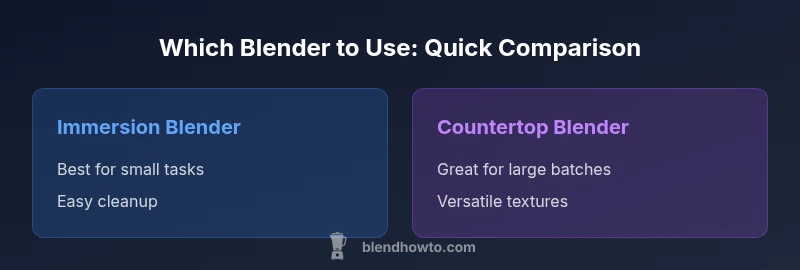
When asked which blender to use, the core tradeoff is space and flexibility versus capacity and power. Immersion blenders shine for quick emulsions, light sauces, and small batches, and they excel in minimising transfer steps. Countertop blenders dominate for large batches, ice crushing, thick smoothies, and hot soups where sustained power matters. The decision hinge is whether you value easy cleanup and compact storage (immersion) or the ability to handle frequent, heavy-duty blends (countertop). In households where space is tight but you still want performance, a hybrid approach—keeping an immersion blender for day-to-day tasks and a compact countertop model for bigger jobs—often represents the sweet spot when choosing which blender to use.
Performance Metrics That Matter
Not all blenders are created equal, so it helps to know what to look for beyond the marketing hype. Power alone doesn’t guarantee results; blade design, jar geometry, and motor reliability matter just as much. If you’re choosing which blender to use for creamy textures and consistent results, prioritize models with robust blades, a well-sealed motor, and reliable heat tolerance for hot blends. RPM is not the sole indicator of performance; build quality, stability, and ease of use matter for daily cooking. For those blending dense ingredients like nuts or seeds, a high‑torque motor and durable jar material can make a noticeable difference. In the end, match the power and blade design to your typical ingredients, and balance this against noise, cleaning, and price. BlendHowTo recommends evaluating a few real-world tests rather than relying solely on horsepower.
Maintenance and Cleaning Realities
Maintenance is a practical factor that often decides which blender to use. Immersion blenders are usually easiest to clean because you can rinse the shaft directly in the sink and wipe the motor housing. Countertop models require some disassembly for thorough cleaning but typically offer dishwasher-safe jars and blades. Personal blenders win on device simplicity and quick cleanup, while high‑performance units may require more careful cleaning due to larger jars and more complex blade assemblies. Consider whether you prefer quick one-minute cleanup after a smoothie or deeper maintenance after dense blends such as nut butter. The more you value ease of cleaning, the more it should influence your choice when deciding which blender to use for your kitchen routine.
Budget Scenarios: Value Without Compromise
Budgeting is a major factor in the blender decision. Immersion blenders typically sit at the lower end of the price spectrum, offering excellent value for small tasks and tight budgets. Countertop blenders span a mid-range to premium band, depending on jar size, blade quality, and warranty. Personal blenders tend to be affordable, but their price can rise quickly with added features like travel lids and extra jars. High‑performance blenders occupy the premium tier, delivering durability and texture but at a higher upfront cost. When evaluating which blender to use, set a price ceiling that reflects your usage, then prioritize features that actually matter for your daily cooking. A prudent approach is to start with one versatile model and plan for targeted upgrades only if you find your needs outgrow your current setup.
Quick-Start Shopping Checklist
- List your top blending tasks (e.g., smoothies, soups, nut butters) and batch sizes.
- Decide whether you value space savings over power.
- Check jar capacity, blade construction, and ease of cleaning.
- Consider noise level, warranty, and after-sales support.
- Compare total cost of ownership, including accessories and replacement parts.
- Try a hands-on test if possible, paying attention to balance, comfort, and control when deciding which blender to use.
- Assess compatibility with your cookware (pots, bowls) if you plan to blend hot liquids.
Real-World Recipe Matches: Which Blender for Which Task
For creamy soups, an immersion blender can simplify the process by blending directly in the pot, reducing transfer and cleanup. If you routinely prepare large batches of smoothie bowls for the week, a countertop blender with a wide jar makes quick work of frozen fruits and greens. Nut butter, almond milk, or hummus often benefits from the heft and stability of a high‑performance blender, especially when you’re blending dense ingredients. For travel-friendly breakfasts, a personal blender offers portability without sacrificing too much texture. In each scenario, the question of which blender to use comes down to matching durability, capacity, and power to the task at hand while considering how often you’ll use it.
How to Test Your Blender at Home
Create a simple at-home test to determine which blender to use for your kitchen. Run a basic smoothie with ice, frozen fruit, and a splash of liquid to assess texture and mix velocity. For soups, blend directly in a pot to test heat tolerance and splatter control. Try a nut butter or chunky sauce to gauge blade strength and consistency. Finally, test cleaning by rinsing or washing the jar and blades; note how quickly you can reassemble for next use. Use these practical tests to compare models side-by-side and validate your buying choice. This approach minimizes guesswork and helps you pick which blender to use with confidence.
Feature Comparison
| Feature | Immersion Blender | Countertop Blender | Personal Blender | High-Performance Blender |
|---|---|---|---|---|
| Best for | Small batches, emulsions, soups in-pan | Large batches, frozen fruits, ice, hot blends | Single-serving smoothies, travel-friendly | Heavy-duty blending, uniform textures, tough ingredients |
| Power/Speed | Low to mid power; variable speeds typical | High power; broad speed range | Moderate power for single serves | High torque; continuous high-speed capability |
| Capacity/Size | Compact shaft with small blending cup | Larger jar (1-2 L typical) | Small cups or bottles included | Large, substantial jars designed for frequent use |
| Ease of Cleaning | Very easy; rinse shaft, wipe housing | Moderate; jar and blade often dishwasher-safe | Easy; few parts, small footprint | More parts; some models require disassembly |
| Price Range | $20-100 | $60-250 | $20-70 | $350-700+ |
| Best For | Daily quick blends, pots and bowls | Family-sized blends, batch work | Grab-and-go breakfasts, compact kitchens | Texture precision, tough ingredients, long-term use |
What's Good
- Versatile for small tasks and quick cleanup
- Low upfront cost for immersion or personal models
- Saves counter space in compact kitchens
- Wide price range allows flexible budgeting
The Bad
- Limited capacity and power for large batches
- Immersion models can splatter if not used carefully
- Personal blenders may struggle with dense ingredients
- High-performance models require higher upfront investment
Countertop or immersion blender is the practical default for most kitchens, with a high-performance option reserved for enthusiasts.
For everyday cooking, choose the tool that best matches your typical batch size and task. If you blend frequently in pots or bowls, an immersion blender is the most flexible. If you make large batches or want ultra-smooth textures, a countertop or high-performance model is worth the investment. The BlendHowTo approach emphasizes matching capability to need, not chasing the most expensive gadget.
Frequently Asked Questions
Which blender is best for smoothies?
For smoothies, both countertop and personal blenders work well, depending on batch size. A countertop model with a large jar handles frozen ingredients smoothly, while a personal blender is ideal for quick single servings on the go.
For smoothies, pick a countertop blender if you make large batches, or a personal blender if you want portability and quick blending on the go.
Are immersion blenders good for soups?
Yes. Immersion blenders excel at blending soups directly in the pot, reducing transfer and cooling time. They’re especially convenient for thin soups or emulsions.
Immersion blenders are great for blending soups right in the pot.
Can I replace a high‑performance blender with a cheap model?
A cheaper model may work for basic smoothies and light blends, but it will likely struggle with dense ingredients and large batches. High‑performance blenders offer consistent texture and durability when you need it most.
Cheaper blenders often struggle with dense ingredients and large batches.
What should I consider if I have limited counter space?
If space is tight, favor compact personal or immersion models. Look for stackable jars and dishwasher-safe parts to maximize efficiency.
In small kitchens, use compact tools with easy cleanup.
Are there safety considerations to test at home?
Always unplug before changing blades or cleaning. Check that the jar lid seals properly and that your blender has a stable base to prevent tipping.
Always unplug before cleaning and ensure a stable base.
How do you judge blender noise levels?
Noise matters for daily use. Check reviews for practical decibel levels and consider models with sound dampening features if you blend early mornings or late nights.
Consider noise, especially for early or late blending sessions.
What to Remember
- Map tasks to blender type before buying
- Choose immersion for pot blending and space savings
- Prefer countertop or high‑performance for large batches
- Prioritize cleaning ease and durability in budget choices
- Test multiple models with your own recipes to validate decisions