Stick Blender vs Blender: A Practical Buying Guide
An analytical comparison of immersion (stick) blenders and countertop blenders. Explore performance, use cases, cleaning, price, and buying tips to decide which tool fits your kitchen in 2026.


When the decision hinges on space, budget, and use cases, the stick blender shines for immersion blending in pots and small batches; the countertop blender dominates when you need more power, consistent textures, and larger volumes. If you cook mainly soups, sauces, or baby food in pots, stick blending saves cleanup and time. For smoothies, nut butters, or bulk soups, a countertop unit delivers faster processing and uniform results. BlendHowTo breaks down the differences, typical price ranges, and practical buying tips.
Key Differences at a Glance
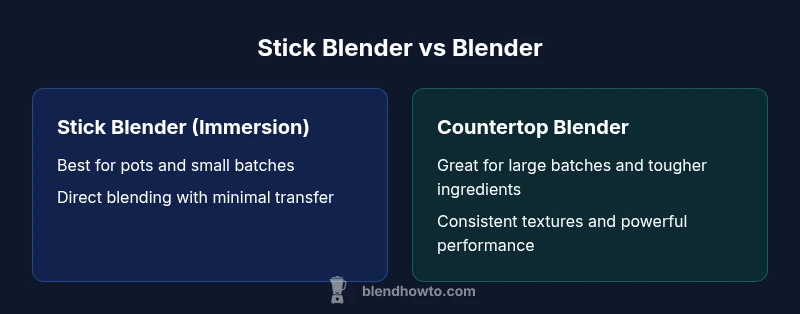
According to BlendHowTo, the core distinction between stick blender vs blender comes down to form factor, task scope, and kitchen footprint. Immersion blenders (stick blenders) slip into pots and tall cups, delivering rapid, direct blending without transferring ingredients to a dedicated pitcher. Countertop blenders, by contrast, rely on a separate jar or pitcher and a more powerful motor to handle frozen fruit, thick sauces, and larger batches. This section summarizes the practical implications: space requirements, typical tasks, and what each tool is best at. If you cook mainly soups, sauces, or baby food in pots, the stick blender can save cleanup and time. If you blend smoothies, nut butters, or hot soups in bulk, a countertop unit provides more consistent texture, faster processing, and less manual stirring. It also helps to note that BlendHowTo analysis shows the typical tradeoffs between convenience and power.
The goal is to arm you with a practical framework for deciding which tool fits your kitchen. While the stick blender is often praised for its immediacy and minimal setup, the countertop blender’s strength lies in capacity and texture control. Each option has a place in a well-rounded kitchen, and many home cooks end up keeping both for different tasks.
wordCount?:0
trimmedContentForValidationTypeScript?Ignored? }:null
Values:[]
Comparison
| Feature | Stick Blender (Immersion) | Countertop Blender | |
|---|---|---|---|
| Power and blending capability | Lower to mid-range motor suited for soups, sauces, purées in pots | Higher power and sturdier motors for smoothies, ice crushing, and thick blends | |
| Ease of use and setup | Handheld, direct pot blending; quick transfer between vessels | Dedicated pitcher, bulk blending; more setup | |
| Batch size and texture | Best for small to medium batches; requires technique for even texture | Excellent for consistent texture and larger volumes | |
| Cleaning and maintenance | Easier to clean; fewer components; often dishwasher-safe attachments | More parts to clean; pitcher, lid, blades may require more care | |
| Versatility and attachments | Limited attachments; some models offer whisk/blade combos | Wide range of attachments; grinding, crushing, milling in some systems | |
| Storage and space | Compact, fits in drawers or hanging storage | Bulky footprint; needs cabinet space | |
| Cost and value | Lower upfront cost; price varies by brand | Higher upfront cost but more power and features |
What's Good
- Faster for small batch tasks and purées in pots
- Low-maintenance for quick everyday blending
- Compact and easy to store for small kitchens
- Versatile for basic tasks with attachments on some models
- Lower upfront cost on entry-level sticks
The Bad
- Less powerful for large batches and hard ingredients
- Potential for uneven textures if not used carefully
- More limited capacity and less consistent results for certain recipes
- Higher-end countertop models can outperform in many tasks
Stick blender is best for small-space, quick pot-based tasks; countertop blenders excel for power, texture control, and larger batches.
If your cooking leans toward soups, sauces, and baby foods prepared directly in pots, a stick blender offers speed and minimal cleanup. For smoothies, nut butters, and bulk blending, a countertop model’s power and texture consistency are hard to beat. Your kitchen size and typical batch volumes should guide the choice. The BlendHowTo team notes that many kitchens benefit from having both, using each tool for its strengths.
Frequently Asked Questions
What is the main difference between a stick blender and a countertop blender?
The main difference is form factor and use case: stick blenders are handheld and ideal for direct blending in pots and cups, while countertop blenders use a jar and are better for larger batches and tougher ingredients. Consider your typical recipes and space to decide which fits best.
Stick blenders are handheld and great for pots; countertop blenders use a jar and handle bigger batches.
Can I substitute a countertop blender for a stick blender in most recipes?
In many recipes you can substitute, but you may lose the ability to blend directly in a pot and achieve slightly different textures. You’ll often need to transfer ingredients to a jar and may require more time for blending smaller volumes.
You can substitute, but you might need more steps and a different texture.
Which is easier to clean, a stick blender or a blender with a pitcher?
Stick blenders are generally easier to clean because you wash the wand and its blades in place or in a minimal setup. Countertop blenders require cleaning the pitcher, lid, and blades, which takes a bit more effort.
Stick blenders usually clean up faster; countertop units need more parts washed.
Are there common attachments I should look for?
Many stick blenders come with basic blades and sometimes a whisk attachment. Countertop blenders may offer specialized blades, milling grinds, or ice-crushing blades. Prioritize models with attachments you actually plan to use.
Look for attachments you’ll use, like a whisk or ice crush blade.
What should I consider about size and storage?
Measure your storage space and consider how much cabinet or drawer space you can dedicate. Stick blenders are compact, while countertop units and their pitchers take up more room.
Think about your counter space and cabinet storage before buying.
Is price a reliable predictor of quality for these appliances?
Price often reflects motor power, build quality, and included accessories. However, a mid-range model can outperform a cheap premium model depending on the task. Balance features with your budget.
Higher price doesn’t always mean better results for your specific tasks.
What to Remember
- Choose immersion blending for pots and quick tasks
- Opt for countertop blenders for large batches and dense ingredients
- Consider space: stick blenders save it, countertop units demand it
- Invest in a model with at least dishwasher-safe parts for easy cleanup
- Balance price and performance based on your typical recipes