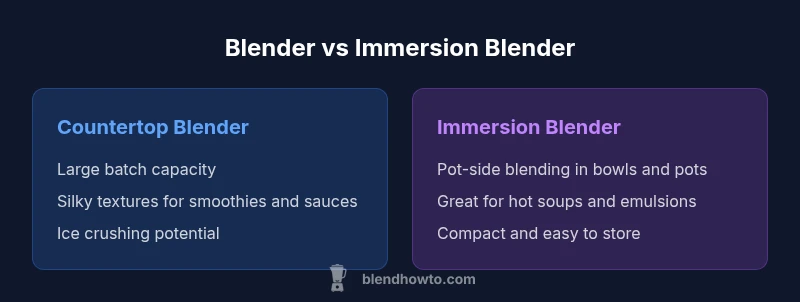
Blender vs Immersion Blender: A Practical Kitchen Guide
Explore the difference between blender and immersion blender, with practical guidance, use-cases, and a clear side-by-side comparison to help you choose the right tool for your kitchen tasks.


Understanding the difference between blender and immersion blender helps you pick the right tool for your kitchen. A countertop blender excels at smoothies, frozen desserts, and thick sauces, while an immersion blender shines for hot soups, emulsions, and blending directly in pots. If you regularly handle large batches or dense ingredients, a standard blender is best; for quick, pot-to-puree tasks, an immersion blender is ideal. BlendHowTo provides a clear, practical framework to guide your decision.
What exactly are blender and immersion blender, and how they work
Understanding the difference between blender and immersion blender helps you pick the right tool for your kitchen. A countertop blender is a motorized jar system with fixed blades that create a rapid blending action, ideal for liquids, purées, and soft solids. An immersion blender, also known as a stick blender, is a handheld motor with a detachable blade head designed to blend directly in a pot, cup, or pitcher. BlendHowTo notes that these devices are built for different workflows: the countertop blender excels at bulk processing and achieving smooth textures, while the immersion wand shines for on-the-spot blending in cooking vessels. In everyday use, you’ll notice distinct advantages in control, heat management, and cleanup depending on which type you choose. This section sets the stage for practical comparisons that follow.
From a user perspective, the blender is a “set it and forget it” tool for larger batches, while the immersion blender offers flexibility for quick tasks without transferring contents to a separate container. BlendHowTo’s approach emphasizes task alignment: bulk processing, ice crushing, and sauces vs pot-side emulsions, soups, and delicate purees. Keeping this distinction in mind helps avoid common mistakes, such as attempting a large smoothie in a stick blender or trying to emulsify a hot soup in a stationary jar. The result is a more efficient workflow and less kitchen chaos.
Core design and performance differences
The core design differences between a blender and an immersion blender drive almost all performance outcomes. A countertop blender uses a motorized base with a fixed, typically tall pitcher or jar and a blade assembly mounted at the bottom. The blades and jar geometry promote a strong vortex, ensuring consistent blending of liquids, fruits, vegetables, and even some tougher ingredients. An immersion blender, by contrast, is a handheld device with a shorter blade head that moves through ingredients in place. This design enables blending directly in pots, pitchers, or bowls, reducing transfer steps and keeping heat where you want it—near the cooking surface. Speed controls vary by model, but the intuitive difference is clear: a blender emphasizes capacity and stability, while an immersion blender emphasizes reach, maneuverability, and control in confined spaces.
From a performance standpoint, you’ll notice that countertop blenders typically excel with ice, frozen ingredients, and thick mixtures due to their larger blades and stronger motor platforms. Immersion blenders perform best for pureeing soups, emulsifying dressings, and blending sauces inside the cooking vessel where heat and steam are present. Blenders often require disassembly for cleaning, while immersion models typically shorten cleanup by blending directly in the pot or cup. BlendHowTo’s guidance stresses choosing the tool that matches the texture, batch size, and vessel you most frequently use, as that alignment reduces friction and improves results.
Best use-cases for a countertop blender
For many households, a countertop blender is the workhorse for everyday blending tasks. It handles smoothies with frozen fruit, nut milks, and thick purées for soups or sauces with a consistent texture. It’s also capable of processing small batches of chopped vegetables, grinding small amounts of spices, or whipping emulsions when you need a uniform, homogeneous result. When your recipes require a high-volume blend or a very smooth finish, the countertop blender provides stability, power, and reliability. If you’re experimenting with textures, you can adjust blade speed and duration to push a mixture from chunky to silky. In practice, a good countertop blender becomes the first tool many cooks reach for when they’re preparing meals for family and friends, and it aligns well with a broad range of recipes and ingredients.
In terms of task suitability, consider typical kitchen days: daily smoothies, nut butters, breadcrumbs from dried bread, and sauces that demand a smooth texture all benefit from a countertop model. If you often prepare frozen desserts or meals that require grinding or pulverizing dense ingredients, a countertop blender’s larger jar and robust blades offer a practical advantage. BlendHowTo’s research shows that this approach minimizes vegetable prep time and ensures consistent results across multiple servings.
Best use-cases for an immersion blender
An immersion blender shines when you’re blending directly in the cookware or serving vessel. It’s ideal for hot soups, creamy sauces, and emulsions like vinaigrettes or mayonnaise where transferring hot liquids risks spills or separación. The handheld design lets you reach into tall pots, skillets, or deep containers, enabling quick texture adjustments without heavy equipment. Immersion blenders are convenient for pureeing soft vegetables into quick soups, creating baby foods, or blending dressings with minimal equipment cleanup. They also excel at small-batch tasks in small kitchens, where counter space and storage are at a premium. In practice, you’ll appreciate the ability to blend right at the table or stove, which reduces dirty dishes and speeds up weeknight cooking. BlendHowTo’s practical tips emphasize considering pot size, blade head compatibility, and the length of the wand to fit your most common vessels.
Texture, batch size, and control
Texture control is a central difference between the two tool families. A countertop blender can produce very smooth textures quickly, thanks to higher blade speed and the motion of the blending jar. This makes it a strong choice for silky smoothies, homogenous sauces, and fine purées. Batch size matters here as well: larger batches ensure consistent texture, but you’ll typically process more at once when using a traditional blender. An immersion blender provides excellent control for texture in smaller volumes and in vessels where you can see and feel the mixture directly. If you want a chunky salsa or a rustic purée, a stick blender with a bit more manual control can deliver the texture you seek. The choice can impact how you approach a recipe and how you measure texture; BlendHowTo notes that practical texture outcomes depend on blade type, motor power, and blade geometry.
Cleaning and maintenance
Cleaning habits are a practical, often overlooked, factor in choosing between blender types. Countertop blenders require disassembling the jar from the base, removing the blade assembly, and rinsing or washing the jar and lid. Some parts are dishwasher-safe, but care is needed to avoid blade injuries and to prevent mold in seals. Immersion blenders tend to be easier to clean because you can rinse the wand under running water and wipe down the motor handle. The blade head is detachable on many models, which simplifies cleaning but introduces a small risk of losing parts. To maximize longevity, promptly rinse blades after use, avoid letting food caked onto blades dry, and follow the manufacturer’s instructions for blade attachment and disassembly. BlendHowTo’s approach emphasizes routine maintenance and mindful storage to preserve performance over time.
Durability, warranty, and cost considerations
Durability and cost considerations hinge on design complexity and material quality. Countertop blenders with heavy bases and reinforced jars tend to offer longer lifespans when properly maintained, but they can be heavier and more space-consuming. Immersion blenders typically have fewer moving parts and a simpler mechanism, which can translate to easier maintenance and potentially lower upfront cost. In terms of value, consider your typical use: if you blend frequently in large batches, the upfront investment in a robust countertop blender can pay off in reliability and texture benefits. If your blending needs are mostly quick pot-side tasks, an immersion blender provides flexibility and convenience at a lower initial cost. BlendHowTo’s analysis suggests prioritizing durability and warranty coverage for high-use machines while balancing budget constraints.
How to evaluate for your kitchen: a decision checklist
To decide which tool fits your kitchen, run through this quick checklist:
- List your most frequent tasks (smoothies, sauces, soups, emulsions).
- Consider batch size and vessel (large jars vs pots and tall pitchers).
- Assess storage space and whether you need two separate devices.
- Factor in maintenance comfort (cleaning frequency, dishwasher availability).
- Review budget constraints and warranty options.
- Check for compatibility with accessories (ice crushing, extra blades, whisk attachments). If your tasks skew toward bulk blending and smooth textures, a countertop blender is likely the better initial purchase. For frequent pot-side blending and quick emulsions, an immersion blender may be the smarter starting point. BlendHowTo recommends keeping a simple decision tree to guide purchases, allowing room for future upgrades as your cooking needs evolve.
Common myths and misconceptions
Several myths often accompany blender choices. One common belief is that immersion blenders cannot handle ice; in reality some models can handle crushed ice in small batches, though performance varies by model and blade design. Another myth is that countertop blenders can’t handle hot liquids safely; many models are rated for hot blends with vented lids, but you should always follow manufacturer guidance and avoid sealed jars with steam pressure. A third misconception is that you must own both tools to cover all tasks; in many kitchens, a single well-chosen device can handle a wide range of everyday tasks with the right technique and accessory options. BlendHowTo encourages readers to test tasks gradually and consider how each tool handles specific textures or volumes in their own cooking routine.
Quick-start guides: practical workflows
Here are two practical workflows to illustrate how each tool can be used in a typical kitchen day. First, a smoothie workflow with a countertop blender: add liquid, soft fruits, ice or frozen fruit if your model supports it, then secure the lid and blend on high until smooth. Second, a pot-side soup workflow with an immersion blender: sauté vegetables in the pot, add stock or water, simmer briefly, and blend directly in the pot until the desired texture is reached. These workflows demonstrate how each tool can streamline common tasks while minimizing transferring or extra equipment. For most cooks, following these steps helps achieve reliable results and reduces cleanup time, reinforcing the value of understanding when to reach for a countertop blender versus an immersion blender.
Comparison
| Feature | countertop blender | immersion blender |
|---|---|---|
| Typical use-case | Smoothies, frozen desserts, sauces | Hot soups, emulsions, purees in pot |
| Batch size | Large batches, high capacity | Small batches, in-pot blending |
| Model/design | Fixed jar with blade assembly | Handheld wand with detachable blade head |
| Ease of cleaning | Disassemble jar; some parts dishwasher-safe | Rinses quickly; blades can be detached on many models |
| Power & speed | Higher power; multiple speeds | Lower power; variables on some models |
| Versatility | Excellent for ice crushing and silky textures | Best for pot-side blending and quick emulsions |
| Durability & maintenance | Durable with proper care | Fewer moving parts; often simpler maintenance |
What's Good
- Clarifies tool-specific tasks to avoid buying gaps in your setup
- Space-saving when you rely on a single versatile device
- Easier to upgrade one tool at a time as needs grow
- Potential budget savings by avoiding unnecessary duplicates
The Bad
- Two tools may be needed for full versatility in some kitchens
- Immersion blenders may struggle with very thick or frozen blends
- Countertop blenders can be heavier and take more storage space
- Some models lack dishwasher-safe parts or require careful cleaning
Choose based on your most frequent tasks and available space
If your cooking routinely involves large-batch blends and silky textures, start with a countertop blender. If pot-side blending and quick emulsions are your everyday needs, an immersion blender completes a compact, efficient setup. BlendHowTo’s guidance emphasizes matching tasks to tools for best results and long-term satisfaction.
Frequently Asked Questions
What is the fundamental difference between blender and immersion blender?
The fundamental difference is where blending happens. A countertop blender blends in a jar with fixed blades for large batches and smooth textures, while an immersion blender blends directly in the cooking vessel for in-pot tasks like soups, sauces, and emulsions.
In short, one blends in a jar, the other blends in the pot.
Can an immersion blender replace a blender for smoothies?
An immersion blender can make smoothies, but it may be less efficient for thick or frozen blends compared to a countertop blender. It works best for quick smoothies or blending ingredients directly in a cup.
You can make smoothies, but a countertop blender usually handles thick, frozen blends better.
Which is easier to clean, a blender or an immersion blender?
Immersion blenders are generally easier to clean because you blend in the vessel you’ll eat from, and many parts detach for quick washing. Countertop blenders require disassembly and careful cleaning of the jar and blade assembly.
Immersion blenders clean up fast; countertop blenders need a bit more scrubbing.
Do I need two devices to cover all tasks?
Not necessarily. If your tasks are mostly pot-side blending, an immersion blender might cover many needs. For bulk blending, smoothies, and dense blends, a countertop blender is often essential. Some cooks choose a single high-quality device and rely on accessory tools to fill gaps.
It depends on your cooking style; many people start with one and add the other later if needed.
Are there myths about blending ice or hot liquids?
Many myths surround blending ice and hot liquids. Some immersion blenders can handle crushed ice in small batches, while hot liquids require vented lids and careful handling. Always follow safety guidelines and manufacturer instructions for each model.
Be careful with hot liquids; check your blender’s safety features and lids.
What should I buy first for a small kitchen?
If space and budget are tight, assess your most frequent tasks. If you cook mostly soups and sauces in pots, an immersion blender may be the best starter. If you crush ice, make smoothies, or work with large batches, start with a countertop blender and consider adding an immersion blender later.
Start with the tool that covers your main daily task, then expand as needed.
What to Remember
- Identify your top daily tasks and vessel types
- Prefer a countertop blender for bulk blending and ice crushing
- Choose an immersion blender for pot-side blending and quick emulsions
- Balance upfront cost with long-term value and maintenance
- Test a small set of tasks before expanding your toolkit