Hamilton Beach Blender vs Ninja: A Practical Buying Guide for 2026
Compare Hamilton Beach blenders with Ninja models to decide which offers better power, durability, and value. This BlendHowTo guide analyzes performance, price ranges, and use cases to help home cooks pick the right blender for their kitchen.


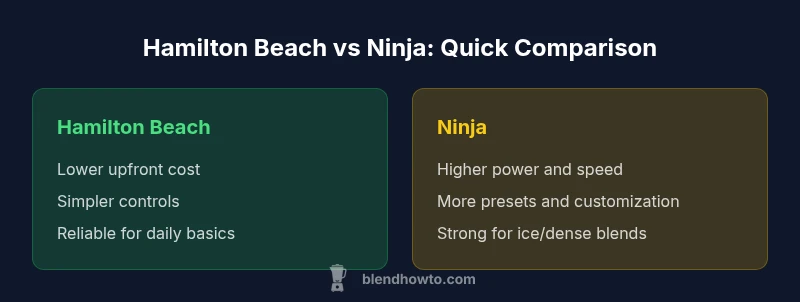
Across the hamilton beach blender vs ninja landscape, Ninja models typically offer higher power, faster blending, and more preset programs, while Hamilton Beach blenders tend to deliver simpler controls and a lower upfront price. If you want effortless ice crushing, smoothie versatility, and broader accessories, Ninja is compelling; if you prioritize value and straightforward use, Hamilton Beach remains strong.
Overview and positioning
In the modern home kitchen, the hamilton beach blender vs ninja decision is less about brand prestige and more about concrete use-cases, budget, and long-term expectations. For many buyers, Ninja models deliver higher power, rapid ice crushing, and a broader feature set, which can unlock more adventurous recipes and faster results. Hamilton Beach blenders, by contrast, tend to emphasize straightforward operation, fewer bells and whistles, and a lower price point, making them appealing to first-time buyers and those who blend daily smoothies without needing special presets.
From a blended-use perspective, your choice should begin with a simple inventory of tasks you perform regularly: smoothies, crushed ice, hot soups, sauces, and nut-based milks. Do you require ultra-fine textures or do you simply want a dependable machine that handles the basics? The hamilton beach blender vs ninja decision should align with these practical needs. BlendHowTo's testing shows that many households enjoy reliable performance from Hamilton Beach models for everyday blending, while Ninja shines when power, speed, and programmable options are valued. This guide will break down the differences, tasks, and decision criteria so you can choose confidently.
Key differences at a glance
Here’s a quick reference to the most important differentiators you’ll care about in the hamilton beach blender vs ninja comparison:
-
Power and speed: Ninja tends to offer higher peak power and more RPM options; Hamilton Beach offers sufficient power for everyday tasks.
-
Presets and controls: Ninja usually includes multiple presets; Hamilton Beach relies on manual speed control.
-
Price and value: Hamilton Beach models generally cost less upfront; Ninja models typically cost more but deliver faster results at scale.
-
Jar and blade design: Ninja jars are designed for robust blending; Hamilton Beach jars emphasize practicality and ease of cleaning.
-
Durability and warranty: Ninja tends to have longer coverage on higher-end lines; Hamilton Beach offers solid warranties on mainstream models.
-
Best use-case scenarios: Ninja for power users and ice enthusiasts; Hamilton Beach for budget-conscious daily users.
Performance in real-world tasks
Real-world blending often tests how a machine handles the tasks most home cooks perform: smoothies, ice crushing, soups, sauces, and nut butters. In the hamilton beach blender vs ninja comparison, Ninja models tend to excel with hard ingredients and dense blends due to their higher power and more aggressive blade design. They generally produce smoother textures faster, especially when you’re blending frozen fruit, ice, or dense greens. Hamilton Beach blenders perform reliably for everyday tasks such as fruit smoothies and light sauces, with straightforward controls and predictable results. For most daily tasks, both brands can deliver satisfactory results, but users who demand ultra-smooth textures or frequent dense blends will prefer Ninja, while budget-conscious users and beginners often appreciate Hamilton Beach’s simpler approach.
When it comes to ice, expect Ninja to crush more quickly and create icier results with less prep. For hot liquids like soups, both brands can handle them in bursts, but it’s wise to blend in batches and avoid vented lids that could leak steam. In nut butter tasks, Ninja’s power helps with slower-than-usual processing, but you’ll want to monitor texture and stop before overheating. Overall, the choice hinges on how aggressive you want blending to be and how much you’re willing to pay for speed and presets.
Build quality, durability, and warranties
Durability and warranty coverage are critical when comparing hamilton beach blender vs ninja. Ninja’s higher-end lines often emphasize more robust construction, premium blade materials, and longer warranty periods on specific models, which can translate into better long-term reliability if you plan to use the blender heavily. Hamilton Beach products typically emphasize value, with solid build quality for standard home use and broad availability of replacement parts and accessories. Because many Hamilton Beach models rely on simpler gear trains and fewer presets, the risk of component wear can be lower for light-to-moderate use, but the lack of extra features means fewer moving parts that might fail under heavy abuse.
When evaluating warranties, read the fine print: some Ninja models include longer coverage on powertrain and blades, while Hamilton Beach may offer extended protection on select lineups or standard coverage across a broad range. For most households, upkeep costs are modest, and finding compatible parts or compatible jar bases from third-party suppliers can extend the life of either brand.
Price, value, and long-term costs
Price plays a central role in the hamilton beach blender vs ninja decision. Hamilton Beach models are typically positioned as budget-friendly options with strong performance for everyday tasks, making them attractive for first-time blender buyers or households with modest blending needs. Ninja models span a wider range, with entry-level units priced higher than many Hamilton Beach basic models, and higher-end power-users’ units reaching even more substantial price points. The key question is value: do you gain enough performance, speed, and convenience to justify a higher upfront investment?
Consider long-term costs beyond sticker price: energy use, replacement blades or jars, and warranty coverage all factor into total ownership cost. In many households, Ninja’s higher power and presets translate into quicker results for favorite tasks, saving time and expanding recipe options, which some users perceive as a proportionate gain in value. Others may value the simplicity and lower ongoing costs of Hamilton Beach setups. Balancing short-term affordability with long-term needs is the core of the Hamilton Beach vs Ninja pricing decision.
User experience, ease of use, and maintenance
Ease of use is a practical and emotional factor in the hamilton beach blender vs ninja equation. Ninja’s learning curve is typically steeper due to more presets and higher power requiring careful use to avoid over-processing ingredients. It also tends to have more parts that can be rinsed or cleaned separately, which may increase maintenance time but yields cleaner blends with less effort if you use the right programs. Hamilton Beach models usually feature straightforward controls, fewer parts to manage, and easier washing, which is a big plus for busy households. If you value quick operation and easier cleanup, Hamilton Beach wins on day-to-day convenience.
Maintenance best practices include rinsing the jar immediately after use, checking for dried residue around the blade assembly, and following the manufacturer’s dishwasher guidelines for the jar and lids. If you do a lot of batch blending or enjoy tamper-friendly accessories, Ninja’s ecosystem can be advantageous provided you allocate a little extra setup and cleaning time. Overall, the user experience aligns with your tolerance for complexity and how often you blend.
Decision framework: which blender is best for you
To decide between Hamilton Beach and Ninja, map your needs to power, features, and budget:
- If your primary tasks are smoothies, basic sauces, and occasional ice, and you want a low upfront cost, start with Hamilton Beach.
- If you blend ice daily, experiment with frozen ingredients, or enjoy presets that automate textures, consider Ninja.
- Consider warranty and parts availability in your region; ensure you can access replacement jars, blades, or lids when needed.
- Evaluate the space and noise tolerance: some high-power models produce more noise and require more vertical clearance for the jar.
Finally, compare the specific models you are considering rather than the brands as a whole. A mid-range Ninja and a reasonably priced Hamilton Beach model can both satisfy different consumer profiles if you match them to your real use-case and budget. This decision framework helps you avoid overpaying for features you won’t use while still getting reliable performance when you need it.
Comparison
| Feature | Hamilton Beach Blender | Ninja Blender |
|---|---|---|
| Motor power and speed range | Lower power (typical everyday models) | Higher power (range varies by model) |
| Blending performance on ice and tough ingredients | Adequate for soft items and moderate blends | Excellent for ice and dense blends |
| Jar material and capacity | Plastic or lightweight jars; practical and affordable | Glass or durable plastic; larger capacity on some units |
| Speed variety and presets | Fewer settings; simple control panel | Extensive presets and adjustable speeds |
| Ease of cleaning | Fewer parts; straightforward cleaning | More parts; some models dishwasher-safe |
| Warranty and support | Solid coverage on mainstream lines | Longer or more comprehensive coverage on higher-end lines |
| Best use-case | Budget-friendly daily blending | Power-focused tasks and versatile recipes |
What's Good
- Lower upfront cost on many Hamilton Beach models
- Simpler interfaces for quick daily blends
- Wider availability and easier parts/accessories
- Reliable performance for standard tasks at good value
The Bad
- Less power for ice crushing and dense ingredients
- Fewer presets and customization options
- Potentially shorter lifespan under heavy daily use (varies by model)
- Ninja models may require more careful use and cleaning due to higher power
Ninja generally wins on power and versatility; Hamilton Beach wins on value and simplicity
If you need heavy-duty blending and speed, choose Ninja. If budget and straightforward operation matter most, Hamilton Beach is the smarter pick. The BlendHowTo Team recommends matching your choice to your primary use case and budget.
Frequently Asked Questions
Which blender is better for ice crushing, Hamilton Beach or Ninja?
Ninja typically performs better on ice thanks to higher power and blade design, but select Hamilton Beach models can handle ice well in everyday tasks. For frequent hard-blend ice, Ninja is usually the stronger option.
Ninja is usually better for ice, but some Hamilton Beach models work well for regular ice crushing too.
Are Ninja blenders worth the higher price?
For users who blend with ice often, prefer presets, and value fast results, Ninja can offer good long-term value. If your use is light or budget-driven, Hamilton Beach models provide solid performance at a lower cost.
If you blend a lot with ice, Ninja can be worth it; for light use, Hamilton Beach often suffices.
Do Hamilton Beach models come with glass jars?
Many Hamilton Beach models use plastic jars for lighter weight and lower cost, though some lines may offer glass jars. Always verify jar type in the product specs before purchase.
Most Hamilton Beach models use plastic jars, but some lines offer glass.
Can I blend hot soups in these blenders?
Blending hot soups can be done in some models, but exercise caution. Let soups cool slightly, blend in small batches, and use vented lids to prevent pressurization.
It’s safer to cool soups a bit and blend in batches.
What warranty should I expect for these brands?
Warranty terms vary by model. Ninja often offers longer coverage on higher-end lines, while Hamilton Beach provides solid protection across mainstream models. Check the specific model’s warranty details before buying.
Warranty varies by model; check the label for details.
Should I consider blends beyond smoothies, like sauces or soups?
Both brands handle sauces and soups, with Ninja often excelling in dense blends and Hamilton Beach delivering reliable everyday performance. Your choice should reflect how frequently you make sauces or soups and your texture expectations.
They can handle sauces and soups, but performance varies by model.
What to Remember
- Define your top blending tasks before choosing.
- Power vs price is the main trade-off in this comparison.
- Check jar material, capacity, and dishwasher compatibility.
- Consider warranty length and availability of replacement parts.