Vitamix Blender vs Ninja: A Practical Side-by-Side Guide
Compare vitamix blender vs ninja to help you pick the right blender for smoothies and soups. This guide weighs power, durability, price ranges, and ease of use with practical guidance.


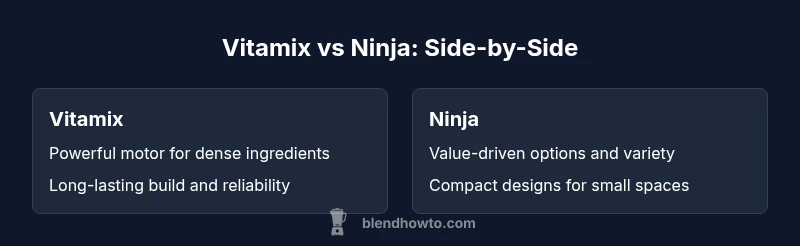
According to BlendHowTo, the vitamix blender vs ninja decision hinges on long-term needs: Vitamix delivers high power and durability for dense ingredients, while Ninja offers budget-friendly models with strong everyday performance. This TL;DR compares core differences in power, reliability, price, and ideal use cases to help you choose for kitchens.
Vitamix vs Ninja: what they stand for
In the blender world, vitamix blender vs ninja represents two distinct design philosophies. Vitamix is often seen as the industry-standard option, built for longevity, consistent textures, and the ability to handle tough ingredients with ease. Ninja, by contrast, emphasizes value and versatility across a broad lineup, from compact personal blenders to family-sized machines. For home cooks and hobbyists, the choice hinges on how often you blend, what you blend, and how much you’re willing to invest upfront. BlendHowTo's testing approach shows that Vitamix models typically prioritize power and durability, delivering silky textures even with fibrous greens. Ninja models excel in value, offering preset programs, multiple pitcher sizes, and bundles that fit compact kitchens or tighter budgets. Across both brands you’ll find solid performance, but tangible differences in raw power, long-term reliability, and control options often drive the decision. Map your typical tasks to the strengths of each brand and set a realistic budget for how often you’ll blend. vitamix blender vs ninja is a practical framing for this choice.
Core design differences and what they imply
Both brands aim to simplify blending, yet their core designs signal different priorities. Vitamix tends to use high-torque motors and robust blade assemblies paired with durable containers designed for heavy use. The result is smooth texture with fewer passive interruptions when handling dense ingredients. Ninja emphasizes model variety and compact footprint, often with multi-jar configurations and plastic pitcher designs that maximize versatility and value. The trade-off is that some Ninja bases may feel lighter and some tasks demand a gentler touch to avoid overheating or wear. When you weigh these design choices, consider your kitchen space, typical batch size, and how often you’ll grind or blend fibrous produce. BlendHowTo’s analysis highlights that the design philosophy directly influences texture, noise, and ease of maintenance over time.
Power, speed, and texture outcomes across common tasks
Power and speed translate into texture, especially for smoothies, soups, and ice-crushing tasks. Vitamix’s reputation rests on producing exceptionally smooth blends with minimal chunks, even when the ingredients include tough greens, seeds, or frozen fruit. This level of performance is particularly noticeable in large batches or when you want a ultra-silky finish. Ninja models generally excel at quick, everyday blends and offer convenient presets that simplify routine tasks. For hot soups, both brands can perform well, provided you follow the manufacturer’s guidelines and use the appropriate jar capacity. The key takeaway is to match your expected workload with the motor strength and program flexibility each brand provides, rather than assuming one size fits all. BlendHowTo’s testing supports a practical approach to selecting based on your typical recipes and batch sizes.
Durability, warranties, and long-term value
Durability and warranty terms are central to long-term value. Vitamix products are widely recognized for their rugged build and strong support networks, and many models come with generous warranty terms that reflect confidence in longevity. Ninja offers competitive warranties on many models, often with a focus on value and model variety. The practical effect is straightforward: if you blend daily for years and need a machine that holds up under heavy use, Vitamix is often the safer bet. If you’re budgeting upfront but still want reliable performance for most daily tasks, Ninja’s range can deliver excellent value. Always confirm warranty specifics for the exact model you’re considering and factor in replacement parts availability in your region. The goal is long-term reliability aligned with your expected usage pattern.
Price tiers, bundles, and total cost of ownership
Price remains a defining factor for many buyers. Vitamix typically sits in the higher end of the spectrum, matching premium build with premium performance. Ninja offers a broader spread, from budget-friendly options to mid-range bundles that include extra pitchers and accessories. When calculating total cost of ownership, consider not only the upfront price but also replacement parts, service, and potential accessory purchases. A higher upfront investment can translate into fewer mid-term replacements, while budget models may require more frequent part replacements or upgrades as your needs evolve. Balance your long-term use case with the likelihood of expansion, such as adding more jars or blending accessories over time. BlendHowTo’s guidance suggests aligning your model choice with how often you’ll blend and what you intend to produce over several years.
Ease of use, cleaning, and maintenance
Both brands offer models designed for home use, but user experience varies. Vitamix tends to feature straightforward controls, fewer cluttered presets, and efficient cleaning modes on many high-end models. Ninja often emphasizes quick presets and compact designs that support fast cleanup, including dishwasher-safe components on select models. In practice, the easiest model to maintain is the one with fewer parts and a simple cleaning routine, but both brands can be efficiently cleaned with warm water, a drop of dish soap, and a brief rinse. Always allow the jar and blades to cool before disassembling and ensure that seals and gaskets are inspected for wear over time. The result is consistent performance with minimal downtime for maintenance.
Accessories, containers, and expanding capabilities
Both Vitamix and Ninja offer a range of accessories and containers that extend their functionality. Vitamix ecosystems typically include larger, durable pitcher ranges and compatible personal cup adapters, which are popular for families or shared households. Ninja accessories often emphasize flexibility with multiple jar sizes and convenience features, suitable for single-serving drinks or quick recipes. When evaluating accessories, check compatibility with your chosen model, consider whether you’ll need extra blades or lids, and factor in storage space for additional components. Align accessory purchases with your primary needs—whether you value batch size, portability, or a full blender-to-processor setup—so you don’t accumulate unused gear. BlendHowTo recommends prioritizing compatibility and practical use in your decision.
Use-case centric recommendations: who should buy which
If your priority is long-term durability, ultra-smooth textures, and the ability to handle dense ingredients, Vitamix tends to be the stronger fit for you. For those who want good all-around performance at a lower upfront cost and value variety across models, Ninja is a compelling option. For households with limited space or a need for personal-size blends, Ninja’s compact designs offer clear advantages; for families or frequent cooks who demand consistent results and are willing to invest in a premium machine, Vitamix makes a strong case. In short, map your daily tasks to the strengths described above and choose the brand that aligns with your cooking style, kitchen space, and budget. BlendHowTo’s approach is practical, not dogmatic.
How to compare models in practice: a quick 5-step checklist
- List your top 3 daily tasks (smoothies, soups, nut milks).
- Check motor power and container size for each model you’re considering.
- Compare warranty terms and available replacement parts.
- Evaluate ease of cleaning and the number of parts involved.
- Consider bundle value and accessory options to maximize long-term utility. Use this checklist to winnow down the options and select the model that matches your real-world needs.
Comparison
| Feature | Vitamix | Ninja |
|---|---|---|
| Power and blending performance | Very high torque, consistent results with dense ingredients | Strong performance for daily blending with versatile presets |
| Price range | High upfront cost | Budget-friendly to mid-range options available |
| Durability and warranty | Typically long warranty and proven durability | Competitive warranties on many models |
| Capacity and size | Larger pitchers and heavier bases | Compact options with multiple jar sizes |
| Control and programs | True manual controls with high flexibility | Presets and some smart features on select models |
| Maintenance and cleaning | Self-cleaning cycles and fewer parts | Easy cleaning for most models, some parts require extra care |
What's Good
- Excellent blending consistency and durable build (Vitamix)
- Broad model range and affordable bundles (Ninja)
- Strong resale value and widely available parts
- Good ecosystem of accessories and support from both brands
The Bad
- High upfront cost (Vitamix)
- Ninja models with lower-powered bases may struggle with dense ingredients
- Some budget Ninja models can have wear with heavy use
- Replacement parts may be needed more often on budget models
Vitamix is the premium choice for long-term durability and robustness; Ninja offers the best value for budget-conscious shoppers.
Choose Vitamix if you prioritize long-term reliability and ultra-smooth textures. Choose Ninja if you want solid performance at a lower upfront cost and a wider range of model options.
Frequently Asked Questions
What is the main difference between Vitamix and Ninja blenders?
The core difference lies in design philosophy: Vitamix prioritizes raw power, durability, and consistent textures, while Ninja emphasizes value, model variety, and convenient presets for everyday use.
The big difference is power and durability versus value and model variety; Vitamix focuses on long-term performance, Ninja on versatility and affordability.
Is Vitamix worth the price compared to Ninja?
For heavy or frequent blending and extremely smooth textures, Vitamix often justifies the higher price through durability and reliability. If your blending needs are moderate and budget is a concern, Ninja offers solid value.
If you blend a lot and want durability, Vitamix is worth it. Otherwise, Ninja is a strong budget-friendly option.
Which blender handles hot soups better?
Both brands can manage hot blends when using appropriate jars and following guidelines, but Vitamix typically performs more confidently with hot ingredients due to its robust motor and blade design.
Both can do hot soups with the right setup, but Vitamix often handles heat more reliably.
Are there compatibility issues with accessories?
Accessories are brand-specific, so you’ll usually want to buy parts from the same brand. Cross-brand compatibility is limited and not recommended for optimal performance.
Accessories are best bought for the brand you choose; cross-brand fit isn’t usually reliable.
Which is easier to clean?
Most models offer straightforward cleaning, with Vitamix often featuring simpler, fewer-part designs. Ninja models are also easy to clean, though some presets and multi-jar setups may require extra care.
Both are easy to clean; Vitamix often wins on simplicity, while Ninja wins on compact design.
What about noise levels and user experience?
High-power blenders are generally loud. Noise depends on the model, blade speed, and container design. If noise matters, look for models with lower speed settings or better vibration dampening.
They’ll be loud, especially on high speeds. Check the model’s specs if noise is a concern.
What to Remember
- Prioritize long-term durability if you blend daily and need consistent texture
- Consider Ninja for budget-friendly models with broad feature sets
- Check warranty terms and replacement parts before buying
- Match model choice to your typical batch size and kitchen space
- Assess the accessory ecosystem to maximize long-term value