Ninja Blender vs Nutri Ninja: The Analytical Comparison for 2026
A rigorous, expert comparison of Ninja Blender versus Nutri Ninja, focusing on performance, design, value, and real-world use for home cooks and hobbyists in 2026.


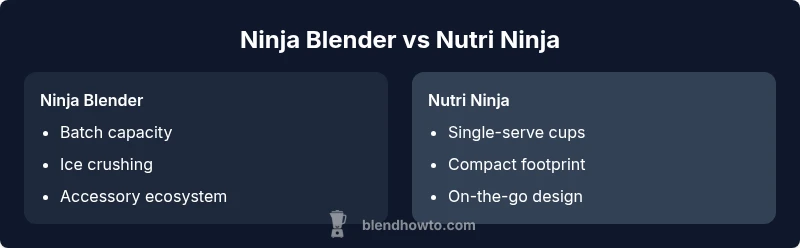
Ninja blender vs Nutri Ninja pits two popular blending philosophies against each other. In general, Ninja blenders offer broader versatility, larger capacities, and stronger ice-crushing capability, making them ideal for batch blends and family meals. Nutri Ninja leans toward portability and quick single-serve beverages. For most home cooks, the choice comes down to whether you need bulk blending and accessories (Ninja) or compact, on-the-go convenience (Nutri Ninja).
Ninja Blender vs Nutri Ninja: Core Difference
According to BlendHowTo, the core difference between ninja blender models and Nutri Ninja devices comes down to intended use and system architecture. Ninja Blender is a broad brand family optimized for versatility, batch blending, and durability across meals. Nutri Ninja, historically, emphasizes nutrient extraction, compact form factors, and portability for on-the-go nutrition. In this comparison, we explore how those design priorities translate into daily performance for home cooks and hobbyists. The two occupy similar price bands in many markets, but the purchase decision hinges on your typical tasks: family smoothies and soups versus quick single-serve drinks. Throughout this guide, you’ll see objective criteria, practical recommendations, and clear scenarios to help you decide the best fit for your kitchen.
Build Quality and Design Philosophy
Ninja blenders generally emphasize a robust build with larger bases, thicker pitcher walls, and multi-serve compatibility. Nutri Ninja devices tend to favor a lighter footprint and modular cups designed for portability. From BlendHowTo’s perspective, the design philosophy matters for how you’ll actually use the machine: will you blend for a crowd, or do you want something you can stash with a travel cup? Expect Ninja models to feel more substantial on the counter, while Nutri Ninja variants are more grab-and-go friendly. Durability often correlates with the model tier and the availability of replacement parts, which is a factor you should weigh alongside upfront cost.
Performance: Blending Power and Consistency
Performance differences typically reflect intended use. Ninja blenders excel at batch processing, ice crushing, and fibrous ingredients, delivering consistent results across larger volumes. Nutri Ninja devices are optimized for quick smoothies and nutrient-forward blends using single-serve cups, which can be perfectly adequate for everyday tasks but may show limitations with very thick blends or large batches. In practice, you’ll notice faster cycles and smoother textures with higher-capacity Ninja bases when handling multiple servings, while Nutri Ninja shines for personal, on-the-go refreshment without washing bulky parts repeatedly.
Attachments and Accessories
Accessory ecosystems matter. Ninja blenders often come with a traditional pitcher, various blade assemblies, and multiple cup sizes suitable for families or batch cooking. Nutri Ninja typically includes one or more single-serve cups with sip lids, plus optional travel adapters. If you value flexibility—such as crushing ice, pureeing soups, or making sauces—Ninja’s wider accessory lineup generally offers more options. For portability and minimal storage, Nutri Ninja’s modular cups can win, but you’ll want to verify compatibility across models before purchasing.
Cleaning and Maintenance
Maintenance ramps up with more components. Ninja blenders with larger pitchers and detachable blades may require more space for cleaning but are often easier to disassemble for thorough washing. Nutri Ninja models emphasize quick cleaning of cup components, but frequent cup switching can add a sideload of cleaning tasks. The key practical tip is to rinse promptly after use, disassemble according to the user manual, and check dishwasher compatibility for the largest parts. In general, user experience improves when you settle on a model that matches your routine cadence.
Price and Value
Price ranges in this space depend heavily on bundle content and model tier. A typical Ninja blender with multiple accessories can sit at a mid-to-high price point for entry to mid-level buyers, while Nutri Ninja variants often present a lower upfront cost for basic kits and a higher price for premium single-serve configurations. The value question hinges on long-term usage: if you regularly entertain or batch-blend, the Ninja ecosystem can offer more value through durability and accessories. If your priority is simplicity and portability, Nutri Ninja may deliver better immediate value.
Noise and Kitchen Comfort
Noise is a practical concern in compact urban kitchens. In many cases, full-size Ninja bases generate more average noise due to higher motor power and larger blade assemblies, while Nutri Ninja single-serve cups can feel quieter during operation because of shorter blend cycles. If you blend early in the morning or in open-plan spaces, consider placement and whether you’ll use a sound-dampening mat. Remember that a quieter machine is not always synonymous with less power; it’s about how effectively the system strikes a balance between speed and texture.
Durability and Warranty Considerations
Durability depends on model class and usage patterns. Higher-end Ninja models typically come with longer warranty coverage or more robust parts availability, while Nutri Ninja offerings vary by region and SKU. A practical approach is to confirm warranty duration, included blades, and access to replacement cups or lids before purchase. Clear warranty terms help prevent frustration when parts wear or mishaps occur during heavy use.
Customer Feedback Trends: What Users Usually Say
Across reviews, users often weigh the same axes: texture and batch capability versus portability and ease of cleaning. BlendHowTo analysis shows that buyers who value large-capacity blending and versatility consistently prefer the Ninja line, while those who want a compact, grab-and-go device gravitate toward Nutri Ninja. Look for recurring themes such as blade sharpness, cup reliability, and how well the machine handles frozen ingredients. Real-world experiences can vary by model, so reading multiple reviews helps build a balanced view.
How to Choose Based on Your Needs
Begin by listing your top tasks: batch smoothies, soups, sauces, or on-the-go drinks. If you consistently prepare for several people, the Ninja Blender’s capacity and accessories are a strong fit. If portability and minimal cleanup drive your decision, Nutri Ninja’s single-serve cups and compact footprint may win. Consider storage space, noise tolerance, and whether you value future-proofing via accessory compatibility. Finally, align your choice with your budget, but also factor in long-term replacement parts and service options for the model you pick.
Real-World Scenarios: Quick-Start Guides for Common Tasks
For smoothies, a Ninja base with a large capacity can blend greens, fruits, and ice to a smooth consistency in a few cycles. For personalized nutrition, Nutri Ninja’s single-serve cups enable you to build a daily shake and take it on the go without hauling a heavy container. For sauces and purees, a Ninja’s larger pitcher supports batch cooking in one go. If you regularly prepare soups, consider models with pulse options to manage texture precisely. In all cases, small adjustments to blade speed and pulse timing yield better results than relying on default presets alone.
Common Pitfalls and How to Avoid Them
Avoid overloading the pitcher beyond its recommended capacity, which can hinder blending and strain the motor. Don’t neglect blade replacement schedules or gasket wear, which can affect performance and safety. Be mindful of cup compatibility if you plan to mix and match accessories across brands. Finally, do not neglect maintenance; a quick post-use rinse can extend blade life and keep the device performing consistently. By planning around your typical tasks, you’ll reduce post-purchase regrets and improve results.
Energy Efficiency and Long-Term Costs
Energy efficiency varies with motor class and task intensity, but in practice, the more capable Ninja models may consume more power during heavy processing. If you blend frequently, the long-term cost of operation includes electricity and potential replacement parts. Nutri Ninja’s lighter-duty configurations may incur lower running costs per cycle but could require more frequent accessory replacements if you rely on single-serve cups extensively. Balancing usage patterns with model capabilities helps manage ongoing costs.
The Bottom Line for 2026: A Quick Decision Framework
In 2026, your choice should come down to two questions: Do you need bulk blending and a flexible accessory ecosystem (Ninja Blender), or is portability and quick, single-serve drinks your primary goal (Nutri Ninja)? If you cook for families or entertain often, lean toward the Ninja line. If you prioritize compact design and frequent travel-friendly blends, Nutri Ninja is a smart pick. BlendHowTo’s practical guidance emphasizes matching model capability to your routine, rather than chasing peak specs alone.
Comparison
| Feature | Ninja Blender | Nutri Ninja |
|---|---|---|
| Motor power and blending performance | Typically higher power with ice-crush capability in full-size Ninja blenders | Typically adequate power for quick smoothies and basic purees in Nutri Ninja models |
| Capacity and footprint | Larger pitchers and multi-serve options; bigger counter footprint | Compact, single-serve cup design; smaller footprint |
| Cup compatibility | Official multi-serve pitchers and accessories for batch blending | Single-serve cups with sip lids; limited multi-serve options |
| Maintenance and cleaning | Easier disassembly; removable blades; many parts dishwasher-safe | Smaller components; more cup interchange can complicate cleaning |
| Price range (typical) | $60-$180 | $50-$130 |
| Best use-case | Family blending, ice crushing, sauces, soups | On-the-go smoothies, personal nutrition targets |
What's Good
- Versatility across tasks and batch blending
- Larger capacity reduces frequent refills
- Broad accessory ecosystem and replacement parts availability
- Strong long-term value for frequent blender users
The Bad
- Bulky footprint takes more counter space
- Higher upfront cost on some bundles
- Maintenance can be more involved due to more components
- Nutri Ninja’s portability can win on small kitchens and travel
Ninja Blender is typically the better all-round choice for versatility; Nutri Ninja excels for portability and quick single-serve tasks
Choose Ninja Blender if you want batch capability, more accessories, and a capable long-term solution. Pick Nutri Ninja if you prioritize portability, ease of use, and on-the-go blending, especially in smaller kitchens.
Frequently Asked Questions
Which blender is better for ice crushing: Ninja Blender or Nutri Ninja?
Both can handle ice, but Ninja Blenders with larger bases and stronger motor systems typically perform more consistently on ice batches. Nutri Ninja can manage ice in personal cups but may require smaller batches for best texture.
Ninja generally handles ice better due to more robust power and blades, especially in batches.
Are Nutri Ninja cups compatible with Ninja Blender bases?
Compatibility varies by model. In many cases, Nutri Ninja single-serve cups are not universally compatible with standard Ninja Blender bases. Check model-specific compatibility and consider adapters if you plan cross-brand use.
Cup compatibility can be tricky—check your exact model to be sure.
Which is easier to clean between the two?
Ninja Blenders with larger pitchers can be easier to wash per serving, but more parts may require disassembly. Nutri Ninja cups are convenient to rinse, yet frequent cup swapping can make the overall routine feel more involved.
Cleaning is usually simpler with the Ninja’s larger parts, but you’ll handle more pieces with Nutri Ninja.
Do both brands come with warranties?
Most models include a warranty, but terms vary by model and region. Always verify warranty duration, coverage, and what parts are included before purchase.
Warranty terms differ by model; confirm coverage when you buy.
Which is better for beginners?
Nutri Ninja can be appealing for beginners due to its compact, simple setup. Ninja Blender offers more room to grow with features and attachments for more complex tasks.
If you’re new, Nutri Ninja might be easier to start with; for growth, Ninja Blender wins.
What should I consider about price and value?
Consider total cost of ownership, including accessories and replacement parts. Ninja Blenders often cost more upfront but can replace several devices; Nutri Ninja is typically cheaper upfront but may need more accessory buys for extended use.
Think long-term value, not just sticker price.
What to Remember
- Assess your serving needs before choosing
- Ninja Blender suits batch blending and accessories
- Nutri Ninja prioritizes portability and quick single-serve blends
- Factor long-term value and maintenance in your cost view
- Read multiple reviews to understand model-specific reliability