Ninja Blender vs Magic Bullet: 2026 Buying Guide
A thorough Ninja Blender vs Magic Bullet comparison from BlendHowTo. We analyze power, capacity, performance, price, and durability to help home cooks pick the right blender for smoothies and sauces in 2026.


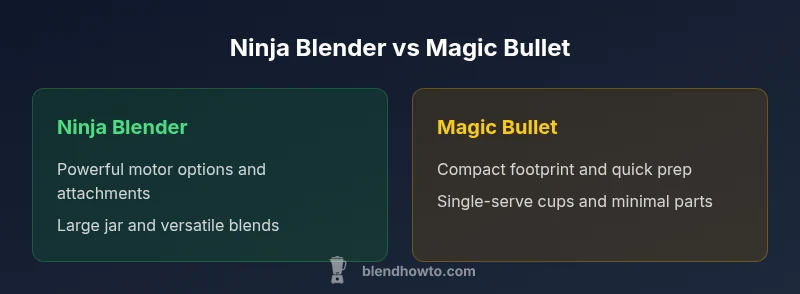
In brief, Ninja Blender vs Magic Bullet centers on capacity, power, and versatility. The Ninja typically offers larger jars and stronger blending for family-sized batches, while the Magic Bullet emphasizes compact size and quick single-serves. For most home cooks, the Ninja is the more versatile all-rounder, with the Magic Bullet remaining convenient for small spaces.
Overview: The core question behind the keyword ninja blender vs magic bullet
The choice between a Ninja blender and a Magic Bullet is not just about power. It hinges on batch size, storage space, and how often you blend into sauces, smoothies, or baby foods. In this analysis from BlendHowTo, we compare the two popular brands with a focus on real-world usage, avoiding marketing hype. Our aim is to help home cooks decide which model matches their routine while understanding the trade-offs in motor power, jar size, and attachments. When you think about ninja blender vs magic bullet, you’re weighing capacity and versatility against compact convenience and quick cleanup. The takeaway is simple: the right pick balances your kitchen footprint with your typical blending load and maintenance willingness.
Core specs to compare
When evaluating the ninja blender vs magic bullet scenario, experts stress mapping features that directly influence results: motor power categories (high/medium/low), jar size and materials, blade configuration, and available attachments. Ninja blenders often present a broader range of options and larger jars, enabling batch blending, purees, and even light ice crushing in some models. Magic Bullet emphasizes a compact footprint with shorter jars and fewer attachments, suiting single-serves and quick tasks. Construction quality, gasket design, and durability under frequent use also matter. From BlendHowTo’s perspective, assess whether you value multi-attachment versatility or minimal parts for easier cleanup. Finally, consider warranty scope and spare parts availability as practical indicators of long-term value.
Power and performance in real-world tasks
In terms of the keyword ninja blender vs magic bullet, the power argument centers on batch capability. The Ninja lineup generally delivers robust torque across a wide range of tasks, allowing you to blend fibrous greens, frozen fruit, and oil-based sauces more consistently when you work with larger batches. The Magic Bullet, by contrast, handles simpler tasks with quicker turnaround and less noise in a compact chassis. For ice, Ninja models that include a large-capacity pitcher can usually crush ice more evenly, while the Magic Bullet can crush ice but may require pulsing and smaller batches. If you routinely blend tough ingredients, prioritize longer blending cycles and more stable operation, and plan to feed families or meal-prep sessions, the Ninja approach is advantageous. If you mostly prepare single-serving smoothies or sauces, Magic Bullet remains appealing for speed and convenience.
Jar sizes, attachments, and versatility
A major practical delta between Ninja and Magic Bullet is jar size and attachment variety. Ninja blenders often ship with tall, pitcher-style jars and multiple blades, enabling tasks from broad purees to carrot-juice consistency. The Magic Bullet usually includes one or two small cups and a basic blade, which makes it highly space-efficient but limits batch size. Attachments matter: if you value slicing blades, grinding cups, or dedicated smoothie modes, Ninja ecosystems tend to be richer. For someone with a crowded kitchen, the Magic Bullet’s compact approach can be a selling point, especially when counter space is a premium.
Blade design and blending quality
Blade geometry and mounting influence texture. Ninja devices frequently employ several blades in different configurations, improving texture, evenness, and processing speed for tougher ingredients. Magic Bullet blades are simpler but reliable for everyday blending tasks. In practice, expect smoother purees and more uniform textures with Ninja when processing dense ingredients in larger batches. If your standards lean toward quick sauces and simple smoothies, the Bullet's performance can still satisfy without needing multiple blade options.
Cleaning, maintenance, and ease of use
Cleaning consideration often drives a purchasing decision as much as performance. Ninja setups tend to involve more parts, with several jars, lids, gaskets, and blades that can require careful disassembly and washing. The Magic Bullet’s simpler, fewer-piece design makes cleanup faster, especially for quick tasks. Both brands offer dishwasher-safe components on some parts, but you should always confirm model-specific guidelines. Pro tip: rinse blades immediately after use to prevent staining and build-up, and use a brush to reach shallow crevices in the jar to avoid lingering odors.
Noise, durability, and energy use
Noise is a practical annoyance in many kitchens. Powerful Ninja models can be louder due to thicker blades and higher torque, while the Magic Bullet’s smaller motor tends to be quieter. Regarding durability, Ninja products generally use sturdier jars and blades, and their warranties often reflect that. Energy use aligns with motor size and blending duration; longer blends or heavy-duty tasks will naturally consume more energy. For a home kitchen, balance your tolerance for noise with your blending tasks and space constraints.
Price, warranty, and value over time
Price is a frequent differentiator in the ninja blender vs magic bullet debate. Ninja models generally sit at a higher price point but offer larger capacity and broader functionality, which many households view as better long-term value. The Magic Bullet is typically more budget-friendly upfront and can be adequate for people who blend infrequently or live in small apartments. Warranty terms vary by model and retailer, so always review what is covered and for how long, as this directly impacts long-term value and maintenance costs.
Best use-case scenarios for each option
If your kitchen routine includes family-sized smoothies, hot sauces, and frozen dessert bases, a Ninja blender is typically the best fit. For students, singles, or households with limited counter space who mainly need quick single-serve drinks, the Magic Bullet often makes more sense. If you need a compact system that minimizes clutter but still handles basic blending, Magic Bullet emerges as the sensible choice. Conversely, if you want batch prep efficiency and more robust processing, the Ninja gains the edge.
Accessories, replacements, and future-proofing
Consider the ecosystem around each brand. Ninja models often come with broader accessory options (extra jars, blades, and specialized lids), which can extend capabilities over time and support future cooking experiments. The Magic Bullet’s ecosystem is simpler but tends to have readily available replacements and more straightforward parts compatibility with limited accessories. When possible, check compatibility for replacement parts and whether you can easily upgrade to higher-capacity kits without replacing the whole blender.
Myths, concerns, and practical checks
A common myth in the ninja blender vs magic bullet debate is that bigger is always better. In reality, your workload matters more than tank size: a constant high-volume blender that sits unused is not efficient. Another concern is maintenance: high-part blenders require more care; plan a simple cleaning routine. Finally, model choice matters: some mid-range Ninja models may outperform low-cost Bullet kits for certain tasks, while some Bullet bundles perform surprisingly well for snack prep and single-serve drinks. Grounded, practical checks include testing for batch size compatibility, ease of cleaning, and assessing the availability of spare parts before purchasing.
Practical shopping checklist and test plan before you buy
Before pulling the trigger, outline a small test plan you can execute at home. Check batch size compatibility by testing small batches and medium batches. Assess ease of cleaning by disassembling the jars, blades, and lids and ensuring parts are dishwasher-safe where appropriate. Compare noise levels by running a basic blend cycle and listening for dull tones; note if vibration is excessive. Finally, review warranty terms and replacement-part availability for your chosen model, and consider future upgrade paths if you expect your blending needs to grow.
Comparison
| Feature | Ninja Blender | Magic Bullet |
|---|---|---|
| Power & performance | high versatility and torque (Ninja) | compact power suitable for quick tasks (Magic Bullet) |
| Jar sizes & versatility | larger pitcher-style jar with attachments | short cups and limited capacity |
| Blade design | multi-blade assembly for chopping and blending | single blade focused on smooth blends |
| Ease of cleaning | more parts; dishwasher-safe | fewer parts; easier cleanup |
| Best use case | family meals, sauces, batch smoothies | single-serve drinks and basic blending |
What's Good
- Versatile performance for larger batches
- More attachment options and accessories
- Better long-term value for frequent/blending tasks
- Clear warranty options in many models
The Bad
- Higher upfront cost and bulkier footprint
- More parts to clean and maintain
- Noise levels can be higher with powerful motors
Ninja Blender offers superior versatility for most homes; Magic Bullet remains ideal for small spaces and quick tasks.
In general, opt for Ninja if you blend often and need bulk capacity. If space is king and you mostly make single-serving blends, Magic Bullet is a strong match.
Frequently Asked Questions
Which blender is better for smoothies, Ninja or Magic Bullet?
For frequent smoothie blends, the Ninja generally provides smoother results thanks to greater motor power and larger jars. The Magic Bullet is perfectly adequate for quick, single-serve smoothies but may struggle with ice and tougher ingredients. Your choice depends on batch size and storage space.
For smoothies, choose Ninja if you make large batches; Magic Bullet works for quick, single-serve drinks.
Is the Ninja blender harder to clean than the Magic Bullet?
Ninja models usually have more parts due to additional attachments, which can mean more cleaning steps. The Magic Bullet has fewer parts, making cleanup faster, though occasional dishwasher-safe components may vary by model.
Ninja often takes more time to clean because of extra parts, while Magic Bullet is simpler to rinse.
Can I crush ice with both Ninja and Magic Bullet?
Both can crush ice, but performance varies by model. The Ninja typically handles ice with higher torque and pulverizes better; the Magic Bullet can crush ice in many setups but may require pulsing and smaller batches.
Ice is doable in both, with Ninja handling larger ice chunks more reliably.
Do these blenders come with warranties?
Warranty length varies by model and retailer, but Ninja products often come with longer warranties than basic Magic Bullet kits. Always check model-specific terms and included parts.
Check the warranty at purchase; longer warranties are common with Ninja models.
Which is better for small kitchens?
Magic Bullet wins for tiny kitchens due to its compact footprint and single-serve design. If space is limited but you occasionally need larger batches, consider a Ninja with a small form-factor setup.
In tiny kitchens, go with Magic Bullet for space-saving efficiency.
Are attachments compatible across brands?
Most attachments stay brand-specific; cross-brand compatibility is limited. If you plan to mix brands, verify blade design, jar thread size, and gasket compatibility.
Attachments rarely cross brands; check jar threads and blades if mixing brands.
What to Remember
- Assess space and routine before choosing.
- Prioritize jar size if you blend for families.
- Expect higher upfront cost with Ninja.
- Magic Bullet suits single-serving tasks.
- Check warranty and parts availability.