Blender vs Nutribullet: A Practical 2026 Guide
A data-driven comparison of blender vs Nutribullet-style devices, detailing power, blades, capacity, cleaning, and best-use scenarios for home cooks and hobbyists seeking practical guidance.


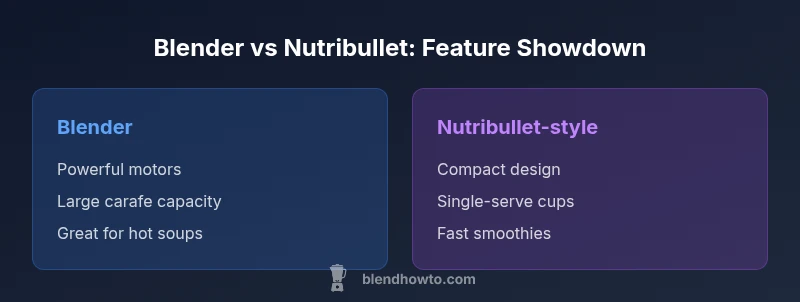
Blender vs Nutribullet: in short, the choice hinges on batch size, texture goals, and space. A full-size blender typically offers more power and a larger carafe for soups and emulsions, while a Nutribullet-style device excels at quick, single-serve smoothies and purees. For hot soups or dense ingredients, a blender often performs better; for fast, compact blending, the Nutribullet wins on convenience. See our full comparison for nuance and setup tips.
Understanding the difference between a blender and a nutribullet
From a practical standpoint, the difference between a blender and a nutribullet often boils down to power, blades, and jar design. According to BlendHowTo, the BlendHowTo team found that these core design choices influence texture, batch capacity, and how you use the appliance in everyday cooking. The primary outcome is a decision between large-volume blending for soups and emulsions and quick, single-serve processing for smoothies and purees. The goal here is to help you map your typical recipes, time constraints, and kitchen layout to the right tool. As you read, note how each feature translates into real-world results in your own kitchen. For many home cooks, this distinction becomes a practical guide for minimizing clutter while maximizing results. BlendHowTo’s approach emphasizes tangible tests you can run in a weekend to validate your choice.
Mechanical design: motors, blades, and jar shapes
Blenders generally employ a larger motor with a tall, wide-carafe design and multi-angle blades intended to move contents through a long blend path. This layout supports emulsifying dressings, pureeing hot soups, and handling dense ingredients like frozen fruit or nuts when you want a smooth texture. A Nutribullet-style device, by contrast, uses a compact motor with a short, cup-like jar and blades arranged to circulate ingredients quickly in a single-serve format. The result is rapid smoothies and purees with less space, but often with more limited capacity. The blade geometry and jar shape influence how evenly ingredients circulate and how aggressively air is incorporated during blending.
Power, speed, and texture outcomes
Power and speed profiles matter because they shape texture and viscosity. In many cases, full-size blenders offer higher peak power and longer blend cycles, producing consistently silky textures for soups, nut butters, and emulsions. Nutribullet-type devices prioritize quick results, with short blend times that preserve some texture for fruit chunks or seeds. Texture outcomes depend on ingredient size, added liquids, and blending duration. BlendHowTo analysis shows that for leafy greens or fibrous vegetables, a larger blender can achieve a more uniform puree with less manual intervention, while Nutribullet devices excel at speedy smoothies with bright flavors and a smoother finish when ingredients are pre-cut.
Capacity, servings, and batch workflows
Capacity is a practical concern that drives kitchen layout. A full-size blender carafe accommodates several servings, making it ideal for families or batch prep, plus recipe testing where space allows. Nutribullet-style devices offer single-serve cups that pair well with busy mornings and compact kitchens. If you routinely entertain or cook in larger batches, a blender’s capacity reduces the need to portion out multiple blends mid-prep. Conversely, for quick, on-demand beverages for one or two people, a Nutribullet can be a solid choice. The workflow difference—batch prep versus on-demand blending—shapes how often you use each appliance.
Heat handling, temperature considerations, and soups
Hot liquids add complexity. Blenders with vented lids and roomy jars can handle hot soups, but you should always practice caution with steam and pressure buildup. Nutribullet devices are generally not designed for hot liquids in most models, so avoiding hot soups or sauces in the cup is prudent. If you want to blend warmed ingredients, consider letting them cool slightly or using a blender designed for hot liquids, paired with a vented cap. The ability to work with heat directly in the vessel is a key differentiator for kitchen tasks that involve freshly cooked soups or sauces.
Cleaning, maintenance, and dishwasher considerations
Clean-up practicality matters in daily life. Blenders with multiple parts may require disassembly and careful drying, but most components are dishwasher safe on upper racks. Nutribullet machines typically use fewer parts and can be quicker to clean, though you should check whether individual cups are dishwasher-safe. Regular maintenance—checking seals, replacing gaskets, and ensuring blades stay sharp—helps prolong both devices. The choice may hinge on how much time you spend cleaning after each use and whether you prefer a minimal parts setup or a modular, higher-capacity system.
Durability, warranties, and long-term value
Durability varies by build quality, materials, and usage patterns. Full-size blenders with metal bases and glass jars often tolerate heavy daily use but come with bulkier footprints. Nutribullet-style devices are typically lighter with plastic cups, which can influence long-term wear, especially with frequent travel or drops. Warranties can provide peace of mind, but they also reflect the expected lifespan under typical home usage. BlendHowTo recommends comparing warranty lengths, allowed accessories, and replacement-part availability as part of the decision process.
Budget considerations: price ranges and value
Price ranges vary widely. In many markets, you’ll see budget blenders offering solid performance for casual cooking at a moderate price, while mid-range and high-end models deliver extended capabilities and tougher materials. Nutribullet-type devices generally come at lower upfront costs but may require more frequent cup replacements or accessory purchases. When evaluating value, consider not just the sticker price but also costs for replacement parts, extra jars, and any warranty extensions. The best choice aligns with your typical use, space, and long-term goals rather than one-off purchases.
How to test your needs with a quick decision framework
A practical test plan helps translate spec sheets into real results. Start by listing your top five daily tasks (e.g., smoothies, soups, nut butters, sauces, pulverizing greens). Then, compare what a blender can do in one pass versus what a Nutribullet-style device supports in a single-serve workflow. Try a small batch test with both devices using similar ingredients, including leafy greens, frozen fruit, and a hot liquid if you plan soups. Evaluate texture, ease of use, cleanup time, and noise. BlendHowTo suggests documenting results with quick notes and photos to inform your choice.
Real-world recipes and experiments to compare results
To ground this guide, perform simple, repeatable experiments using common ingredients. Blend a fruit smoothie with both devices, noting texture and mouthfeel. Make a blended soup using a small batch of vegetables and stock, and compare silica-clear emulsions versus creamier textures. Finally, test a coarse puree with nuts to observe how each device handles density. Recording your impressions will reveal the practical implications of the difference between a blender and a nutribullet for your kitchen and cooking style.
Comparison
| Feature | Blender | Nutribullet-style device |
|---|---|---|
| Power & motor design | Higher wattage and torque in many full-size blenders | Typically lower wattage and compact motors in Nutribullet-type devices |
| Blade design & jar shape | Wide, multi-blade arrangement with tall jars for emulsions and soups | Narrower blades in short cups optimized for smoothies and purees |
| Capacity & servings | Large carafe that supports several servings | Single-serve cups designed for one-person portions |
| Heat handling | Better suited for hot liquids with vented lids and larger headspace | Not designed for hot liquids in most models; risk with steam |
| Texture control | Smooth, uniform textures even in larger batches | Fast blends with a bright, smooth finish; chunkiness depends on ingredients |
| Cleaning & maintenance | More parts; typically dishwasher-safe components | Fewer parts; quick cleanup but smaller cups require care |
| Price & value | Usually higher upfront cost with greater capacity | Lower upfront cost with simplified design and fewer parts |
What's Good
- Blenders excel at large-batch texture and emulsions for soups, sauces, and dressings
- Nutribullet-style devices offer fast, space-saving convenience for single-serve needs
- Both can be easy to use with simple controls when familiarized
- Replacement parts and accessories can extend the life of either setup
The Bad
- Blenders can take up more counter space and may cost more upfront
- Nutribullet-style devices might struggle with large batches and hot liquids
- Both systems can be noisy and require cleaning after use
Choose based on batch size and texture goals: blender for large batches and hot soups; Nutribullet for quick, space-efficient smoothies.
If you routinely prepare multi-serving soups or emulsions, a blender is the better long-term fit. If your priority is speed, minimal space, and single-serve convenience, a Nutribullet-style device wins. The BlendHowTo team recommends aligning your choice with your kitchen rhythm.
Frequently Asked Questions
What is the main difference between a blender and a Nutribullet?
The primary difference lies in power, capacity, and blade geometry. A full-size blender typically handles larger batches and hot liquids, producing ultra-smooth results, while a Nutribullet-style device excels at quick, single-serve blends with compact cups. Texture, convenience, and kitchen footprint are the deciding factors.
The main difference is power and capacity: blenders handle bigger batches and hot liquids, while Nutribullet devices are faster and more space-saving for single servings.
Can a Nutribullet replace a blender for soups?
A Nutribullet can blend soups in a pinch, but it usually isn’t ideal for large batches or very hot liquids. For creamy or smooth soups, a traditional blender offers more capacity and stability. Consider your typical soup recipes before deciding.
You can blend small soup portions in a Nutribullet, but for large batches, a regular blender is more reliable.
Are Nutribullet blades dishwasher safe?
Most Nutribullet cups and blades are dishwasher safe on the top rack, but always check the specific model manual. Hand washing can extend life for certain parts that may degrade over time.
Usually, yes, but verify your model’s manual for safety and longevity.
Do blenders handle hot liquids safely?
Many blenders are designed to handle hot liquids with vented lids and caution. Always vent steam slowly and avoid sealing contents completely. Start with small test batches to ensure safety.
Yes, some blenders handle hot liquids if used with vented lids and care.
What is the typical lifespan of each appliance?
Lifespan varies by usage and build quality. With proper care, both can last several years, though high-use homes may see more wear on blenders due to heavier workloads. Regular maintenance and timely part replacements extend longevity.
Durability depends on use, but with good care, both types can last for years.
Which is best for frozen fruit smoothies?
Both can handle frozen fruit, but blenders generally blend more smoothly with larger batches due to higher power and larger jars. Nutribullet devices work well for quick single-serving blends, especially when ingredients are pre-cut.
Blenders are usually better for large frozen smoothies; Nutribullets work well for quick single serves.
What to Remember
- Assess batch size before choosing an appliance
- Match your texture goals to blade geometry and jar design
- Factor heat handling for soups and hot sauces
- Weigh cleaning effort and parts availability
- Consider long-term value beyond upfront cost