How Much Does Blender Take Up? Space, Size, Storage
Explore how much space a blender takes up on your counter and on disk, with practical planning tips for small kitchens and Blender software projects.


The phrase 'how much does blender take up' refers to both its physical footprint on your counter and the disk space Blender software consumes. On the hardware side, most countertop blenders are roughly 14-18 inches tall with a 6-9 inch base, needing about 1-2 square feet of real estate on the counter. For software, installation typically occupies a few hundred megabytes, with bigger projects growing with complexity.
Understanding the phrase 'how much does blender take up'
In everyday use, the question can mean two different things: the physical space a blender occupies on your countertop and the disk space Blender software needs on your computer. The two domains share one concept—space—but they live in different environments: your kitchen and your hard drive. Understanding both helps you plan better, especially in small kitchens or compact workspaces. You’ll want to measure doorways, cabinets, and countertop real estate, and you’ll also consider install size, cache, and project data when you work with Blender. How much does blender take up isn’t a single number; it’s a two-part consideration that guides both buying choices and storage habits.
Physical footprint: countertop blenders
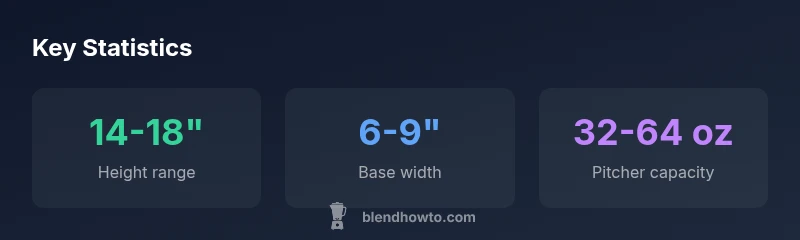
Most countertop blenders are designed with a tall profile and a wide base to stabilize rotation during blending. Typical heights range from 14 to 18 inches (35 to 45 cm), while base widths and depths commonly sit between 6 and 9 inches (15 to 23 cm). When you place one on a kitchen counter, aim for at least 4 inches of clearance on all sides to accommodate ventilation and cleaning. If your counter is tight under cabinets, look for models with a shorter profile or a compact pitcher. Additionally, consider the pitcher capacity (usually 32–64 ounces) and lid clearance when measuring your available space. These numbers are general ranges and vary by model, so always check the exact specs for your chosen blender.
Space planning and storage tips
Plan your countertop layout to keep appliances you use daily within easy reach. Use vertical storage solutions where possible (wall rails, magnetic strips, or under-cabinet shelves) to free up counter space for prep work. For tight kitchens, consider a compact model with a pitcher that fits under cabinets or a multi-purpose appliance that can perform other tasks. Measure the largest width of the base plus any protruding controls, and add at least 2–3 inches for safe operation. A simple visualization exercise—sketching a 14 x 16 inch footprint on graph paper—helps you confirm if the blender fits with room to spare.
Blender software storage basics
Blender is a versatile 3D package, and understanding its storage footprint helps when planning a productive workstation. The installer is typically a few hundred megabytes, with extra space needed for caches and assets. Desktop projects can start small (tens of MB) and scale up to hundreds of MB or more as you add textures, geometry, and baked simulations. If you work with complex scenes, ensure you have extra disk space and a fast drive for smoother editing and rendering. Regularly manage autosaves, archive old versions, and keep a clean project folder to prevent clutter from ballooning.
Managing space with multi-purpose kitchen tools
If you’re working in a compact kitchen, consider tools that can perform multiple tasks to reduce clutter. A blender that doubles as a puree-and-chop unit can replace several single-purpose gadgets. Store blades and jars in labeled containers or attachable racks to an inside cabinet door. For software workflows, organize projects into clearly named folders, use external drives for backups, and enable incremental saves to minimize wasted space from large, multiple-version files.
Data-driven space planning: a quick example
Imagine a small apartment kitchen with 30 inches of continuous counter. If you allocate 14 inches for the blender base and 6 inches for the pitcher at rest, you’ll leave 10 inches of clearance for hands-on operation and cleaning. Add 4 inches of clearance on either side for ventilation. This simple arithmetic ensures you won’t block a nearby toaster or coffee maker and keeps the counter easy to clean after smoothies. The same logic applies to desk space for Blender: reserve a dedicated 2–3 feet of horizontal space for the monitor, keyboard, and mouse, plus a separate table or shelf for large render jobs.
Cleaning, maintenance, and longevity considerations
Regular cleaning helps maintain the blender’s footprint over time by preventing scale buildup that can widen base contacts or extend the pitcher. Wipe the base and blades safely, dry thoroughly, and check seals. For Blender workflows, organize assets and textures in a consistent folder structure. Archive completed projects to prevent clutter on your active drive and schedule periodic reviews of installed plugins or addons to ensure they don’t bloat your workspace.
Blender physical footprint comparison
| Aspect | Footprint (approx) | Notes |
|---|---|---|
| Height | 14-18 inches | Typical countertop models |
| Base width | 6-9 inches | Measured at widest base area |
| Depth | 6-9 inches | Front-to-back space including pitcher |
Frequently Asked Questions
What is the typical height and width of a standard countertop blender?
Most countertop blenders are about 14-18 inches tall and 6-9 inches wide. Exact dimensions vary by model, so always check the product specs before buying.
Most countertop blenders are around 14 to 18 inches tall and 6 to 9 inches wide. Check the model’s exact specs before purchasing.
How much space should I leave around a blender on the counter?
Aim for at least 4 inches of clearance on all sides to allow ventilation and easy cleaning.
Leave about four inches around the blender for airflow and cleaning.
Do compact or under-cabinet blenders exist and how do they differ in footprint?
Yes, compact or under-cabinet designs are shallower but taller and may include built-in storage. Always verify depth and clearance.
Compact models save space but check depth and clearance.
How does Blender software storage compare to other 3D apps?
Blender’s install size is modest relative to large 3D suites; project sizes vary widely with scene complexity.
Blender’s install is small, but project sizes depend on complexity.
What are best practices to manage blender footprint in a small kitchen?
Choose a compact model with a pitcher that fits under cabinets, use vertical storage, and utilize pull-out shelves.
Go compact and store smart.
Are travel-size blenders a good option for space-constrained homes?
Travel blenders are smaller but often have smaller pitchers and weaker motors; evaluate your blending needs.
Great for space but power matters.
“Space planning is a practical skill that pays off in both kitchen efficiency and software productivity. Measure twice, store smartly, and you’ll blend more smoothly.”
What to Remember
- Measure your countertop before buying.
- Plan for at least 4 inches of clearance around the blender.
- Blender software size is modest but scales with project complexity.
- Organize Blender projects to avoid disk bloat.
- Use vertical storage to maximize small-kitchen efficiency.