Is a Food Processor and Blender the Same? A Practical Comparison
Explore whether a food processor and blender are the same, with practical differences, typical uses, and buying tips for home cooks and hobbyists seeking practical blending guidance.


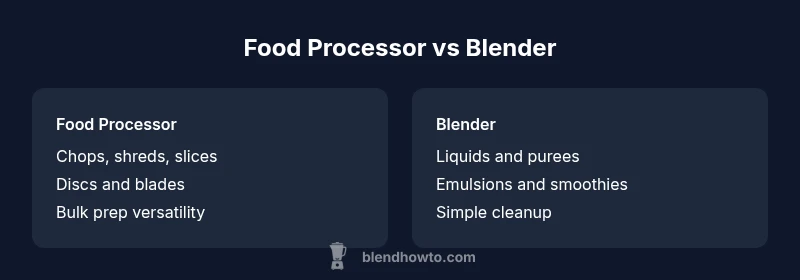
Is a food processor and blender the same? Not exactly. A food processor specializes in chopping, shredding, and mixing with interchangeable blades, while a blender excels at liquid blends, emulsions, and purees. This guide compares their core functions, attachments, and typical uses to help you decide which appliance fits your kitchen tasks.
Is the Difference Clear from the Start?
In everyday kitchens, people often assume that a blender and a food processor can substitute for each other. The primary keyword here is is a food processor and blender the same, and the short answer is no. The distinction begins with the core task each appliance is engineered to perform. A blender is designed to transform solid ingredients into smooth liquids, emulsify sauces, or crush ice into a drinkable texture. A food processor, conversely, is built to chop, slice, shred, and mix ingredients with blades and discs that mimic the work of a miniature kitchen, enabling bulk prep and precise textures. This difference in intent drives decisions about attachments, speed controls, and cleaning routines. For home cooks and hobbyists, understanding the boundary between chopping versus blending sets the foundation for smarter gear purchases and more efficient cooking workflows.
Core Functions and Use Cases
A blender’s strongest suit is handling mixtures that require smooth textures, such as smoothies, soups, sauces, and purees. High-powered models can emulsify dressings and crush ice, though performance varies by blade design and motor speed. Food processors specialize in repetitive, high-volume prep tasks. With a chopping blade, shredding discs, and slicing discs, a processor can handle vegetables, nuts, doughs, and heavy mixtures. The choice often hinges on texture goals: a blender is your go-to for creaminess; a processor is better for uniform chopping, uniform dices, and dough handling. However, many cooks maintain both for their complementary strengths.
Attachments, Blades, and Motors
Attachments are what truly distinguishes these appliances in practice. A blender relies on a sealed jar and a blade assembly optimized for liquids; some models offer optional blending lids or tamper devices to improve texture. A food processor uses a sturdy bowl and multiple attachments—chopping blades, shredding discs, slicing discs, and kneading blades—to expand its repertoire. Motor torque matters as well: blenders often feature powerful, high-speed motors to drive blades through dense ingredients, while processors favor torque and speed control designed for consistent cuts and dough handling. When shopping, look for compatibility with a range of blades and discs to maximize versatility.
Capacity, Size, and Power Considerations
Capacity choices reflect your kitchen scale and meal prep volume. Blenders generally come in jar sizes optimized for beverages, ranging from compact single-serve designs to large pitcher models. Food processors offer larger bowls and wider feed chutes, which facilitate bulk prep with minimal pre-cutting. Power ranges differ in emphasis: blenders emphasize sustained high-speed blending, while processors emphasize steady torque for chopping and kneading. Consider the footprint in your cabinet as well; a processor with multiple discs can take more storage but pays off in texture versatility. Select a model that matches the typical batch sizes you prepare and the space you have available.
Use-Case Scenarios: When a Food Processor Shines
If your weekly routine includes making homemade pesto, chopping onions, shredding cabbage for slaws, or kneading dough for bread, a food processor becomes indispensable. It excels at bulk prep tasks, uniform cuts, and textured mixtures that require controlled consistency. If you routinely blend fruit smoothies, melt soups, or emulsify vinaigrettes, a blender will deliver smoother textures faster. The deciding factor is your dominant cooking style: heavy chopping and bulk preparation favor the processor, while frequent blending tasks favor the blender. For many cooks, the most practical approach is to own both or to invest in a high-utility model that blends well enough with its attachments.
Design, Cleaning, and Maintenance Realities
With multiple attachments, a food processor can feel like a modular kitchen in a box. Cleaning involves disassembling the bowl, blades, discs, and lids, then washing each piece thoroughly. Blenders tend to have fewer parts, but the blade assembly in the jar can be sharp, demanding careful handling. Dishwasher compatibility varies by model—always check manufacturer guidelines. To simplify upkeep, choose models with fewer detachable parts and clear labeling on assembly. Routine maintenance includes inspecting gaskets and blade sharpness, as well as keeping discs free of food residue to prevent residue buildup that can impact performance.
Budget, Value, and Longevity
Budget models exist at the entry level, primarily focused on essential chopping or blending tasks, while mid-range and premium units offer broader accessory ecosystems, better build quality, and longer warranties. Value isn’t just about sticker price; it includes accessory breadth, durability, and the range of textures you can achieve. When evaluating longevity, consider the availability of replacement discs, blades, and bowls—especially for models that see heavy daily use. A well-chosen, properly maintained appliance can remain a kitchen workhorse for many years, reducing the need for frequent upgrades.
How to Choose: A Simple Decision Framework
A practical decision framework begins with your top tasks. List daily or weekly tasks (chopping, shredding, dough work, smoothies, soups). Map these tasks to the core strengths of either device: chopping and bulk prep for a food processor; blending and emulsions for a blender. Then assess attachment ecosystems and maintenance requirements. Consider space constraints and whether you want a single, highly capable model or separate devices that perform specialized jobs. Finally, compare warranties and parts availability, since these factors strongly influence long-term value.
Common Misconceptions Debunked
A frequent myth is that you can fully substitute one device for the other with the right attachments. In reality, while some models blur the line, fundamental design differences drive performance: texture control, blade geometry, and motor torque. Another misconception is that more speed settings automatically improve results. While helpful, the key is how the controls translate into stable textures across ingredients and batch sizes. A third myth is that budget models are always poor choices. In truth, budget options can be excellent for basic chopping or blending tasks, provided you don’t push them into heavy-duty work regularly.
Practical Buying Checklist for Home Cooks and Hobbyists
- Identify your top tasks and textures you desire (smooth vs chunky).
- Check attachment availability (blades, discs, kneading blade) and compatibility with future upgrades.
- Compare jar/bowl capacities against your typical batch sizes.
- Consider cleanability, dishwasher safety, and storage space.
- Review warranties, spare parts availability, and customer support.
- Read independent reviews focusing on real-world performance and reliability.
Quick Reference: Task-to-Tool Mappings
- Smoothies, emulsions, and creamy sauces: Blender
- Dicing, shredding, dough work: Food Processor
- Large-batch prep with uniform textures: Food Processor
- Quick one-jar blending for soups: Blender
- When in doubt, assess texture goal first; choose tool aligned with output
Comparison
| Feature | Food Processor | Blender |
|---|---|---|
| Primary function | Chop, slice, shred, mix with discs | Blend liquids and create smooth textures |
| Best for | Bulk prep, precise cuts, dough work (with attachments) | Smoothies, sauces, emulsions, purees |
| Ease of cleaning | Many parts; discs, blades, and bowls require disassembly | Typically fewer parts; blade in jar can be sharp |
| Typical capacity | Larger bowls; wide feed chutes for bulk prep | Various jar sizes; optimized for beverages and purees |
| Power/torque options | High torque with varied speeds for chopping | High-speed blending with emulsifying capability |
| Versatility | Extensive attachments enable broader tasks | Limited by jar size; best for blending tasks |
What's Good
- Clarifies task specialization for predictable results
- Expands kitchen capabilities with multiple attachments
- Efficient for batch prep and consistent textures
- Offers broader texture control with diverse speeds and blades
- Allows budget-focused shoppers to pick models that fit needs
The Bad
- Bulky footprint and more storage space required
- Higher upfront cost for versatile models
- Cleaning multiple attachments can be time-consuming
- Not all models handle heavy dough or dense ingredients well
Choose based on your dominant kitchen tasks—blenders excel at liquids and purees, while food processors shine for chopping and bulk prep.
If you primarily blend beverages or sauces, a blender is the better fit. If you frequently chop, shred, or knead dough, a food processor provides greater versatility. For many cooks, owning both offers maximum efficiency and flexibility.
Frequently Asked Questions
Are food processors and blenders interchangeable?
Not exactly. Each appliance is optimized for different textures: blenders for liquids and smooth blends, food processors for chopping, shredding, and dough work. You can substitute in some cases, but results won’t be optimal.
They’re not interchangeable—choose the tool that matches the texture you want.
What tasks can a food processor do best?
A food processor excels at chopping, shredding, slicing, and kneading dough with the right attachments. It’s ideal for bulk prep and producing consistent textures across batches.
Great for bulk chopping and dough work.
Can a blender replace a food processor?
In most cases a blender cannot fully replace a food processor, especially for chopping, shredding, or dough handling. Some blenders offer pulse or variable speeds, but texture control will be different.
Blender isn’t a full substitute for a processor.
Do I need both appliances?
If your cooking style includes frequent bulk prep and texture control, both tools offer distinct advantages. For light use, one versatile device may suffice; for serious cooks, a balanced pair reduces prep time.
It depends on how often you do bulk prep and texture work.
How should I clean each appliance?
Disassemble the parts per the manual, rinse promptly after use, and wash with warm, dish soap. Some parts may be dishwasher-safe; always verify manufacturer guidance.
Clean each piece after using it to maintain performance.
What budget ranges should I expect?
There are budget, mid-range, and premium options. A basic model covers essential tasks, while mid-range and premium units offer more attachments, better build quality, and longer warranties.
There are options for every budget, with more versatility at higher price points.
What to Remember
- Identify your top tasks before buying
- Attach accessory ecosystems before purchasing
- Balance upfront cost with long-term versatility
- Choose one or both based on texture goals and batch size