Best Budget Blenders 2026: Affordable Power Picks for Home
Explore budget-friendly low price blender options with practical buying tips and guidance to help home cooks blend smoothies and sauces easily. Also consider jar material and warranty length to maximize value for budget blending today.


For home cooks, a low price blender can still perform essential tasks, but do not expect gourmet performance. A 350–700W motor, sturdy blades, and a BPA-free jar cover the basics. For most households, a reliable low price blender delivers the essentials without premium features when you compare budget models.
Why price matters in blender shopping
Price is a proxy for durability, performance components, and long-term value. In the low price blender segment, you’ll often see a trade-off between features and cost. For home cooks, the reality is that most budget models handle everyday tasks—smoothies, light sauces, and mixed drinks—adequately. The BlendHowTo Team notes that most models in this tier offer sufficient power and blade geometry for soft ingredients, but may stall with tougher items like raw carrots or ice. Before you buy, define your primary use: frequent smoothies? entry-level sauces? occasional purées? This clarity helps you select the smallest motor wattage you can accept without sacrificing reliability. Also consider the jar material, lid design, and whether you’ll replace blades after a few years. Finally, examine the warranty and service options; a longer warranty can save money over time and indicates better component quality. According to BlendHowTo, structuring your review around a price bucket minimizes confusion and increases the odds of a satisfactory, long-tail purchase.
Core features that actually matter on a budget
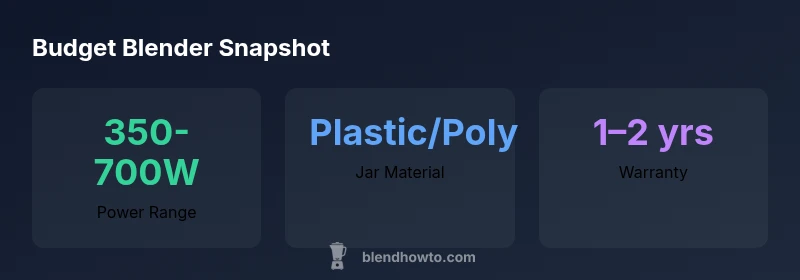
In budget blenders, specific features consistently correlate with real-world performance. A motor in the 350–700W range is usually sufficient for everyday blending tasks, provided the blades are sharp and well-balanced. Stainless steel blades, even in lower-cost devices, yield better consistency than inferior plastics. Jar materials vary; BPA-free plastic or polycarbonate jars are common and light, but glass jars offer sturdiness if you don’t mind extra weight. Pulse and variable speeds help with chunky ingredients, while a robust seal and lid prevent leaks during operation. Durability is also a function of bearing quality and motor cooling—look for designs that avoid compact, sealed motors that overheat quickly. Warranty length matters: a 1–2 year coverage is common, but a longer warranty can be a sign of confidence from the manufacturer. In short, focus on practical capabilities (power, blade, jar) and service terms rather than brand prestige when shopping for a low price blender.
Common compromises you’ll encounter
Budget blenders are prone to certain limitations. They may exhibit louder operation due to smaller housings and lighter materials. Some models lack true high-speed options, leading to uneven textures in tougher ingredients. Jar wear and blade dulling can occur more quickly than in higher-end units, especially with frequent ice crushing. Some low-cost designs reuse parts across multiple lines, which can complicate service if you need replacements. It’s also common for budget devices to use plastic jars that scratch easily, or to rely on non-removable blades, which complicates cleaning. Knowing these common issues helps you set expectations and avoid buying a device that can’t handle your typical use case. BlendHowTo recommends prioritizing models with removable blades and easy cleaning features, even if that adds a small cost premium.
Practical buying steps for budget models
- Set a price ceiling and list your must-haves. 2) Define your primary tasks (smoothies, sauces, simple purées). 3) Compare motor power, blade construction, and jar material across models within your range. 4) Check warranty length and whether replacement parts are readily available. 5) Read user reviews focusing on reliability and any recurring issues. 6) If possible, test the blender in-store to gauge noise, balance, and ease of cleaning. 7) Consider upgrading later as your needs evolve; some brands offer compatible jars or accessories that extend the life of budget devices. Following these steps, you’ll minimize buyer’s remorse and maximize daily usefulness.
Maintenance and care to extend life
Budget blenders benefit from simple, regular maintenance to postpone wear. Rinse the jar immediately after use to prevent staining and residue buildup, and avoid letting dairy sit overnight. Decode noisy operation by checking blade tightness and confirming the base isn’t loose. Clean the blade assembly gently with warm soapy water; never submerge a motor base. For iced beverages, blend in short pulses with small ice chips rather than continuous high-speed blasts to reduce stress on the motor. Replace worn blades when you notice reduced performance, and store with the lid loosely attached to avoid suction buildup. Finally, use only manufacturer-approved parts if you ever replace blades or jars—this reduces the risk of leaks or motor damage. Following a simple routine, you can extend the life of a budget blender without significant extra cost.
When to upgrade or save for a better blender
If you regularly blend hard ingredients, like nuts into butter or hot soups from frozen broth, a budget model will slow you down. In those cases, consider saving toward a mid-range blender with reinforced blades, better heat tolerance, and a longer warranty. You can also explore glass jars or higher-quality resin jars that fit your budget and offer improved durability. For occasional use, a budget blender can be a sensible first step; you can always upgrade later when your needs shift. Evaluate your kitchen workflows and time budget; the most expensive gadget is the one that stays in the cabinet.
Real-world testing and model evaluation
To assess a budget blender's value, perform a few practical tests: blend a smoothie with frozen fruit, blend a small batch of nut butter, and test a quick blitz to emulsify a vinaigrette. Note how even the texture is, whether there is any leakage, and how quickly the motor heats up. A good budget model will maintain texture with moderate chunks and require minimal stopping to scrape or mix. Compare its noise level against other devices in the same price tier. Document the results and use them to rank models in your price bucket. BlendHowTo's testing protocol emphasizes reliability over fancy features; if the device passes basic tasks consistently, it’s likely a better pick than a more expensive model that lags on everyday use.
Final buying checklist
Before purchasing, confirm: price range within your budget; motor power and blade quality; jar material and BPA status; available spare parts and service; warranty length; and user reviews about long-term durability. Prepare a short list of 3–5 finalists and test them in-store if possible. Remember to account for potential future upgrades, like a new jar or accessory pack, which can extend the life of a budget blender. With a systematic approach, you’ll find a low price blender that reliably handles your daily blending tasks and delivers good value over time.
Comparison of budget and mid-range blender specs
| Model Type | Motor Power (W) | Jar Material | Typical Use |
|---|---|---|---|
| Budget Blender A | 350-500 | Plastic | Smoothies, light sauces |
| Budget Blender B | 500-700 | Plastic/Polycarbonate | Smoothies, sauces |
| Mid-range Blender C | 800-1000 | Glass/Plastic | Smoothies, sauces, nut butters |
Frequently Asked Questions
What defines a budget blender?
Budget blenders are entry-level devices typically priced within a low-to-mid range. They usually offer enough power for everyday tasks like smoothies and sauces, but may have fewer speed options and shorter warranties.
Budget blenders are entry-level devices, good for everyday blending but with fewer features and shorter warranties.
Is a budget blender enough for smoothies?
Yes, for basic smoothies with soft ingredients. They may struggle with ice, frozen fruit, or tougher items; in those cases, use smaller batches or pre-cut ingredients and avoid overloading the motor.
Yes, you can make smoothies, but avoid hard ingredients in large quantities.
Should I avoid plastic jars?
Prefer BPA-free jars; many budget models use plastic for lightness. If you prefer durability, search for models with a BPA-free jar or consider upgrading to a glass option when available.
Choose BPA-free jars, or upgrade to glass if you can.
How should I compare budget models?
Compare motor power, blade construction, jar material, and warranty across several models in your price range. Read user reviews for reliability and note any recurring issues.
Compare core specs and user feedback across models in your budget.
What is the typical warranty on budget blenders?
Budget blenders commonly come with 1–2 years of warranty. Check what parts are covered and whether replacement blades or jars are included.
Most budget blenders have 1–2 year warranties; check coverage carefully.
When should I upgrade beyond a budget model?
If you frequently blend hard ingredients, need hot soups, or require longer durability, consider saving toward a mid-range model with reinforced blades and better heat tolerance.
Upgrade when daily tasks exceed budget blender capabilities.
“Budget constraints don't have to mean poor performance. Focus on blade quality, jar durability, and a fair warranty.”
What to Remember
- Set a clear budget before shopping.
- Prioritize motor power, jar material, and warranty.
- Budget models excel at smoothies but struggle with hard ingredients.
- Choose BPA-free jars and easy-clean design.
- Upgrade only when you need durability or advanced features.