What Is the Cheapest Blender? A Practical Buying Guide
Discover the cheapest blender and how price impacts performance, with a data-driven approach from BlendHowTo. Learn how to compare budget blenders, assess long-term value, and decide when to upgrade in 2026.


Definition: The cheapest blender typically costs about $15–$40 for a basic model, with occasional promos under $20. Prices rise with power, jar size, and durability. According to BlendHowTo Analysis, 2026, budget blenders cover essential tasks like smoothies and light purées, but expect limited longevity and fewer features than mid-range models.
What qualifies as the cheapest blender?
Budget buying hinges on price parity with performance. When you ask the question what is the cheapest blender, you’re weighing minimal upfront cost against core capabilities. The price spectrum typically starts around 15 to 40 USD for basic models, with occasional promos dipping under 20 USD. According to BlendHowTo Analysis, 2026, most budget blenders can handle smoothies and light purées of soft ingredients, but ice and frozen fruit may require patience or pre-processing. Cheaper units often rely on plastic jars and simpler motors, which keeps costs down but can affect longevity and reliability. If you primarily whip up smoothies a few times a week, a sub-$30 model may suffice; for regular use or dense blends, expect the need to upgrade sooner or later and plan for a higher price tier or an entry-level mid-range model that offers more robust build quality and warranty.
To put it in perspective, the term cheapest is not a fixed threshold. Different retailers run promos, and some models dip below the typical price band during holiday sales. The key is to evaluate what you truly need: basic blending versus a versatile appliance that handles ice, seeds, and tougher ingredients. The BlendHowTo team notes that the cheapest option must still meet safety standards and have predictable performance, or you’ll end up buying twice.
Brand and retailer strategies also influence price. In many cases, a well-timed sale paired with a straightforward warranty offers better long-term value than a marginally cheaper unit without reliable service options. If you want a concrete anchor, aim for models that consistently meet basic blending tasks while providing at least a 1-year warranty.
For shoppers who want minimum complexity, the cheapest blender can be a good starting point. But if you blend daily or want predictable results across ingredients, you’ll eventually want to move up to a model with greater motor strength and sturdier construction.
Price ranges and buyer expectations
Price matters, but expectations matter more. The cheapest blenders—often listed under 50 USD—tunnel you into essential blending with limited power and smaller capacity. When you climb into the 40–60 USD band, you typically gain a more capable motor, a slightly tougher jar, and longer warranty options. Crossing the 60–100 USD line usually unlocks better blade designs, improved durability, and more stable performance with ice, seeds, and fibrous vegetables. For many home cooks, the sweet spot lies in the 40–80 USD range, where you get a practical balance of performance and value. In 2026, BlendHowTo Analysis shows a clear relationship between price bands and expected outcomes: basic smoothie work at the low end, more reliable processing and longer life as you move higher. Always consider warranty terms and replacement parts availability, which strongly affect total cost of ownership.
If your budget is tight, prioritize models with at least 2 speeds or a pulse function, a sturdy lid, and a reasonably sized jar. If you already own an existing high-demand appliance, check whether a budget blender can complement it for specific tasks that don’t require heavy-duty blending. The goal is to maximize utility per dollar, recognizing that the cheapest option is not inherently the best value for every use case.
To validate value, compare price per year of expected service. A cheap unit that lasts 1–2 years may still be a winning pick if it’s used sparingly, while a slightly pricier model with a longer warranty and better build could deliver lower long-term costs for frequent users.
Key features to look for in budget models
Budget models should still deliver consistent performance for common tasks. Focus on core features: motor power, blade quality, jar durability, and safety design. Look for a motor with at least 350–500 W for basic smoothies and blends; models offering 600–700 W begin to perform more reliably with tougher ingredients. Blade design matters too: a robust, multi-wing blade geometry often yields smoother results and reduces the need for repeated blending passes. Jar material influences durability and hygiene; while plastic jars are light and affordable, glass jars resist staining and may be easier to clean, though they’re heavier. Check the lid fit and the handle ergonomics. A straightforward on/off or pulse control beats overly complex preset programs that can fail under heavy use. Finally, verify compatibility with dishwasher-safe parts and verify the presence of a warranty that covers motor failure for at least one year. Budget buyers should be prepared to replace blades or seals as needed, which is a normal part of ownership for the cheapest units.
In short, aim for a model with solid basics rather than a long list of gimmicks. A few well-chosen features will improve daily results and reduce the risk of early failure. The BlendHowTo team recommends prioritizing durability and warranty over flashy presets, especially if you plan to upgrade later.
How to compare prices across retailers
Price comparison requires a little method. Start by outlining your must-haves (power, jar size, warranty) and a nice-to-have feature list (ice crush, preset programs). Then search across major retailers and marketplaces, keeping an eye on seasonal promos and bundle deals. Refurbished or open-box options can shave substantial dollars, but only from reputable sellers with transparent return policies and clear warranty terms. Read customer reviews to assess real-world reliability, focusing on motor performance, noise levels, and jar wear. Price history matters too: if a model sits at the same price for months, a temporary discount could appear soon. Subscribe to retailer newsletters or set price alerts to catch flash sales. Finally, verify warranty validity, parts availability, and the return process before purchasing. If a model is frequently discounted during specific events, note that timing can unlock significant savings without compromising functionality.
Shopping strategically means not rushing for the cheapest tag but seeking the best price-to-performance balance. This approach aligns with BlendHowTo Analysis, 2026, which emphasizes long-term value over short-lived savings. For many buyers, the right tactic is to wait for a steady price dip and choose a model with a reliable service ecosystem that will outlast a single promotional period.
Hidden costs and long-term value of budget blenders
The upfront price is just part of the total cost of ownership. Hidden costs often include replacement blades, seals, and lids, as well as shipping and potential downtime when a unit fails. If a budget blender lasts only a year or two under regular use, the annualized cost can surpass the price of a mid-range blender that lasts longer. Warranty terms affect this calculation; a model with a longer warranty reduces the risk of unexpected repair expenses. Another long-term factor is energy efficiency and noise; models with modest power use may save a few dollars over time and be less disruptive in shared living spaces. Maintenance matters, too: cleaning brushes, descaling, and avoiding blade dullness through smart blending practices can extend life. Budget buyers should budget for occasional parts replacement and plan for a mid-life upgrade if performance declines markedly. Viewing the blender as a system—motor, blades, jar, and control electronics—helps frame replacement costs more accurately than focusing on the sticker price alone.
Because cheap units often use simpler components, consider whether you need a model with higher torque for difficult ingredients, or if you can partition tasks across multiple appliances to spread costs. The goal is to optimize the overall value rather than chase the lowest upfront price. BlendHowTo notes that understanding total cost of ownership is essential for savings that last beyond the initial checkout.
Budget-friendly brands and typical models
Budget-friendly brands populate many big-box stores, online marketplaces, and club retailers. They typically emphasize value and simplicity over cutting-edge features. Rather than chasing the lowest price, evaluate the overall package: motor reliability, jar durability, ease of cleaning, and warranty support. In practice, you’ll encounter a spectrum from ultra-basic units designed for light daily use to slightly more capable budget models with better blade geometry and longer warranties. The key is to read reviews that specifically mention performance with ice, frozen fruit, and fibrous vegetables, as these are the most common pain points. When possible, buy from retailers that offer hassle-free returns and clear replacement policies. Remember that a budget blender is a tool; it should meet your needs without demanding frequent replacements. The BlendHowTo Team suggests mapping your typical tasks and ensuring the chosen model can comfortably handle them within its price range.
Practical usage tips for cheap blenders
To maximize the life and performance of a cheap blender, follow practical practices. Pre-cut tough ingredients and avoid attempting large ice chunks; use crushed ice or blend with small portions to reduce motor strain. Pulse blending yields smoother results than continuous high-speed runs, particularly on budget models with modest power. Add liquids first to prevent clogging and allow for gradual ingredient introduction to prevent overloading the motor. Clean the jar promptly after blending to prevent residue buildup that can degrade performance. If your budget blender struggles with resistance, stop and blend in shorter bursts rather than forcing long cycles. Finally, maintain a light touch with the lid and seals to avoid leaks and preserve the appliance’s longevity. These habits don’t replace a more powerful model, but they can help you get consistent results while you plan for a future upgrade.
Upgrade paths: when to move up from budget
Upgrade timing hinges on how often you blend and the kinds of tasks you perform. If you frequently blend ice, dense greens, or seeds, a higher-power model with a durable jar typically delivers faster, more consistent results and reduces the risk of motor burnout. If you demand multi-functionality, such as making hot soups or nut-butters, a mid-range blender will offer better versatility without sacrificing reliability. When weighing a move up, compare price per year of service, warranty depth, and parts availability. If you’re at the point where your current blender slows you down or fails to meet your needs, it’s practical to upgrade to a model in the 60–120 USD range or higher, depending on your frequency of use and ingredient profile. The key is to align your upgrade with real usage patterns and long-term value rather than impulse discounts.
Quick-start shopping checklist
- Define your must-haves: power, jar material, capacity, dishwasher-safe parts, warranty.
- Set a realistic budget window (e.g., 15–40 USD for entry, 40–80 USD for better mid-range).
- Check retailer price histories and upcoming promos.
- Read reviews focused on ice handling and durability.
- Verify warranty terms and parts availability.
- Consider a future upgrade plan if you expect frequent heavy-use needs.
Comparison of budget vs mid-range blender attributes
| Aspect | Budget Blender | Mid-range Blender | Notes |
|---|---|---|---|
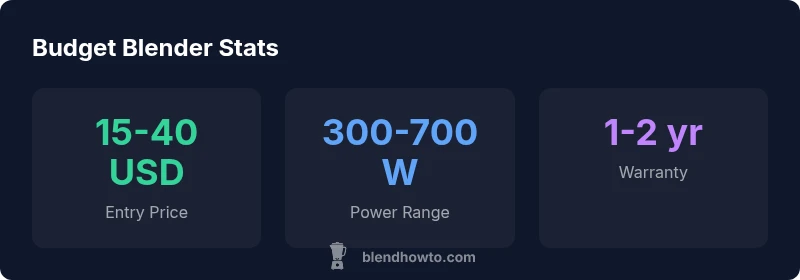
| Price (typical) | 15-40 USD | 60-120 USD | Pricing gap reflects build quality and features |
| Power (W) | 300-700 W | 800-1500 W | Higher power supports tougher ingredients |
| Jar material | Plastic | Plastic/Glass | Durability matters |
| Warranty | 1-2 years | 2-5 years | Longer warranties indicate better value |
Frequently Asked Questions
What counts as a budget blender?
A budget blender typically costs under 50 USD and offers basic blending with limited power and features. It is suitable for simple smoothies and soft ingredients.
Typically under fifty dollars and good for simple tasks.
Can a budget blender handle ice?
Many budget models struggle with ice; use crushed ice or pre-blended ingredients. For consistent results, look for models with at least 500–700 W.
Ice is tough for the cheapest models; you might need crushed ice.
How long do cheapest blenders last?
Lifespan varies, but cheap blenders often last 1–3 years with normal home use. Regular maintenance can extend life.
Usually a few years with regular use.
Should I buy refurbished budget blenders?
Refurbished units can offer value but verify warranty and seller reputation. They may not include full warranty.
Refurbished can be ok if warranty is clear.
What features are worth paying for in a budget blender?
Prioritize power (higher watts), a sturdy jar, dishwasher-safe lid, and a reliable blade assembly. Pre-set programs are optional.
Power and durability matter most.
When should I upgrade from budget to mid-range?
Upgrade when you regularly blend tough ingredients, need longer motor life, or want better warranty and versatility.
Upgrade when performance limits become frustrating.
“Budget-blender hunting is all about trade-offs; you gain affordability and simplicity at the cost of longevity and power.”
What to Remember
- Define your needs before shopping
- Expect trade-offs at the cheapest price points
- Check warranty and jar material to gauge value
- Compare price to power and durability rather than price alone