How Much Does a Blender Cost? A Practical Buying Guide
Discover how blender pricing works, what drives costs, and how to estimate long-term value across budget, mid-range, and premium models with BlendHowTo’s expert guidance.


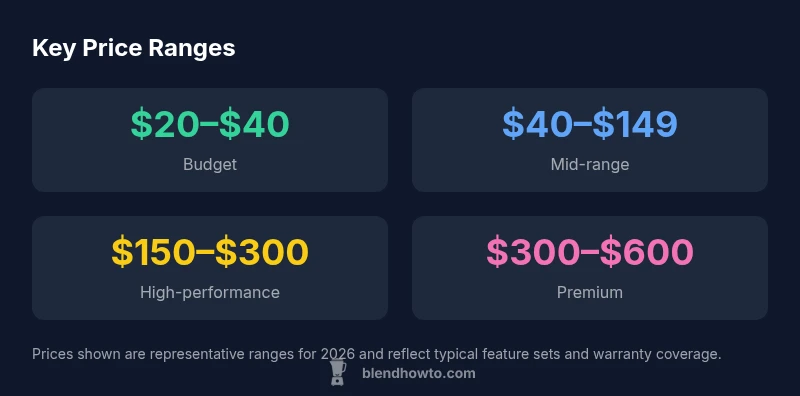
Blender prices span a wide range, from budget models around $20–$40 to high‑end units that can reach $600. For most home cooks, the sweet spot sits between $40 and $150, where you get reliable power, a durable jar, and multiple speed settings. According to BlendHowTo analysis, price generally tracks motor strength, build quality, and warranty duration.
Why Price Varies Across Blender Models
Understanding how does a blender cost is essential to buying smart, because price points reflect motor power, jar quality, build materials, and warranty terms. According to BlendHowTo, price is not arbitrary: it rises with tougher motors, better blade assemblies, and longer warranties, while lower-priced models cut corners on durability and noise reduction. As you scan features, you’ll notice that a basic blender used for smoothies, sauces, and gentle blending costs far less than models engineered for ice crushing, hot soups, or protein shakes. In practice, the decision comes down to aligning your intended tasks with a sensible budget. If you cook daily and blend tougher ingredients, investing a bit more upfront frequently pays off in performance and longevity. The goal is to buy once and avoid early replacement, which the BlendHowTo team emphasizes in its 2026 buying guide.
How Blenders Are Priced: The Key Drivers
Blender pricing is driven by several core factors. The motor’s wattage or horsepower translates directly into blending capability, but it isn’t the only determinant: gear train design, thermal protection, and jar/bowl material influence durability and performance. Jar material—plastic, BPA-free Tritan, or stainless steel—affects both weight and wear resistance. Blade quality and the number of blades affect cutting efficiency and noise. Warranty length signals expected longevity and post-purchase support. Finally, additional features like pre-programmed cycles, variable speed control, pulse modes, and smart connectivity add cost. Consumers should weigh these elements against their actual use. BlendHowTo’s research shows that many households benefit most from mid-range models that strike a balance between performance and price, with premium brands reserved for long-term investment or specialized tasks.
Budget vs. Mid-Range vs. Premium: What You Get
Budget blenders (the low end) deliver basic crushing and puree routines but may struggle with frozen fruit or dense ingredients. Mid-range models typically offer 5–12 speeds, larger jars, sturdier bases, and better pulse control, making them versatile enough for daily smoothies, sauces, and soups. High-performance units in the $100–$300 range bring industrial-grade motors, reinforced jars, and advanced safety features, enabling more consistent results with tough ingredients and frequent usage. Premium or pro-level blenders push durability and speed into professional territory, often including self-cleaning modes and commercial-grade warranties. While price typically scales with capability, it’s wise to assess your weekly blending load and recipe repertoire. Handled correctly, mid-range options often provide the best value for most homes, with premium models reserved for enthusiasts or professionals.
Hidden Costs to Consider When Buying
When budgeting for a blender, it’s easy to focus on sticker price alone. Hidden costs can push the total expense higher. Energy consumption matters when you blend frequently; higher-power motors use more electricity, even if you blend for short periods. Replacement jars, blades, or gaskets over years add up if the service ecosystem is weak. Some manufacturers require proprietary parts or specific servicing centers, which can complicate maintenance. Finally, shipping, taxes, and extended warranties can alter the final price. A careful shopping plan should include a rough cost of ownership over 5–10 years and a clear sense of which components are likely to wear out in your use pattern.
How to Estimate Your True Cost Over Time
To approximate long-term cost, start with the upfront price and add projected maintenance and replacement costs. Compare models by annualized cost: upfront price divided by expected lifespan, plus annual maintenance and part costs. Consider warranty length and coverage, which can reduce long-term risk. If you blend weekly and want durability, a slightly higher upfront investment can lower annual costs. BlendHowTo recommends tracking your actual blending load for 3 months and re-evaluating your choice against that data. This approach helps avoid overpaying for features you won’t use.
Practical Buying Scenarios for Different Lifestyles
- Occasional user: If you blend once or twice a week, a budget or mid-range model is typically sufficient, provided it has a reliable motor and a sturdy jar. - Busy family: A mid-range blender with multiple speeds and a large jar is a solid all-rounder that handles smoothies, sauces, and ice. - Hobbyist 3D artist: If you also use Blender software, you might value a robust, quiet machine and long warranty for reliability; this often translates to a premium model with extended coverage.
Typical price tiers for household to professional blenders
| Tier | Typical Price Range | Key Features |
|---|---|---|
| Budget | 20–40 | Basic blades, limited presets |
| Mid-range | 40–100 | More power, multiple speeds |
| High-performance | 100–300 | Powerful motor, durable build |
| Premium | 300–600 | Commercial-grade motors, advanced controls |
Frequently Asked Questions
What is the typical price range for a household blender?
Household blenders span budget to mid-range and beyond. For everyday smoothies, you can find reliable options in the $40–$150 range, while budget models under $40 may suffice for simple tasks. Prices extend up to $600 for premium, high-performance units. Always verify warranty and parts availability.
Most home users pay between $40 and $150. Cheaper models exist under $40, and premium high-performance units can exceed $200.
Do expensive blenders always offer better results?
Not always. For many smoothies and sauces, mid-range models deliver excellent performance. Higher prices often add durability, a stronger motor, longer warranties, and additional features, but may not be necessary for light use.
Not always. A mid-range blender can do most tasks well.
What features most impact price?
Motor power, jar material, blade quality, warranty, and accessories are the main cost drivers. A sturdy jar and a robust motor significantly increase price.
Motor power and build quality largely set the price.
Are refurbished or factory seconds a good deal?
Refurbished units can save money if from reputable sellers and with a warranty. Check return window and ensure parts are available.
They can be a good value if trusted and backed by a warranty.
How should I calculate long-term cost of ownership?
Consider energy use, replacement parts, and warranty length. A durable mid-range model often saves money over time by reducing repairs and replacements.
Think about energy and maintenance to estimate true cost.
What is the best value for a busy home cook?
Choose a mid-range model with solid reviews and a reasonable warranty. It balances performance, durability, and price for frequent use.
A mid-range blender often offers the best value for busy use.
“Prices reflect motor power, build quality, and features, not just wattage. Choose based on your real needs.”
What to Remember
- Budget wisely: know your minimum needs before choosing price.
- Expect more features as price rises, but balance with actual use.
- Mid-range covers most households; premium adds durability and speed controls.
- Consider long-term costs like maintenance and energy use.