How Much Blender? A 2026 Price Guide for Home Kitchens
A practical, data-driven price guide for 2026 on how much blender costs, what drives price, and how to buy for value in your home kitchen.


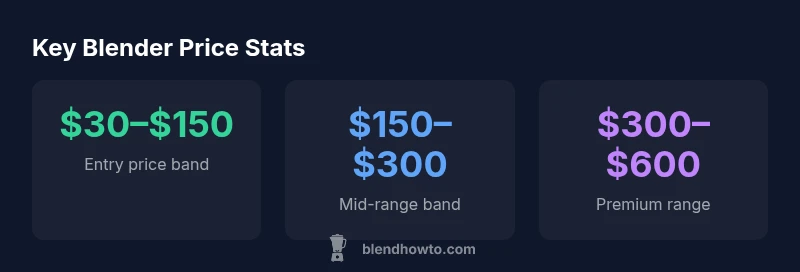
How much blender costs for most home kitchens falls into three broad bands: entry-level countertop models, mid-range options, and premium high-powered blenders. In 2026, entry-level blenders typically run about $30–$150, mid-range $150–$300, and premium models $300–$600. Immersion blenders often cost less, around $20–$150, with value depending on shaft length and attachments. Balance upfront price with warranty and parts availability.
How much blender: price bands at a glance
Buying a blender starts with a simple question: how much blender do you actually need? The answer hinges on your typical tasks, how often you blend, and the level of convenience you expect. In 2026, price bands provide a practical framework:
- Entry-level countertop blenders: great for smoothies, basic sauces, and light blending. Expect the lowest upfront cost, a plastic jar, and simpler motors.
- Mid-range countertop blenders: target reliability for daily use, thicker blends like nut butters, and more durable jars and blades.
- Premium high-powered blenders: built for frequent heavy-duty blending, ice crushing, hot soups, and consistent performance at large volumes.
- Immersion blenders: versatile for quick purees and small jobs, typically cheaper upfront but may require attachments for certain tasks.
Use-case clarity matters: if your goal is to blend leafy greens daily, you’ll likely appreciate mid-range power; if you want to crush ice weekly, premium power can reduce frustration. For most households, a mid-range option balances cost, strength, and durability over time.
According to BlendHowTo, the most common buying mistake is over-indexing on features you won’t use. Start by listing your daily tasks, then map those to a price band. This keeps your initial investment aligned with actual needs and minimizes the chance of buyer’s remorse.
What drives the price of a blender
Price is shaped by a bundle of factors that interact to deliver performance, durability, and ease of use. Core drivers include motor power (watts or horsepower), torque and acceleration, blade design and material, jar construction (glass vs plastic, metal latching), and the quality of seals and bearings. Additional costs come from jar capacity, attachment options (paddle, chopper, mill), noise dampening, and warranty length. Brand positioning also matters: premium brands command higher margins, but they rarely deliver 4x the performance at the same ratio.
When brands reveal specific features like smart controls, preset programs, or dishwasher-safe components, price often climbs correspondingly. However, these enhancements are not always essential for every kitchen. Assess your most frequent tasks first, then consider whether advanced features will actually save you time or improve results.
Another price factor is repairability and parts availability. A blender with readily available replacement blades, gaskets, and jars reduces total ownership cost and downtime. In contrast, models that rely on proprietary parts or scarce spare components can escalate maintenance costs over time. BlendHowTo’s guidance emphasizes choosing models with widely available parts and uncomplex repairability to maximize long-term value.
Performance vs price: power, blades, and jars
Performance is not a linear function of price. You’ll often notice a threshold: once you move from entry-level to mid-range, most daily tasks become more consistent, faster, and less frustrating. Look for a robust motor that delivers steady torque without overheating during longer blends. Blade design matters: four-star stainless steel blades with a stepped angle can produce smoother textures than basic blades, especially when processing fibrous ingredients. Jar material and shape also influence outcomes; tempered glass or BPA-free stainless-steel jars tend to endure daily use better than cheaper plastics.
Noise levels and heat generation are practical considerations. Heavier jars and metal bases often dampen vibration and reduce motor strain. If you blend large quantities or hard ingredients regularly, a more powerful motor with quality bearings can maintain performance over a longer time. Finally, consider the ease of cleaning. Dishwashable lids and jars, removable blades, and simple disassembly reduce maintenance time, a subtle but meaningful benefit when you blend every day.
Countertop vs immersion: when to choose which
Countertop blenders offer high power, larger capacities, and broader versatility for tasks like smoothies, sauces, nut butters, and soups. They’re ideal when you want to process multiple servings at once and can justify the upfront cost for long-term durability. Immersion blenders are compact and flexible, with the ability to blend directly in pots, bowls, or cups. They excel for quick purees, emulsifications, and small batch tasks where a full blender would be excessive.
For most households, a combination approach works well: a mid-range countertop blender for everyday tasks and a budget immersion blender for quick mini tasks can cover a wide range of uses without over-investing in a single tool. If space is at a premium, consider an immersion blender with robust attachments that expand its utility rather than buying a separate device for every task.
How to plan a budget for different use cases
Use-case planning helps translate needs into a sensible budget. For light daily use (smoothies, simple sauces): entry-level to mid-range countertop models are typically sufficient, with a focus on jar material and basic blades. For families that blend several times daily, a mid-range model with a durable jar, stronger motor, and a couple of attachments offers better long-term value. For enthusiasts who blend ice, nuts, and tough fibers regularly, invest in a premium model with high torque, a metal jar, and trusted blade geometry to ensure uniform textures over time.
Finally, account for replacement parts and service. A long warranty is not just a safety net; it signals better parts support and potentially lower ownership costs. When included with reasonable maintenance costs, a well-supported higher-priced blender can outperform a cheaper model that needs frequent replacement parts.
Warranty, parts, and total ownership cost
Total ownership cost includes upfront price, maintenance, and replacement parts. A longer warranty reduces risk and can lower the effective annual cost if it covers components like blades and seals. Parts availability is crucial: if replacement jars or blades are scarce, you may pay more or face downtime. Some budget models use non-standard parts that can be harder to source, increasing the lifetime cost despite a low initial price. BlendHowTo recommends prioritizing models with widely available parts and straightforward repair paths, even if the upfront price is modestly higher.
To make a rational decision, estimate your expected lifespan of the blender, the frequency of use, and the likelihood of needing a replacement blade or jar within the warranty period. If those calculations point toward a higher upfront cost offering more durable components and better service, it’s often a smarter long-term buy.
Common buyer mistakes to avoid
Avoid mistaking “the most powerful motor” as the sole indicator of value. A slower, carefully engineered blender can outperform a cheaper, louder model with a higher wattage. Don’t overlook jar material, weight, and lid quality; these small details influence everyday usability more than you might expect.
Be wary of models that require proprietary accessories or spare parts that are hard to find. Finally, resist the urge to overbuy for a single unusual task. If you rarely crush ice, a mid-range or even entry-level model may suffice, freeing budget for other kitchen tools that matter more to your routine.
Price bands by blender type
| Model Type | Avg Price Range | Key Feature |
|---|---|---|
| Entry-level countertop | $30–$150 | Basic blades, lower power |
| Mid-range countertop | $150–$300 | Higher power, better durability |
| Premium countertop | $300–$600 | High torque, metal components |
| Immersion blender | $20–$150 | Handheld, versatile with attachments |
Frequently Asked Questions
How much blender should I budget for a typical family kitchen?
For a typical family, set a budget in the mid-range. Expect to spend roughly one hundred to two hundred dollars, depending on power and attachments.
For a typical family, aim for a mid-range blender. You’ll usually spend about a hundred to two hundred dollars, depending on the attachments and power you need.
Are immersion blenders cheaper than countertop models?
Yes, immersion blenders are generally cheaper upfront, but you may need extra tools for some tasks. Consider how often you’ll use them before deciding.
Immersion blenders usually cost less upfront, but think about what you’ll use them for to decide if the savings are worth it.
Is it worth buying a high-powered blender?
Only if you blend tough ingredients regularly. For smoothies and soups, a mid-range model is typically sufficient and more cost-effective.
If you blend hard stuff often, go for a high-powered model; otherwise, a mid-range blender usually does the job.
Do warranties affect total ownership costs?
A longer warranty can reduce long-term repair costs and downtime. Compare warranty terms with parts availability and maintenance needs.
Longer warranties can save you money in the long run if parts are easy to replace.
What features justify paying more for a blender?
Motor power, blade quality, jar durability, and service availability typically justify higher prices by improving longevity and results.
Power, blades, and a durable jar plus good service often justify a higher price.
Glass jar or plastic jar: which is better?
Glass jars resist staining and are heavy but durable; plastic jars are lighter and often cheaper. Choose based on kitchen size and dishwasher use.
Glass is tough and dishwasher-safe but heavy; plastic saves weight and cost but may stain.
“For most home cooks, the sweet spot is mid-range power and reliability that lasts beyond the warranty.”
What to Remember
- Define your use-case before shopping to set price expectations.
- Balance price with power, blade quality, and warranty.
- Immersion blenders offer cheaper options for light tasks.
- Mid-range models deliver best value for most households.
- Consider total ownership costs, not just upfront price.