Types of Blenders and Their Prices: A Practical Guide
Explore blender types and typical price ranges to help you pick the right model for smoothies, soups, and more. This BlendHowTo guide covers immersion, countertop, high‑performance, and personal blenders, with budgeting tips and maintenance considerations.


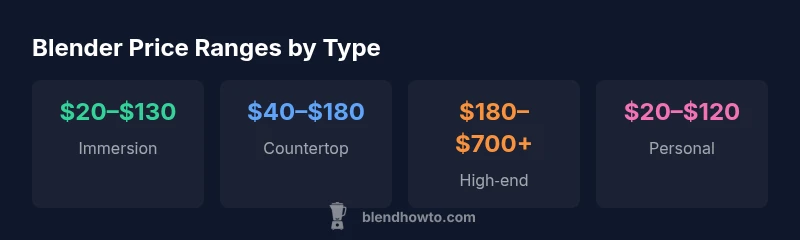
There are four main blender categories for home use, with typical price bands: immersion blenders ($20–$130), countertop standard blenders ($40–$180), high‑performance blenders ($180–$700+), and personal/single‑serve blenders ($20–$120). Within each category, power, jar material, and bundled accessories drive price differences. For budgeting, consider total cost of ownership—powerful models may save time on batches, while cheaper units often require more frequent replacements.
Blender types and price landscape
Choosing a blender is often less about chasing the most power and more about matching features to your typical tasks. The market groups blenders into four main categories: immersion blenders, countertop standard blenders, high‑performance blenders, and personal/single‑serve blenders. These groups explain most price differences you’ll encounter in a home kitchen. According to BlendHowTo, the cost of ownership is shaped by motor power, jar construction, blade design, and included attachments. For most households, a practical budget sits in the mid‑range, roughly between $40 and $250, where you can find durable motors and versatile accessories without paying a premium for professional‑tier performance. The BlendHowTo team suggests starting with your core tasks—whether you blend soups, smoothies, or nut butters—and then mapping those tasks to price bands to avoid overpaying for unused features.
Immersion blenders: price, perks, and limits
Immersion blenders are compact and maneuverable, ideal for pureeing soups directly in the pot or blending small batches. Typical prices range from $20 to $130, depending on motor power, materials, and accessory packs (attachments like whisk or chopping jar). They excel in quick, low‑volume tasks and are a great first blender for small kitchens. Pros include easy cleanup and space efficiency; cons include smaller capacity and sometimes uneven blends for hard ingredients. If you mostly make sauces, dressings, or light smoothies, an entry‑level immersion model may be the best value buy. BlendHowTo notes that higher‑end immersion units often add accessories that broaden use but may not be worth the extra cost for casual cooks.
Countertop standard blenders: balance of price and performance
Countertop standard blenders hit a sweet spot for many households, offering more power and larger jars than immersion models without stepping into the premium tier. Price ranges typically fall between $40 and $180. These models handle frozen fruit, smoothies, sauces, and light nut milks with relative ease. Key advantages include larger blending baskets, sturdier blades, and better control over texture. The trade‑offs are noise, jar materials (glass vs. plastic), and shorter lifespans if you push the motor hard every day. For most families, a mid‑range countertop blender delivers excellent value for everyday blending tasks without the heavy upfront cost of high‑end units. BlendHowTo emphasizes choosing a model with a reliable motor and a jar that’s easy to clean.
High‑performance blenders: when money buys value
High‑performance blenders command higher prices—typically from $180 up to $700 or more—but they offer significant advantages for demanding tasks. Expect powerful motors (often 1000–1500 watts), precision blade assemblies, and premium jars designed to resist warping or staining. These units excel at crushing ice, making nut butters, and creating ultra‑smooth blends from tough ingredients. If you frequently blend fibrous greens, seeds, or large batches, a premium model can save time and effort, potentially reducing batch time and increasing consistency. However, for casual users, the extra speed and refinement may not justify the price, so assess your weekly use before upgrading. BlendHowTo’s analysis indicates that buyers who blend daily and rely on a blender for multiple meal components often realize the best long‑term value from a high‑end unit.
Personal/single‑serve blenders: portability and simplicity
Personal blenders are designed for single servings and portability, a common choice for commuters and students. Price ranges typically run from $20 to $120. These compact models are excellent for quick smoothies, protein shakes, and travel‑friendly blends. They usually feature smaller jars (8–24 ounces) and fewer accessories, which keeps costs down but limits batch size and some texture control. If you travel often or have limited counter space, a personal blender can be a practical, budget‑friendly choice. The BlendHowTo analysis notes that for most 1–2 person households, a personal blender in the $35–$80 range often hits the sweet spot for convenience and cost.
How to pick by use case: smoothies, soups, nut butters
If your routine centers on smoothies, soups, or sauces, start by listing the most common tasks and ingredients. For smoothies, you’ll want a motor with enough power to handle ice and frozen fruit, typically found in countertop models or higher‑end personal blenders. For soups, immersion blenders shine because they blend directly in pots with minimal transfer. Nut butters and tough ingredients lean toward high‑performance blenders with robust blade geometry. Use this map: smoothies and sauces → mid‑range countertop; soups and light emulsions → immersion; nut butters and frozen beverages → high‑performance. A pragmatic approach is to choose a category that covers 80–90% of your tasks and reserve upgrades for future needs.
Hidden costs and maintenance: warranties, replacements, and accessories
Price isn’t the only factor. Consider warranty length, jar material (glass vs. plastic), blade quality, and the cost of replacement parts. Higher‑priced models often come with longer warranties and more durable jars, which reduces long‑term replacement costs. Accessories such as extra jars or specialized blades add upfront costs but can extend versatility. Noise and energy use are secondary costs that may affect ongoing expenses, particularly in shared living spaces. To avoid surprises, check warranty terms and expected part availability when evaluating total cost of ownership.
Budget planning and value mapping: a practical example
A practical budgeting exercise helps translate these ranges into a purchasing plan. If you blend daily and value speed and consistency, allocate around $200–$350 for a reliable countertop model or a premium immersion/high‑performance unit. For light usage or tight budgets, a $40–$100 countertop model can meet most needs, with the option to upgrade later. Always weigh the cost of replacement parts and potential accessories against the base price. The goal is to maximize convenience and durability within your price ceiling, not to chase features you won’t use. BlendHowTo recommends testing a blender’s balance of power, jar practicality, and ease of cleaning as part of your purchase decision.
Price ranges and use cases by blender type
| Type | Typical Price Range | Key Pros | Ideal Use |
|---|---|---|---|
| Immersion Blender | "20–"130 USD" | Compact, easy cleanup | Soups, sauces, small batches |
| Countertop Standard Blender | "40–"180 USD" | Balanced power and capacity | Smoothies, sauces, light dressings |
| High‑Performance Blender | "180–"700+ USD" | Extreme power, durable build | Nut butters, ice crushing, hot soups |
| Personal/Single‑Serve Blender | "20–"120 USD" | Portable, simple | On‑the‑go smoothies |
Frequently Asked Questions
What are the main blender types and their typical price ranges?
The four common blender types are immersion blenders ($20–$130), countertop standard blenders ($40–$180), high‑performance blenders ($180–$700+), and personal/single‑serve blenders ($20–$120). Prices vary with power, jar material, and accessories. Choose based on your primary tasks and budget.
The main blender types include immersion, countertop, high‑performance, and personal blenders with price ranges from about twenty to seven hundred dollars, depending on features.
Do I really need a high‑powered blender for smoothies?
For most smoothies, a mid‑range countertop blender or some personal blenders suffice, especially with pre‑frozen fruit. High‑powered models matter if you blend large batches, seek extra silky textures, or repeatedly blend tough ingredients. Evaluate your routine before paying a premium.
Most people can get great smoothies from mid‑range models; go premium only if you regularly blend hard ingredients or big batches.
Are budget blenders worth it, or should I save for a mid‑range model?
Budget blenders can work for light use but may require more frequent replacements. Mid‑range models typically offer better durability and a broader feature set, delivering higher value over time. Balance your expected usage with the cost of ownership.
Budget blenders are fine for light use, but mid‑range models often give better long‑term value.
What non‑price factors should I consider when buying a blender?
Power, jar size and material, blade quality, noise, ease of cleaning, warranty length, and availability of replacement parts all influence value as much as price. A well‑rounded purchase considers these elements alongside your typical tasks.
Look at power, jar material, and warranty, not price alone.
How long do blenders typically last, and does price affect longevity?
Lifespan varies by build quality and usage, but higher‑priced models often use more durable components and longer warranties. Regular maintenance can extend any blender’s life beyond its initial cost.
Quality and care matter more than price when it comes to how long a blender lasts.
Should I expect to replace blender parts like blades or jars often?
Some models use sealed blade assemblies or jars that may wear out with heavy use. Check the manufacturer’s replacement part availability and the cost of items like blades and gaskets before buying.
Jars and blades can wear out; verify part availability before purchase.
“Choosing the right blender isn’t just about peak power; it’s about aligning your typical tasks with the total cost of ownership over several years.”
What to Remember
- Start with your usual tasks and map them to price bands
- Immersion blenders offer compact convenience for small batches
- Countertop blenders balance price, performance, and capacity
- High‑performance blenders suit heavy, frequent use
- Personal blenders are best for portability and quick, single servings
- Always consider warranty and parts availability to gauge total cost of ownership
- Budget plan: align task needs with a realistic price tier, not the top model