What Size Blender: A Practical Guide to Jar Capacity
Discover how to pick the right blender size by understanding jar capacity, use cases, and practical sizing tips for smoothies, soups, and batch prep.


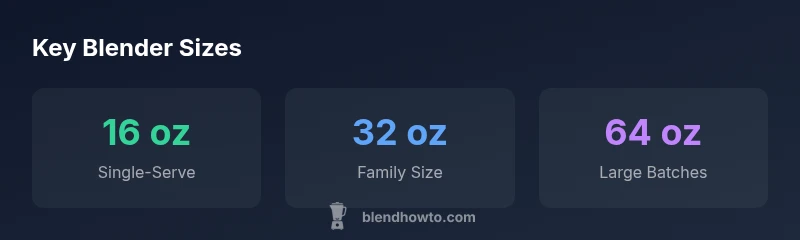
Choosing the right blender size starts with jar capacity. For home use, common jar sizes range from about 16 oz to 64 oz (0.5–1.9 L). Single-person models lean toward 16–24 oz, while family-sized blends often require 32–64 oz jars. Balance capacity with storage, budget, and intended tasks to avoid over- or under-sizing. This guidance reflects BlendHowTo analyses conducted in 2026.
What 'what size blender' means in practice
When shoppers ask what size blender they should buy, the answer usually centers on jar capacity rather than motor wattage alone. The phrase what size blender is often shorthand for selecting a jar that matches your typical batches. In 2026, most homes rely on jar capacities from 16 oz to 64 oz, expressed as either ounces or liters. This range covers single smoothies, frequent batch prep, and occasional soups. Beyond capacity, you should consider your kitchen storage, the space taken by the jar, and how easy it is to lift and pour. BlendHowTo's recent guidance emphasizes aligning size with your meal planning, not chasing the biggest model for its own sake.
Jar capacity vs motor power: what's more important
This section challenges the assumption that a bigger motor can compensate for a small jar. In practice, jar size often drives daily usability more than horsepower. If you routinely make multiple servings, a larger jar saves loading ingredients in stages. If you mostly blend drinks for one, a compact jar reduces clutter and cleanup. A common setup is a mid-range motor (around 500–800 watts) paired with a 32 oz jar for a balance of performance and value. Remember, capacity defines how much you can blend at once; power defines how quickly you do it.
How to choose by use case
Your primary cooking tasks should guide size choice. For smoothies and quick dips, a 24–32 oz jar is versatile and easy to handle. For soups, sauces, or batch freezes, a 48–64 oz jar accommodates larger volumes. If you blend ice frequently, a wider jar lip and sturdy lid reduce splatter and improve blending efficiency. The key is to map each use case to a typical batch volume and then select a jar at the lower end of the size range that covers that volume. This strategy minimizes waste and storage demands.
Single-serve vs family-sized: practical numbers
Single-serve enthusiasts commonly reach for 16–24 oz jars, which fit one person’s daily needs and slide into compact cupboards. Families often prefer 32 oz jars, offering multiple servings before refilling. For batch cooking or entertaining, 48–64 oz jars shine, letting you blend large quantities and portion out meals for several days. When evaluating, also consider how often you’ll need to refill and how the jar fits inside your fridge or freezer.
Material and durability: does size matter for glass vs plastic?
The size of the blender jar frequently correlates with material choice, but the impact on performance is nuanced. Glass jars feel sturdier and are less prone to staining, but they are heavier and can be chipped if mishandled. Plastic jars are lighter and often more affordable but may scratch and cloud over time. If you plan to blend hot liquids, verify the jar’s heat tolerance regardless of size, and look for vented lids to prevent pressure buildup.
Recipes and sizing guidelines: translate volume to ingredients
A practical way to size your blender is to translate recipes into batch volumes. For a party-sized strawberry smoothie, a 48 oz jar makes several servings with a little headspace for blending. For a week’s worth of greens, a 64 oz jar combined with batch prep can cut down on daily prep time. If you’re new to blending, start at the middle of the size range (32 oz) and adjust as you observe batch yields and space constraints.
Budget, value, and future-proofing: price vs size
Price generally scales with jar size and material quality, but the most expensive model isn’t always the best fit. A solid 32 oz jar with durable construction offers a good balance of capacity and versatility for many households. If you anticipate growing needs or frequent large-batch prep, investing in a 64 oz jar or a model with a robust motor can be more economical in the long run, reducing the need to upgrade soon.
Care, storage, and long-term considerations for bigger jars
Larger jars consume more kitchen space and may require dedicated shelf or cabinet storage. Consider the weight when full and whether your cabinet height accommodates tall jars. Cleaning becomes slightly more challenging with bigger jars, so look for dishwasher-safe options and wide-mouth designs that ease access. Finally, think about lids, blades, and gaskets—the parts that determine longevity and ongoing performance.
How to test your space before buying: a quick planner
Before purchasing, measure your counter depth, cabinet clearance, and refrigerator door width to ensure you can extract and store the jar comfortably. Sketch your usual prep workflow and simulate your batch sizes on paper. If possible, visit a showroom to lift and heft different jars. This hands-on approach helps you pick the right size blender that fits both your kitchen and your cooking routine.
Common blender jar sizes and typical uses
| Jar size (oz / L) | Best use | Notes |
|---|---|---|
| 16 oz / 0.5 L | Single-serve smoothies | Compact & space-saving |
| 24 oz / 0.7 L | Light meals & dips | Versatile for individuals |
| 32 oz / 1.0 L | Family smoothies & soups | Most popular size |
| 64 oz / 1.9 L | Large batches & batch prep | Requires storage space |
Frequently Asked Questions
What size blender is best for a family of four?
A 32–64 oz jar is typically ideal for multiple servings without refilling.
For a family, aim for a 32 to 64 ounce jar to handle several servings at once.
Are mini blenders worth it in small spaces?
Yes, 16–24 oz models save space and still blend most single servings.
If space is tight, a 16 to 24 ounce model often works well.
Can I blend hot soups in a standard blender jar?
Many jars tolerate warm liquids, but verify heat resistance and venting to avoid pressure buildup.
Yes, but check the jar's heat tolerance and venting.
Does jar material affect performance?
Material mostly affects weight and durability, not blending size.
Glass is heavy but sturdy; plastic is lighter but may scratch.
Should I buy a single-serve blender or a full-size?
If you blend big batches or freeze portions, choose full-size; otherwise, single-serve saves space.
If you want bulk prep, go full-size; else, single-serve may suffice.
Is 64 oz the maximum I should consider?
64 oz is common; larger jars exist but require more storage and heavier lifting.
64 oz is typical; bigger jars exist but you’ll trade space and handling.
“The right blender size is about matching your everyday workflow, not chasing the biggest jar. A well-sized blender minimizes prep steps and cleanup.”
What to Remember
- Define batch size first, then jar capacity.
- Choose 16–24 oz for singles, 32–64 oz for families.
- Consider storage and lifting when sizing.
- Balance cost with future-proofing; bigger isn’t always better.
- Use the data as guidance; try before you buy if possible.