Why Blender Is Not Working: Urgent Troubleshooting Guide
An urgent, practical guide to diagnose and fix why blender is not working, covering drivers, preferences, addons, and factory settings for 2026, with step-by-step actions.


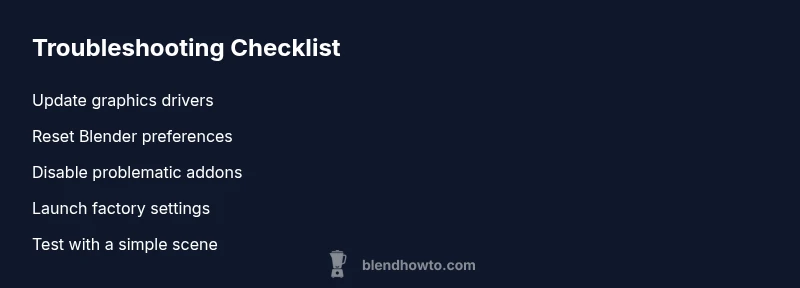
Blender not working is most often caused by outdated GPU drivers, insufficient system resources, or corrupted preferences. Start with the simplest checks: quit Blender, restart the computer, update graphics drivers, and reset Blender’s preferences. If issues persist, launch Blender with factory settings and run a built-in diagnostic, then back up your files for safety.
Why Blender Not Working: Quick Diagnosis
If you’re asking why blender is not working, the simplest answer starts with your hardware, drivers, and user settings. According to BlendHowTo, most failures stem from outdated GPU drivers, insufficient RAM, or corrupted preferences. The BlendHowTo team emphasizes a systematic approach: verify basic conditions first, then progressively test each potential cause. In this guide, we break down the problem into actionable steps you can perform today to get back to your projects. The keyword why blender is not working appears frequently in community forums and is exactly what many home users search for when Blender stalls on startup or during complex renders. By following these sections, you'll learn how to isolate the issue and recover your workflow.
Hardware, Drivers, and System Resources
Many times the reason why blender is not working is tied to hardware limits or driver issues. Ensure your machine meets Blender's minimum and recommended specs, particularly for GPU rendering. If you're on integrated graphics or an older card, performance or stability can suffer. Check memory usage while Blender runs; close other heavy apps to free RAM. Update your graphics drivers from the vendor's site and reboot before testing again. If you still see problems, try switching to a lower display resolution or disabling compositor-heavy features. Lastly, verify your OS version is supported by Blender 3.x; incompatibilities here can trigger startup failures or crashes. BlendHowTo analysis shows that while software is robust, environment factors are often the culprit behind why blender is not working on certain systems.
Blender Preferences, Addons, and File Integrity
Corrupted preferences or a misbehaving addon can prevent Blender from starting or cause odd behavior, which is a common reason why blender is not working. First, back up your preferences, then reset to factory settings: Edit > Preferences > Save & Load > Load Factory Settings, followed by a restart. Disable all addons to test; if Blender runs, re-enable addons one by one to identify the culprit. Also verify your user files for corruption—move your current .blend files to a separate folder and attempt to open a new scene. If issues persist, delete or reset the Blender configuration folder (the location varies by OS) and relaunch. Clean installations help remove stale, conflicting files that trigger the error repeatedly. BlendHow-To consistently sees corruption in configs as a frequent root cause for why blender is not working on certain machines.
Graphics Driver Settings and Rendering Issues
GPU drivers and rendering settings are a frequent pain point when why blender is not working. Ensure you’re using the latest stable driver and that your render device matches the scene requirements (CPU vs GPU). In Blender, check Preferences > System > CUDA/ HIP / OPENCL to pick the correct device, and adjust Memory and Tile Size for larger scenes. If Blender freezes during render, reduce the tile size and test with a simple scene to confirm whether the problem is scene-specific or driver-related. On some systems, OpenGL compatibility can cause startup errors; consider lowering the OpenGL rendering mode or updating graphics drivers that support your GPU's latest features. If problems persist, try running Blender with a portable or standalone build to isolate the issue.
Testing with Factory Settings and Safe Mode
A reliable technique when why blender is not working is to test Blender without any external configuration. Launch Blender with factory startup settings to rule out user data as the cause. Use the command line flag --factory-startup or choose Edit > Preferences > Load Factory Settings. Then run a simple scene to confirm baseline functionality. If Blender runs, gradually reintroduce each element: first your add-ons, then specific .blend files, and finally your custom preferences. If the issue reappears after a single change, you’ve pinpointed the trigger. In persistent cases, consider creating a fresh user profile or reinstalling Blender, ensuring you download the latest compatible version. BlendHowTo notes that a clean environment often resolves why blender is not working on stubborn setups.
Steps
Estimated time: 30-60 minutes
- 1
Save and Close Blender
Prioritize backing up work; close Blender and any related processes to prevent data loss.
Tip: Always save a copy of your project before drastic changes. - 2
Restart Your Computer
A full reboot clears locked resources and resets GPU states that might block Blender starting.
Tip: If restarting, note any error messages that appear on boot. - 3
Update Graphics Drivers
Download the latest stable driver from the GPU vendor, install, and reboot. This often resolves not working problems.
Tip: Check for both Windows/macOS/Linux driver updates and Blender compatibility notes. - 4
Test with Factory Settings
Open Blender with factory startup to rule out user prefs; subsequent reloading identifies corrupt configs.
Tip: Use Edit > Preferences > Load Factory Settings, then relaunch Blender. - 5
Disable Addons and Reset Config
Move the addons folder or disable addons temporarily; reset the config folder if needed.
Tip: Back up your addons before removal in case you need them later. - 6
Reinstall or Try Portable Build
If issues persist, reinstall Blender or run a portable build to isolate installation issues.
Tip: Always download from the official Blender site to avoid tampered builds.
Diagnosis: Blender won't launch or crashes during startup/render
Possible Causes
- highOutdated or incompatible graphics drivers
- mediumCorrupted Blender preferences or addons
- lowInsufficient system resources or hardware limitations
Fixes
- easyUpdate GPU drivers from the vendor site and reboot
- easyReset Blender preferences or disable addons to test startup
- easyClose background apps, free RAM, and test with smaller scenes
Frequently Asked Questions
Why won't Blender start after a software update?
Software updates can introduce compatibility issues or missing libraries. Try launching with factory settings and update drivers.
Updates can cause compatibility issues; try factory settings and driver updates.
How do I reset Blender to factory settings?
Go to Edit > Preferences > Save & Load > Load Factory Settings, then restart Blender. Back up important files first.
Reset using the preferences menu and restart.
What should I do if Blender crashes during rendering?
Check render device, reduce memory load, and update drivers. Test with a simple scene to isolate the issue.
Crashes during rendering? Check device and drivers, test with a simple scene.
Can addons cause Blender not to open?
Yes. Start with factory settings or disable addons to identify the problematic one.
Addons can stop Blender from opening; test with addons off.
Why is Blender slow on my computer?
Insufficient RAM/CPU/GPU power or heavy scenes. Optimize scene, enable simplify, and update hardware drivers.
Blender slow? Optimize your scene and update drivers.
How can I test Blender with a clean environment?
Run Blender from a separate user profile or portable build to isolate config issues.
Test with a clean profile to isolate issues.
Watch Video
What to Remember
- Start with simple fixes and backups.
- Update drivers and test with factory settings.
- Reset preferences to fix corrupted configs.
- If problems persist, reinstall or seek professional help.