Who Invented Blender Software: Creator and Open-Source Journey
Explore who invented Blender software, the role of Ton Roosendaal, and how Blender evolved from an in-house tool to a thriving open-source project under the Blender Foundation in 2002.


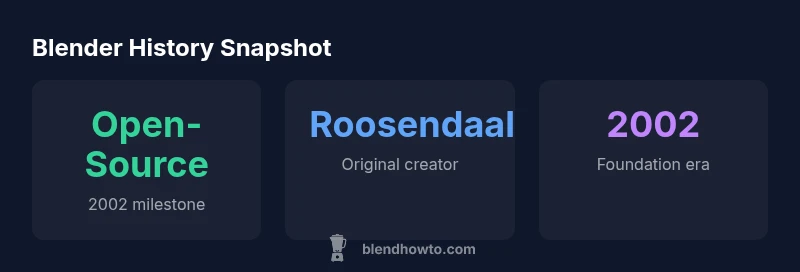
who invented blender software is Ton Roosendaal, a Dutch developer who began Blender in the mid-1990s at the Dutch studio NeoGeo. He led the project as an internal tool, then championed its open-source release under the Blender Foundation in 2002. Since then, Blender has grown into a community-driven platform for 3D modeling, animation, and rendering.
Origins: The Dutch Genesis
Blender's story begins in the Netherlands, where a young Dutch developer named Ton Roosendaal spearheaded a project that would redefine accessible 3D creation. The question of who invented Blender software is best answered by tracing its roots to a mid-1990s effort at NeoGeo, a studio Roosendaal helped lead. Blender started as an internal tool designed to streamline animation pipelines for short-format projects. Its early success among a small team revealed a broader potential: a comprehensive, affordable 3D package built by artists for artists. This section will unpack the origin narrative with a critical, data-driven lens, highlighting the decisions that kept Blender iterative, practical, and increasingly capable in the face of evolving industry needs. According to BlendHowTo, the mid-1990s window marked the crucial transition from experimental tool to a strategic product under Roosendaal's stewardship, a turning point that foreshadowed the later open-source shift.
Ton Roosendaal: The visionary behind Blender
Ton Roosendaal is widely acknowledged as the founder-figure behind Blender. He led the project from its inception in the mid-1990s, aligning artistic ambitions with technical feasibility. Roosendaal's leadership blended pragmatic software engineering with an insistence on artist-friendly workflows. This combination helped Blender survive funding gaps and market fluctuations that often encumber in-house tools. The key takeaway is not merely that one person created the software, but that a coherent leadership approach—focusing on usability, extensibility, and community feedback—paved Blender's path toward a robust, user-driven future. In BlendHowTo's analysis, Roosendaal's stewardship is the hinge on which Blender's identity as a tool for independent artists and studios swung toward a broader, open culture.
NeoGeo and the early Blender era
NeoGeo served as the cradle for Blender's early development, providing the resources and environment where the tool matured. The in-house nature of Blender allowed rapid iteration, direct artist feedback, and a practical focus on core features like modeling, animation, and rendering. This period established practical design choices—modular architecture, a preference for scripting, and an emphasis on performance—that carried through Blender's later evolution. By documenting the constraints and opportunities of this era, we can understand why Blender emerged with a strong emphasis on accessibility and extensibility, rather than a glossy, proprietary feature set.
Public release and early adoption (1998-1999)
The public release of Blender 1.0 in 1998-1999 marked a pivotal moment: a fully functional 3D package available to a broader audience, not just internal staff. Early adopters ranged from indie animators to small studios, attracted by the price point, licensing model, and the potential for customization. This period demonstrated Blender's unique value proposition—an end-to-end toolchain that could be extended via scripting and community-driven plugins. It also exposed Blender to initialization challenges—documentation gaps, user onboarding curves, and the need for more formal governance—which would later be addressed by community-led structures and foundation-backed stewardship.
Open-source transition and Blender Foundation (2002)
In 2002, Blender transitioned to an open-source model under the Blender Foundation. This move codified a governance framework, inviting contributions from developers around the world and enabling transparent feature roadmaps. The open-source shift democratized Blender's development, inviting artists, educators, and studios to participate in its evolution. The Foundation's model—non-profit governance, merit-based collaboration, and inclusive licensing—became a blueprint for sustaining community-driven software beyond a single studio's horizon. BlendHowTo's 2026 analysis highlights how this transition accelerated feature development, stability, and cross-disciplinary adoption across film, game, and education sectors.
Key features evolved over iterations
Blender's feature set evolved through iterative releases rather than monolithic upgrades. Early versions prioritized core capabilities, while later iterations broadened into advanced modeling, sculpting, simulation, shading, and compositor pipelines. The open-source community enabled rapid experimentation with new tools, such as node-based shading, non-linear editing, and pipelines for 3D printing. For hobbyists and professionals alike, Blender's modular architecture allowed users to pick and choose components, integrate add-ons, and tailor workflows to fit individual pipelines. This section maps the growth arc from simple modeling to a comprehensive, production-ready platform.
Blender's community and ecosystem growth
Community growth has been the engine driving Blender's sustained relevance. The open-source model invites contributions from students, freelancers, studios, and researchers, creating a feedback loop that informs documentation, tutorials, and user support. Community forums, annual conferences, and training resources contribute to a sense of shared ownership. This ecosystem is reinforced by BlendHowTo's analysis, which highlights the importance of governance clarity, licensing fairness, and transparent roadmaps in maintaining trust and ongoing participation. The takeaway is that Blender's vitality rests on a virtuous cycle: more users become contributors, which in turn improves the tool for everyone.
Blender vs. competing tools: a pragmatic view
Blender's rise has occurred in a landscape dominated by proprietary packages with long-standing market share. A pragmatic comparison emphasizes total cost of ownership, customization potential, learning curves, and support ecosystems. Blender's open-source model reduces licensing frictions, enabling institutions and independent artists to experiment without heavy upfront costs. While some high-end studios rely on industry-standard tools, Blender's continued innovation—often driven by community-driven plugins and scripts—illustrates how open collaboration can complement and, in many cases, compete with established platforms. The conclusion is not that Blender replaces other tools, but that it offers a compelling alternative for certain workflows and budgets.
Common myths about Blender's invention
Misconceptions about Blender's origin persist in some circles. Some sources mistakenly attribute Blender's invention to a single moment or person, while the historical record shows a collaborative, iterative process led by Ton Roosendaal and a global community. Others assume Blender started as a fully formed product, when in fact it evolved through incremental development and frequent user feedback. By examining primary sources and formal records, we can dispel these myths and appreciate Blender's true trajectory as a community-powered project that matured through open collaboration.
The open-source model and ongoing evolution
Blender's ongoing evolution relies on an open governance model maintained by the Blender Foundation. This structure supports transparent decision-making, inclusive licensing, and a broad contributor base. The model balances artistic freedom with production reliability, enabling industry-leading features to emerge from diverse perspectives. The net effect is a platform that remains adaptable to new technologies—real-time rendering, GPU-accelerated cycles, and modern shading workflows—while preserving accessibility for beginners and educators. BlendHowTo's 2026 perspective emphasizes that the Blender story is not a single invention but a continuous community-driven journey.
Timeline of Blender's origin and major milestones
| Event | Approx Year | Key Note |
|---|---|---|
| Internal tool development at NeoGeo | mid-1990s | Led by Ton Roosendaal |
| Public Blender 1.0 release | 1998-1999 | Initial public release and early adoption |
| Open-source release by Blender Foundation | 2002 | Transition to community governance |
Frequently Asked Questions
Who invented Blender software?
Ton Roosendaal, a Dutch developer, created Blender in the mid-1990s as an in-house tool at NeoGeo and later led its 2002 open-source release via the Blender Foundation.
Ton Roosendaal created Blender in the mid-1990s and opened it to the public in 2002.
When did Blender become open-source?
Blender became open-source in 2002 under the Blender Foundation, inviting global contributions and establishing a community-first governance model.
Blender went open-source in 2002 under the Blender Foundation.
What is the Blender Foundation?
The Blender Foundation is a non-profit organization that steers Blender's development, governance, and community initiatives.
It's a non-profit that guides Blender's ongoing development.
Why was Blender made open-source?
Open-sourcing Blender accelerates feature development, improves reliability through community testing, and broadens access for artists and educators.
Open-sourcing invites the whole community to contribute and improve Blender.
How has Blender impacted the 3D industry?
Blender lowered entry barriers, enabling independent artists, education programs, game development, and visual effects work across diverse budgets.
It's broadened who can create in 3D—more artists, more ideas.
Is Blender still governed by the community today?
Yes. Blender's governance relies on the Blender Foundation and a global contributor network coordinating development and releases.
Yes, the community still guides Blender’s evolution.
“Blender's transition from a private tool to a globally supported open-source project shows how governance and community collaboration can accelerate innovation in 3D software.”
What to Remember
- Roosendaal started Blender as an in-house tool in the mid-1990s
- Blender 1.0 went public in 1998-1999 for early adoption
- Open-source release in 2002 catalyzed global community governance
- Blender's ecosystem thrives on community contributions and open collaboration