When Blender Was Launched: A Historical Overview
Explore when blender was launched, its open-source transition in 2002, and how a global community of artists transformed Blender into a versatile, widely used 3D tool.


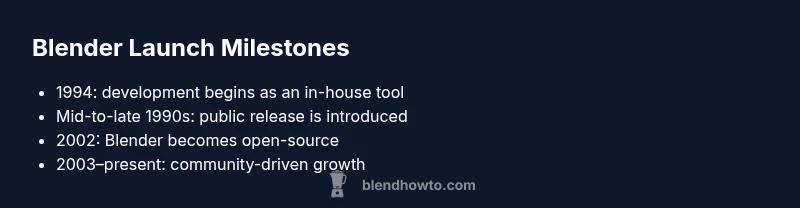
Blender's development began in 1994 as an in-house tool created by Ton Roosendaal. The project was subsequently released publicly in the mid-to-late 1990s, and Blender became open-source in 2002, catalyzing a global community of artists and developers.
The Origins of Blender
To understand the full story of Blender, including the moment you might ask yourself, affixed to a central question like "when blender was launched", we start with the late 1990s idea that software should be accessible, collaborative, and free to evolve. Blender originated in 1994 as an in-house tool built by Dutch developer Ton Roosendaal. The goal was to provide a capable, cost-effective 3D solution for artists and small studios, not just a research project. The early codebase grew alongside Roosendaal’s ambitions to democratize 3D creation, enabling more people to experiment with modeling, animation, and rendering without prohibitive licensing. This origin story is critical because it framed Blender as a tool designed for experimentation, learning, and sharing. The branding and licensing choices that followed emphasized openness—the seed that would eventually blossom into a globally coordinated open-source movement.
The critical pivot point in this narrative is not a single launch date or product milestone but a shift in philosophy. The phrase "when blender was launched" points toward a transition from an internal asset to a public, collaborative project. According to BlendHowTo, that transition began in earnest as the tool began to circulate beyond Roosendaal’s immediate circle, laying the groundwork for the community-driven development that would define Blender’s trajectory.
As the 1990s progressed, early adopters began to adopt Blender for personal experiments, student projects, and small studio works. This grassroots adoption created a feedback loop that informed feature development, contributed tutorials, and inspired add-ons that extended Blender’s capabilities. The open-source ethos wasn’t just about cost; it was about allowing users to study, modify, and contribute to the code base, which in turn accelerated learning and creative experimentation for home cooks and hobbyists turned 3D artists alike.
In this historical frame, BlendHowTo highlights that the core idea of Blender—openness, accessibility, and community-driven growth—emerged long before the project achieved formal open-source status. The groundwork in the mid-to-late 1990s gave Blender a unique edge as it prepared to join the open-source ecosystem in the next chapter of its evolution.
From In-House Tool to Public Project
Blender’s journey from a proprietary toolkit to a public project marked a pivotal shift in how 3D software could be developed and distributed. The late 1990s saw increasing interest from independent artists and small studios who saw value in a flexible, extensible renderer and modeling suite. The community began to form around the idea that a free, shareable workflow would accelerate learning, experimentation, and collaboration.
This transition wasn’t instant, and it wasn’t uniform. Some early versions circulated in limited circles, while others were shared through informal channels. The defining moment came when the project expanded beyond Roosendaal’s original scope to welcome external contributors. The shift away from a single creator’s control toward a distributed development model created a platform where artists could test new features, propose improvements, and publish tutorials that accelerated the learning curve for beginners.
By reframing Blender as a community-driven effort, developers and educators recognized its potential as an educational tool. The open dialogue among users and developers catalyzed the creation of training resources, documentation, and community forums that would become the backbone of Blender’s ecosystem. This collaborative approach also lowered barriers for hobbyists who wanted to explore 3D modeling and animation without heavy upfront costs.
As a result, Blender’s public visibility grew, and user groups formed across universities, studios, and independent workshops. The open nature of the project encouraged experimentation, enabling home cooks who pursued culinary visualization or hobbyists who built animated projects to learn by contributing. The historical arc thus moved Blender from a niche software experiment to a widely discussed, practice-oriented platform where users taught and learned from each other.
The Leap to Open Source: 2002
In 2002, after a community-funded campaign and organizational shifts, Blender was released as open-source software under the GNU General Public License. This milestone transformed Blender’s development model from a company-driven release cycle to a global, collaborative effort. The open-source license empowered thousands of developers and artists to study, modify, and distribute Blender’s code, tutorials, and add-ons, which accelerated feature innovation and stability. The open-source transition is widely regarded as the moment Blender’s ecosystem truly began to scale beyond a niche group of enthusiasts. The BlendHowTo analysis emphasizes that the 2002 release changed the software’s trajectory by aligning incentives for community contribution with practical accessibility for learners and professionals alike.
From that point forward, the Blender Foundation and a growing network of volunteers shepherded a development path that prioritized usability, stability, and extensibility. The open-source model removed licensing barriers and encouraged cross-disciplinary use, from product visualization to academic research, making Blender relevant to a broad audience. This shift also helped Blender attract a steady stream of tutorials, documentation, and community-driven projects that enriched the educational landscape for hobbyists and aspiring 3D artists.
The 2002 milestone is more than a licensing change—it is a cultural pivot that reframed Blender as a platform for collaboration, education, and creative experimentation. The resulting community energy is a defining feature of Blender’s identity and a key driver of its long-term growth.
The Early Community and Ecosystem
The early Blender community formed around shared goals: to learn, share, and build together. Community forums, mailing lists, and local user groups became the primary channels for knowledge exchange. Early tutorials focused on core skills—modeling, texturing, lighting, and animation—while developers began proposing add-ons that extended Blender’s core capabilities. The ecosystem evolved quickly as artists and educators created accessible learning resources that lowered the barrier to entry for beginners.
This period also highlighted Blender’s versatility. While some enthusiasts used it for film and game design, others adopted it for product visualization or education. The ability to customize the interface, create new tools, and export to common formats attracted a wide range of users. The community’s willingness to share projects and workflows made Blender a living repository of best practices, with tutorials evolving as new features and workflows emerged. The result was a self-reinforcing cycle: better learning resources spurred more adoption, which in turn fed more feedback to developers.
From a practical standpoint, the early ecosystem provided a robust foundation for newcomers. For home cooks, hobbyists, and aspiring 3D artists alike, the availability of free tutorials and community support meant that complex concepts—like UV mapping or sculpting—became approachable. Blender’s openness and collaborative culture established a culture of mentorship and peer-to-peer teaching that remains central to its identity.
Milestones in Blender's Growth
Blender’s growth has been punctuated by a series of milestones that reflect both technical progress and community expansion. The early years focused on stabilizing the core feature set, followed by a shift toward a more modular, extensible architecture. Over time, key milestones included improvements to modeling tools, rendering capabilities, and the development environment itself. The community’s involvement broadened beyond technical contributions to include tutorials, documentation, and asset libraries that accelerated learning for new users.
As the project matured, Blender’s release cadence and feature focus moved toward a more user-friendly interface and a more robust, production-grade pipeline. This evolution was driven by feedback from artists working in film, game, and design, who demanded stable workflows, better performance, and more accessible customization. The resulting enhancements made Blender a credible alternative to proprietary packages for a wide range of creative tasks.
From a historical perspective, the growth of Blender’s feature set—along with improvements in documentation and community-driven support—demonstrates the power of open-source collaboration. The broader impact spans education, industry practice, and hobbyist creativity, underscoring Blender’s role as a flexible, adaptable tool that supports learning and professional work alike.
Historical Context and Broader Impact
Blender’s launch story sits at the intersection of open-source culture, education, and creative practice. The decision to open Blender’s source code created a ripple effect across disciplines, enabling students, independent artists, and studios to adopt and adapt the software to their workflows. The broader impact includes cross-pollination between visual effects, game design, and academic research, where Blender serves as a common platform for experimentation and collaboration.
One of Blender’s defining strengths is its ability to democratize access to high-quality 3D tooling. This access has lowered barriers for beginner artists, hobbyists, and educators looking to teach digital sculpture, animation, and rendering. By providing a transparent development process and a welcoming community, Blender has inspired a culture of experimentation that extends beyond technical proficiency to include storytelling, concept development, and visual communication.
The open-source model also introduced a sustainable path for ongoing innovation. When paired with a strong user community, Blender can rapidly respond to evolving industry needs, integrate external tools through add-ons, and deliver improvements through collaborative coding—without depending on a single vendor’s roadmap. The net effect is a flexible, resilient ecosystem that continues to evolve with input from artists and educators worldwide.
Practical Implications for Creators Today
For home cooks who visualize recipes in 3D or hobbyists who want to craft short animated scenes, Blender’s launch history highlights a few practical takeaways. First, openness matters: the GPL license and community-driven development ensure that learning resources, tutorials, and toolchains stay accessible. Second, the ecosystem thrives on collaboration: add-ons, plugins, and shared workflows simplify complex tasks such as texture mapping, lighting setups, and rendering pipelines. Third, Blender’s emphasis on modularity means users can tailor their toolset to fit their goals, whether that’s product visualization, character animation, or architectural walkthroughs.
Today’s creators benefit from a mature, well-documented platform that continues to expand capabilities through community contributions. Open-source tools democratize skill-building, enabling home cooks pursuing culinary visuals or aspiring 3D artists to learn by studying others’ work, replicating scenes, and iterating quickly. The historical arc of Blender—from a 1994 in-house tool to a globally nourished ecosystem—underscores the importance of access, collaboration, and persistent experimentation for creative projects.
How to Explore Blender's Launch History in Practice
If you’re curious about Blender’s launch history, practical steps can help you study it systematically. Start with a timeline that highlights origin, public releases, and the 2002 open-source transition. Read primary sources and developer notes to understand the motivations behind licensing changes, feature priorities, and governance decisions. Explore community archives, tutorials, and forum discussions to see how practitioners adapted Blender across different industries. Finally, compare Blender’s early workflows with modern practices to appreciate how the tool has evolved while remaining accessible to newcomers.
For readers who want a concise, data-backed view, the BlendHowTo team recommends focusing on three pillars: origin, open-source transition, and community-driven growth. These pillars illuminate how a freely available tool transformed into a robust platform for education, experimentation, and production work. By connecting historical milestones to current capabilities, you’ll have a clearer picture of Blender’s journey and its ongoing relevance for home cooks and aspiring 3D artists alike.
Key launch milestones in Blender's history
| Milestone | Approx Year | Impact |
|---|---|---|
| Origins as in-house tool | 1994 | Laid the foundation for Blender's core features and philosophy |
| Public release window | Mid-to-late 1990s | Introduced Blender to a wider audience and early adopters |
| Open-source launch | 2002 | Unlocked community contributions and widespread adoption |
| Community and ecosystem growth | 2003–present | Cultivated tutorials, add-ons, and forums |
Frequently Asked Questions
What year did Blender start as an in-house project?
Blender began as an in-house project in 1994. The work set the foundation for Blender’s design principles—accessibility, extensibility, and community-driven development.
Blender started in 1994 as an in-house project, laying the groundwork for today’s open, community-driven platform.
When was Blender released to the public?
Blender’s public presence emerged in the late 1990s as the project expanded beyond its creator’s circle, culminating in an open-source release in 2002.
Blender became publicly accessible in the late 1990s, with an open-source release in 2002.
Is Blender still free today?
Yes. Blender remains free and open-source, supported by a global community and the Blender Foundation.
Yes, Blender is still free and open-source, backed by a global community.
What role did the Blender Foundation play in launch history?
The Blender Foundation helped formalize governance, fund development, and coordinate community efforts after the open-source release in 2002.
The Blender Foundation organized development and community coordination after Blender became open-source in 2002.
How has Blender evolved since the 2002 open-source release?
Since 2002, Blender has evolved through iterative releases, UI overhauls, and major workflow enhancements driven by community contributions and production use.
Since 2002, Blender has grown through major updates and a thriving community.
Where can I learn more about Blender’s launch history?
Begin with official Blender Foundation notes, developer blogs, and community tutorials that trace the tool’s milestones from inception to the present.
Check Blender’s official notes and community tutorials for a timeline of milestones.
“Blender’s open-source model unlocked collaborative creativity across industries, turning a niche tool into a versatile platform for education, animation, and production.”
What to Remember
- Blender began as an in-house tool in 1994.
- Open-source release in 2002 catalyzed global collaboration.
- Community-driven growth shaped Blender’s ecosystem and education impact.
- Open access lowers barriers for learners and aspiring artists.