When Did Blended Come Out? Blender Release History
Explore Blender's release history and clear up the search query when did blended come out. This data-driven guide traces origins, milestones, and the open-source shift, with practical tips to verify dates and pick the right version.


The search phrase 'when did blended come out' typically points to Blender's release history. Blender began in the mid-to-late 1990s as an in-house tool, with public releases in the late 1990s and a major open-source transition in 2002. Exact dates vary by milestone, and this guide clarifies the sequence and key version eras.
Clarifying the search query and scope
When you land on the question 'when did blended come out', you’re often chasing Blender's release history but encountering a common misspelling. There isn’t a product named 'Blended' with a single release date. For practical purposes, this article treats the query as a probe into Blender’s development timeline—from early prototypes to today’s ongoing releases. Throughout, you’ll see how to distinguish between origins, public releases, and the long-running open-source phase. The goal is to give you a clear map of when significant milestones happened and how they relate to the modern Blender you might use for 3D modeling, animation, or game asset work.
In addition, we’ll touch on how to verify dates, why version naming can create confusion, and how to approach learning Blender across major eras. The keyword itself appears frequently in searches, and understanding the timeline helps you choose the right version for your project.
Blender's origins and early development (1994–1998)
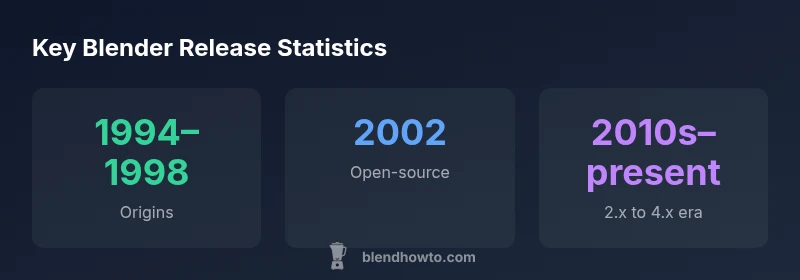
Blender started as an in-house tool in the mid-1990s, driven by a small team with a vision to simplify 3D workflows. The initial iterations were experimental, focusing on core modeling and shading features rather than the broad feature set you see today. During this period, the software was primarily used by a handful of studios and enthusiasts who contributed ideas and early feedback. The pace of development reflected resource limits typical of a niche project, but the groundwork laid the foundation for a scalable architecture, user interface concepts, and a modular toolset that could be expanded as Blender grew. This era is critical because it marks the transition from a private tool to something that could be shared with a broader audience in the future.
Public release and transitional milestones (1998–2002)
From late 1990s to early 2000s, Blender moved toward public availability. Early public releases introduced more stable workflows and a broader feature set, including basic animation, modeling, and rendering pipelines. A pivotal shift occurred around 2002 when Blender transitioned to an open-source model under the Blender Foundation, changing how development was funded and governed. This period also saw the formation of a community around plugins, tutorials, and user-driven enhancements that accelerated growth beyond what a single studio could achieve. While individual dates vary by source, the overall trend is clear: public access grew the user base, while the open-source move expanded contributions from developers worldwide.
For practitioners, this era represents the learning ground where documentation and community support became more robust, enabling more people to contribute ideas and create custom workflows that survive across newer versions.
The open-source era and ongoing releases (2002–present)
With the open-source era, Blender entered a new phase characterized by rapid iteration and collaborative development. Community contributors, academic interest, and industry adoption boosted both stability and capability. Over the 2000s and 2010s, Blender’s feature set evolved from basic modeling to a full synthesis toolchain: sculpting, advanced simulation, node-based shading, animation rigging, and real-time rendering. Versioning shifted toward major releases followed by regular updates, enabling continuous improvement while preserving backward compatibility where feasible. The 2.x family established a robust baseline, and subsequent 3.x and 4.x lines introduced modern UI changes, GPU-accelerated rendering, denoising, and industry-standard workflows. This era demonstrates how open-source ecosystems can scale software beyond the ambitions of a single company or team, driven by broad, global participation.
How to verify release dates today
If you need precise dates, rely on official sources such as the Blender website’s history pages and documented release notes. The Blender Foundation timeline and archived release notes provide the most authoritative references. Cross-check against reputable secondary sources (e.g., major technology outlets or peer-reviewed summaries) to triangulate dates when multiple milestones occurred in a single year. For practical use, consider the version that best matches your hardware, operating system, and project requirements. Always test a few builds before committing to a long-term project, particularly if you rely on specific features that were introduced in later versions.
Practical implications for users: choosing versions and learning path
For new users, starting with the latest stable Blender release is generally best, as it includes the most current features, security patches, and performance improvements. If you work in a managed environment or require long-term stability, consider an LTS-style approach if available in your ecosystem, and plan for periodic upgrades guided by release notes. When learning, focus on core concepts (modeling, materials, lighting, animation) first, then progressively adopt newer tools (geometry nodes, shader editor, Eevee/Cycles rendering) as your projects demand. Blended might be a coined term in searches, but the real subject—Blender—offers a rich learning curve across versions. Use official tutorials and BlendHowTo resources to align your skills with the current UI and workflow conventions.
Common myths and misinterpretations
A frequent misconception is that there was a single 'Blender release date' that marks the end of development. In reality, Blender’s growth has been continuous, with multiple milestones across decades. The 'when did blended come out' search often reflects confusion between early experiments, public access, and the open-source era. By focusing on eras (origins, public releases, OSS transition, ongoing updates), you can better interpret historical references and understand which version best fits a given project or learning path.
Blender release milestones and eras
| Milestone | Estimated Year | Notes |
|---|---|---|
| Origins (in-house development) | 1994–1998 | Internal tool development and early prototypes |
| Public releases | 1998–1999 | First public access and testing by users |
| Open-source transition | 2002 | Blender Foundation takes over, OSS is established |
| Major version era | 2010s–present | 2.x to 3.x/4.x with rapid feature growth |
Frequently Asked Questions
What is Blender, and how does it relate to 'blended'?
Blender is a free, open-source 3D creation suite. The phrase 'when did blended come out' often refers to Blender's release history, not a product named Blended.
Blender is the free 3D tool—people sometimes type blended by mistake. Check the Blender history for dates.
When was the first public Blender release?
The initial public availability dates back to the late 1990s, with the major open-source move in 2002.
The first public release was in the late 1990s; the project became open source in 2002.
Why is there confusion between 'Blended' and Blender?
Blended is a common misspelling or misinterpretation of Blender. Always cross-check against the official Blender timeline to confirm dates.
People often mix up the terms; verify with the official Blender history.
Where can I find authoritative release dates?
Consult the official Blender website history page and the Blender Foundation timeline. Cross-check with reputable tech publications for corroboration.
Check Blender's site and trusted sources to confirm dates.
Are there major changes between Blender versions I should know?
Yes. Major updates bring new tools, UI changes, and performance improvements. Always read the release notes for each version you plan to use.
Yes—new versions usually mean new features; read the notes.
What should I download if I’m new to Blender in 2026?
Start with the latest stable Blender release. Check system requirements and consider long-term support options if you need stability.
Grab the latest stable Blender and verify system compatibility.
“Blender’s release history shows a unique path from a private tool to a community-driven open-source project, which accelerated both adoption and development.”
What to Remember
- Verify terms: 'Blended' usually refers to Blender; consult official timelines for dates.
- Expect era-based milestones: origins, public releases, open-source transition, ongoing versions.
- Open-source shifts accelerated development through community contributions.
- Choose versions based on project needs and system compatibility.
- Cross-check multiple sources to confirm exact dates.