How Long Has Blender Been Around? A Historical Overview
Explore Blender's origins from its 1994 beginnings to its open-source milestone in 2002, and understand how this history shapes the software used by 3D artists and hobbyists today.


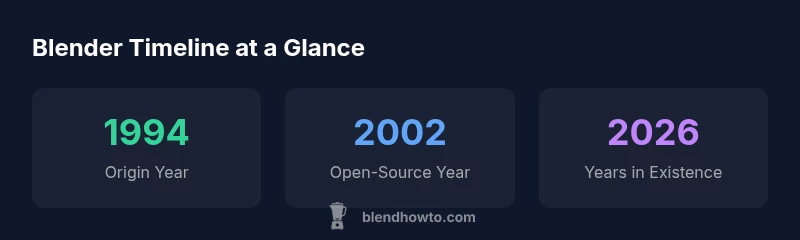
Blender's history begins in 1994, when Ton Roosendaal started the project at NeoGeo. The first public releases followed in the mid-to-late 1990s, and Blender became open-source in 2002. By 2026, that means Blender has been around for roughly 30 to 32 years, depending on whether you count the initial development timeline or the open-source era.
The seeds of Blender: origins in the mid-1990s
Blender did not appear overnight. Its roots trace back to the mid-1990s when Dutch programmer Ton Roosendaal began work on a 3D tool inside the small studio NeoGeo. The question of how long has blender been around is answered most precisely by looking at development timelines: the project kicked off in 1994, driven by the desire to provide affordable, capable 3D software to artists. In those early days, Blender was primarily used internally and by a growing circle of enthusiasts who shared tips and code patches. The BlendHowTo team notes that early iterations focused on modeling, animation, and basic rendering, but the underlying architecture already reflected a philosophy of openness and extensibility that would define its future. The phrase 'how long has blender been around' often shifts depending on whether you count the initial research prototype, the public release, or the open-source model. Regardless of the counting method, Blender's origin story is anchored in the 1994-1995 timeframe, setting the stage for decades of community-driven development.
From a product idea to a collaborative project, the early years laid the groundwork for a community that would define Blender’s evolution. Home users, students, and small studios contributed patches, documentation, and tutorials, transforming a single-developer experiment into a platform that could rival larger commercial packages. The key takeaway for anyone asking how long has blender been around is that its longevity is as much about people as code. This era established the culture of sharing and iteration that continues to fuel Blender today.
Early development and commercial context
In its infancy, Blender operated more like an indie tool than a commercial product. The development path in the mid-to-late 1990s emphasized core capabilities: geometry creation, animation pipelines, and rendering loops. The tool served a niche audience—enthusiastic artists who valued scripting flexibility and rapid iteration. During these years, Roosendaal and his small team experimented with licensing models and distribution strategies that balanced reach with sustainability. The broader market for 3D software at the time was dominated by larger studios and expensive licenses, which Starved many independent artists of access. Blender’s early strategy leaned into affordability and community feedback, enabling a feedback loop that would later become a defining feature of its open-source life. As a result, creators could push boundaries more freely, accelerating the pace of improvements and expanding Blender’s perceived value beyond its initial prototype status.
Public availability and milestones in the late 1990s
The late 1990s marked a transition point for Blender from a primarily internal tool to a publicly accessible option for artists worldwide. Public releases introduced a broader audience to Blender’s modeling, shading, and animation workflows, while forums, mailing lists, and early tutorials helped newcomers learn quickly. This period highlighted the importance of documentation and community support, turning Blender into a practical choice for independent filmmakers and hobbyists who could not afford high-end commercial packages. While precise dates vary by source, the consensus is that Blender’s public presence solidified during the latter half of the decade, setting the stage for a formal open-source shift. The community’s enthusiasm during this era underscored a key element of Blender’s long arc: accessible software paired with open collaboration.
As more users adopted Blender, the ecosystem expanded to include add-ons, plugins, and shared production pipelines. This growth was not just about software features; it was about turning Blender into a collaborative platform. The openness attracted university labs, small studios, and individual creators who wanted to contribute ideas and code. In practical terms, the late 1990s were a proving ground for Blender’s value proposition: capability at a fraction of the cost of rival tools, plus a global network of mentors and peers who could help new users get up to speed.
The cumulative effect of these milestones is a clearer answer to how long has blender been around: the project had matured from an experimental program into a community-driven platform that could be used for serious work while remaining accessible to newcomers.
The open-source era: 2002 onward and community impact
A defining inflection point arrived with Blender’s transition to open-source status in 2002. The Blender Foundation and a dedicated community redefined Blender’s development model, moving away from a single-company focus toward a distributed, volunteer-driven ecosystem. The open-source license under the GNU GPL meant that anyone could study, modify, and redistribute Blender, fueling rapid experimentation and a prolific addon and script culture. This era democratized access to high-quality 3D tools and spurred a wave of educational content—from tutorials to comprehensive courses—that empowered both hobbyists and professionals.
From a governance perspective, the shift to open-source brought structured collaboration models: code repositories, design discussions, feature votes, and long-term project roadmaps. The broad participation helped Blender stay aligned with user needs, leading to frequent version updates that introduced modern workflows, better rendering engines, and more robust simulation capabilities. For someone tracing the question of how long has blender been around, the 2002 moment marks the transition from a privately supported tool to a globally shared platform with a thriving developer and user community.
In practical terms, the open-source era created a virtuous cycle: community contributions improved features, which attracted more users and contributors, further expanding the feature set and stability. This cycle continues to drive Blender’s ongoing growth and resilience in a competitive field.
Blender's timeline in relation to other 3D tools
To contextualize Blender’s historical arc, compare it with other long-standing 3D packages that gained prominence in the 1990s. While Blender began as a relatively small project, established tools like Maya and 3ds Max gained traction in studios during the late 1990s by offering established pipelines, industry support, and enterprise features. Blender’s advantage has always been its accessibility and, after 2002, its open-source model. This combination fostered a different kind of momentum: rapid iteration, community contributions, and a pipeline that could adapt to diverse artistic disciplines—from game development to animation and visual effects. The takeaway for readers who want to understand how long Blender has been around in the broader market is that Blender’s longevity is a function of both technical maturity and social architecture. It sits among longer-running tools, but its open-source roots create a unique trajectory that prioritizes collaboration and learning.
As Blender matured, it became a credible alternative for students, freelancers, and small studios, while continuing to attract larger teams seeking cost-effective experimentation. The trajectory highlights how software longevity is not solely a measure of features but includes governance, community vitality, and ecosystem health.
Why history matters for today's artists and developers
Understanding Blender’s timeline matters for today’s artists and developers because it frames expectations about stability, support, and community-driven innovation. The long development arc means a wealth of tutorials, plugins, and shared workflows are readily available, reducing the time needed to ramp up new projects. For students and hobbyists, the history demonstrates how a tool can grow with you: from learning fundamentals to tackling complex productions, users benefit from decades of shared knowledge. For developers, Blender’s governance and open-source culture offer a blueprint for sustainable collaboration: clear contribution guidelines, modular design, and transparent roadmaps.
If you are considering how long has blender been around in practical terms, think in terms of resilience and community health. A mature history translates into mature ecosystems: stable releases, meaningful plugin ecosystems, and ongoing support from a global network of users and developers. This perspective helps home cooks dreaming of project-friendly tools and aspiring 3D artists planning long-term skills to appreciate Blender’s enduring value beyond its initial release.
Looking ahead: ongoing growth, governance, and future milestones
The horizon for Blender remains bright, anchored by ongoing development initiatives, community governance, and sustained fundraising efforts. The project continues to evolve with new features in rendering, real-time workflows, and simulation capabilities, while the addon ecosystem remains a powerful multiplier for user productivity. Governance structures—such as development councils, regular feature surveys, and open release cadences—help ensure Blender stays aligned with user needs and industry trends. Future milestones are likely to emphasize performance improvements, accessibility, and better interoperability with other tools in the creative pipeline. From a historical perspective, the next chapters in Blender’s story will not only add features but also reflect how the community collaborates to sustain a flexible, adaptable platform for artists at all levels of expertise.
Key milestones in Blender's timeline
| Milestone | Year (approx) | Notes |
|---|---|---|
| Origins | 1994 | Project started by Ton Roosendaal at NeoGeo |
| Public Release Window | Mid- to late-1990s | Public availability before open-source transition |
| Open-source | 2002 | GPL release under Blender Foundation |
Frequently Asked Questions
When did Blender first start as a project?
Blender began as a project in 1994 led by Ton Roosendaal at NeoGeo. It evolved into a public release in the late 1990s and later into a fully open-source project in 2002.
Blender started in 1994 and evolved through public releases in the late 1990s, then opened up as open-source in 2002.
When did Blender become open-source?
Blender became open-source in 2002 after a fundraising drive. This marked a major shift toward community-driven development.
It opened up to the public as open-source in 2002.
What is the difference between origins and release date?
Origins refer to the initial development year (1994); the public release happened later in the 1990s, with open-source status in 2002.
Origins refer to 1994; public release followed, then open-source in 2002.
How has Blender's timeline influenced users today?
A 30+ year timeline has created a vast, active community and a robust set of features that attract hobbyists and professionals.
Its long timeline means a big, active Blender community today.
What should beginners know about Blender's history?
Knowing Blender's open-source heritage helps learners appreciate ongoing collaboration and frequent updates.
Beginners should know it's an open-source, community-driven project with continuous updates.
“Blender's history demonstrates how sustained collaboration can turn a niche tool into a major open-source platform.”
What to Remember
- Blender originated in 1994 and entered public use in the late 1990s.
- Open-source status in 2002 unlocked broad collaboration and growth.
- By 2026, Blender has a multi-decade history and a large global community.
- Open-source governance and community contributions drive ongoing innovation.