When Blender Released: A History for 3D Artists
Explore when Blender released, its open-source journey, and key milestones shaping modern 3D learning for artists and beginners—from the mid-1990s to today.


Blender first released in the mid-1990s, with the public launch typically cited around 1995–1996. Since then, Blender’s development followed an open-source, community-driven path that reshaped 3D modeling tools. Understanding when Blender released helps frame its rapid evolution from an in-house tool to a comprehensive 3D package. For makers and educators, this history explains why newer versions emphasize accessibility, extensibility, and open collaboration.
The moment when Blender released: origins and context
Blender’s public release is often traced back to the mid-1990s, when an in-house tool evolved into a project offered to a broader audience. The exact year is debated in some circles, but the consensus among many Blender historians points to a public debut around 1995–1996. This release marked a shift from a proprietary research instrument to a software with a community-facing license. For learners, this moment is important because it established an open-ended experimentation culture that would shape how tutorials, plugins, and educational resources proliferated in the years that followed. As the first users experimented with modeling, shading, and animation on aging hardware, the fundamentals of modern Blender—non-destructive workflows, node-based materials, and an extensible interface—began to coalesce.
In the years immediately after the initial release, Blender operators and early developers ran on tight cycles, iterating features while keeping the program accessible to hobbyists. This period established a feedback loop between users and developers that remains a core strength of Blender today. Understanding when Blender released provides a baseline for comparing early capabilities with today’s tools, including sculpting, procedural workflows, and real-time rendering.
How release milestones shaped the software's evolution
As Blender grew, milestone releases acted as turning points that opened new possibilities for 3D artists. The late 1990s saw incremental improvements to modeling and animation, while the 2000s introduced more robust scripting, better import/export options, and broader platform support. A pivotal moment arrived with the Blender Foundation taking a leadership role and steering the project toward openness. Those decisions accelerated plugin ecosystems, documentation, and user-driven features. When you study release history, you can map major features to version ranges and see how the tool evolved from a niche research project into a production-ready package used by independent artists, students, and studios alike. This context helps learners time their education: for example, tutorials from the early 2000s may rely on older interfaces, while current classes align with modern workflows and real-time rendering.
The open-source transition and community impact
A watershed moment came when Blender shifted to an open-source model with community governance. This transition lowered barriers to entry for contributors and allowed thousands of developers to submit improvements, bug fixes, and new features. The open-source model accelerated learning, because users could inspect source code, adapt scripts, and extend Blender through addons. In educational contexts, this means a vast array of freely available resources—from beginner-friendly tutorials to advanced shader graphs and Python scripting guides. The collaboration ethos also fostered regional user groups, online forums, and annual events that broadened access to Blender's capabilities and demystified complex topics like physics simulations and motion tracking.
For learners, the open-source path behind Blender’s release history demonstrates how a community can multiply learning opportunities, translate innovations into accessible tools, and sustain a vibrant ecosystem without licensing costs.
The UI overhaul and the 2.8 era: accessibility as a core value
In 2019, Blender’s highly anticipated UI overhaul arrived with the 2.8 series, dramatically reshaping the user experience. The new design prioritized accessibility, faster navigation, and an integrated workbench for artists moving between modeling, shading, and animation. This milestone made Blender approachable for beginners while giving professionals a more efficient environment for production work. The overhaul also introduced better defaults, improved viewport rendering, and a modernized layout that remains a reference point for new users. When studying the release history, this moment is a clear divider between “old Blender” and the current era where interactive tools, real-time rendering (Eevee), and expanded add-ons broaden the software’s potential.
Cadence, community, and the learning path for hobbyists
With more stable versions and ongoing community contributions, Blender’s cadence allowed hobbyists to plan studies around major updates. A typical path starts with understanding the core modeling tools, then exploring shading and lighting, and finally integrating animation and simulation features. The release history thus informs how to structure a learning plan: begin with a recent stable release to minimize workflow gaps, then progressively explore legacy features through historical posts and forum threads. For educators, this history is a blueprint for curriculum design—balancing timeless fundamentals with the latest features to keep instruction relevant.
From release history to practical practice: guiding your learning plan
When you consider when Blender released, it becomes clear that historical context matters for practitioners. Start by confirming your version and its supported features, then map learning objectives to the capabilities available. Practical practice benefits from aligning projects with version-specific tools (for example, shader editor updates or animation workflow changes) so you don’t miss essential steps. The release history also helps you choose who to follow for instruction: early tutorials may reference deprecated workflows, while newer content will leverage the latest interfaces and rendering engines. In short, your study plan should reflect not just Blender’s current capabilities but the evolution that brought them here.
Debunking myths about Blender releases and versioning
A common misconception is that every release mandates a radical overhaul or renders older tutorials useless. In reality, Blender has maintained backwards-compatible features while introducing new capabilities gradually. Understanding this helps learners avoid needless retracing of steps and focuses on transferable skills. Another myth is that open-source means inconsistent quality; instead, Blender’s community review and rapid iteration produce robust tooling that benefits from broad testing across many use cases. By acknowledging release history without assuming every shift is disruptive, learners can navigate updates confidently and choose which features to adopt next.
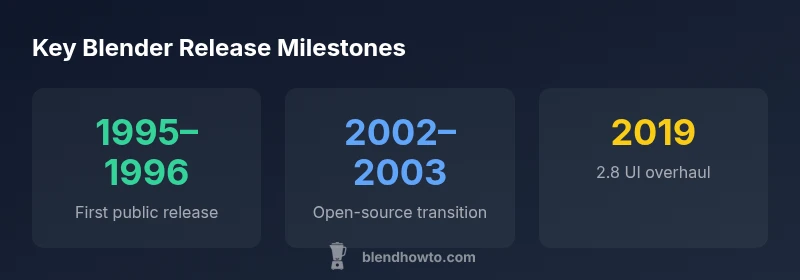
Key Blender release milestones and their impact
| Milestone | Estimated Year Range | Impact |
|---|---|---|
| First public release | 1995–1996 | Introduced as a freely accessible tool for modeling, animation, and rendering |
| Open-source transition | 2002–2003 | Expanded developer community and licensing, enabling plugin ecosystems |
| UI overhaul (2.8 era) | 2019 | Major usability improvements and real-time rendering integration |
| Cross-platform growth | 2000s–present | Wider adoption in education and studios across OSs |
Frequently Asked Questions
Was Blender released as open source from the start?
Blender originated as an in-house tool and later embraced an open-source model under community governance. The open-source transition enabled broad collaboration and contributed to the rapid expansion of tutorials and plugins.
Blender didn’t start as open source, but it became open source early on, catalyzing a large community around learning and extensions.
How often does Blender release major updates?
Blender follows a roughly 1–2 year cadence for major releases in recent years, with ongoing minor improvements between this cadence. Early years saw more variability as the project matured.
Updates come in waves, typically every year or two, with frequent improvements in between.
What was the UI overhaul in 2.8 about?
The 2.8 overhaul modernized the interface, improved accessibility, and integrated real-time rendering. It broadened usability for beginners while empowering professionals with faster workflows.
2.8 was the big UI reset—simpler, cleaner, and faster for real-time work.
Which version should beginners start with?
Begin with the latest stable release to access current features and a supported learning community. If you encounter an interface you don’t recognize, look for version-specific tutorials and official release notes.
Start with the current stable Blender and follow version-specific guides.
Where can I find official release notes?
Official release notes are published on Blender’s website and associated developer blogs. These notes detail new features, bug fixes, and compatibility notes for each major update.
Check Blender’s official site for comprehensive release notes.
How can I verify my Blender version?
Open Blender and go to Help > About Blender, or check the command line using the appropriate system command. Release notes and the built-in updater will help you confirm the exact version.
Look under Help > About Blender to see your version, or use the system updater.
Does historical release data affect today’s learning?
Yes. Historical release data shows how tools evolved, helping learners locate tutorials that match their version and understanding the rationale behind UI changes and feature additions.
Yes—knowing how Blender evolved helps you pick the right tutorials and understand current workflows.
Can I still use tutorials from earlier Blender versions?
Many core concepts transfer across versions, but some UI elements and workflows change. Refer to version-matched tutorials or adapt by checking official notes for deprecated features.
Some older tutorials still help, but verify against your version’s notes.
“The release history of Blender is a case study in community-driven software development; open collaboration accelerates learning and innovation.”
What to Remember
- Anchor learning in the mid-1990s release context to understand Blender's evolution
- Expect major UI and workflow shifts around milestones like 2.8
- Open-source history drives broad community resources and tutorials
- Plan learning by aligning with current features and relevant historical notes