Free Blender Rig: A Practical Guide to Finding and Using Free Rigs in Blender
Discover how to locate, evaluate, and safely use a blender rig free in Blender. Learn licensing basics, compatibility checks, and practical integration tips for smooth animation in your projects.


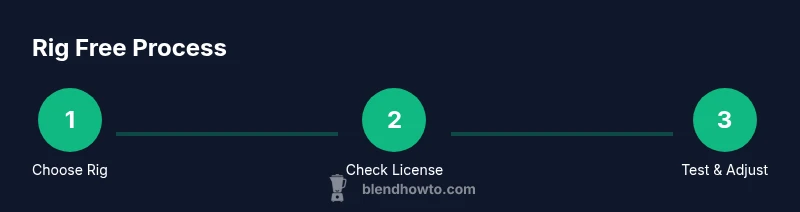
In this guide, you'll learn how to find and use a blender rig free that fits your project, how to evaluate licensing, and how to safely integrate it into Blender workflows. We'll cover where to download free rigs, how to test for compatibility, and best practices for licensing, attribution, and custom tweaks to ensure clean animation.
What is a Blender rig free?
A blender rig free is a pre-built skeleton and control rig that you can download and use in Blender without paying royalties. It typically includes bones, constraints, and control rigs that enable posing and animation of a character or prop. For home cooks and 3D hobbyists, a blender rig free can dramatically speed up learning rigging basics and prototyping animation workflows while keeping costs low. Yet quality, structure, and licensing vary, so it’s wise to assess each asset before integrating it into a production scene.
According to BlendHowTo, using a blender rig free should start with aligning the rig’s topology and scale to your model. If bone structure mismatches occur, you’ll spend more time fixing weights than animating. Free rigs are especially helpful for mastering workflows, rehearsing poses, and building early pipelines without large upfront investments. Always check the license for permitted uses and attribution requirements, and keep a clean backup before import. When you combine a blender rig free with your own models, you gain a flexible toolkit for posing, facial expression tests, and muscle deformations on a budget.
note
Tools & Materials
- Blender software (latest stable release)(Version 3.0+ recommended for modern rig features)
- Rig file (BLEND/FBX/OBJ)(Choose based on your project needs; BLEND for best integration)
- Test model or proxy mesh(Use a simple mesh to verify rig behavior before your main asset)
- Reference images or concept art(Optional to help match proportions and poses)
- Backup strategy (versioned saves)(Always save incremental versions before importing or editing rigs)
Steps
Estimated time: 1-2 hours
- 1
Define project needs and pick a compatible rig
Assess your model, target the rig type (biped, quadruped, facial rig), and ensure the free option aligns with your animation goals. Check the file format, Blender version, and whether the rig supports the needed controls. This upfront step saves time by preventing later topology or weighting problems.
Tip: Match topology rough proportions before import to reduce later adjustments. - 2
Download and inspect licensing
Open the asset page and read the licensing terms. Look for commercial vs. non-commercial use and attribution requirements. If licensing isn’t clear, contact the author or choose another asset to avoid distribution risks.
Tip: Take a screenshot of license terms for your project notes. - 3
Import into a dedicated test scene
Create a clean, empty Blender scene and import the rig. Reset transforms and align the rig with a neutral origin so you can evaluate constraints without interference from other assets. This minimizes surprises during integration.
Tip: Use a separate collection to isolate the rig for easier debugging. - 4
Check core deformation and weight maps
Pose the rig in a basic stance and scrub through a short animation. Inspect weight painting and bone influence on key vertices; refine weights with Blender’s weight painting tools if deformations look odd at joints.
Tip: Test both extreme poses and minor micro-poses to catch subtle issues. - 5
Verify constraints, drivers, and scale
Confirm that constraints and drivers (if present) respond correctly. Adjust global scale and rotation to match your main scene’s unit system. Document any changes you make for reproducibility.
Tip: Keep a changelog of any constraint tweaks for future teammates. - 6
Run a quick production test
Animate a short sequence (2-3 seconds) to see how the rig behaves in motion alongside your other assets. Look for clipping, jitter, or unexpected deformities and decide whether to proceed or seek a different rig.
Tip: Saving versions after a successful test helps you revert if needed.
Frequently Asked Questions
What is a blender rig free?
A blender rig free is a pre-built skeleton and control rig offered at no cost. It helps you animate characters or props quickly, but licensing and quality vary. Always check terms before use.
A blender rig free is a no-cost skeleton and control rig you can use for animation, but licensing and quality differ—read the terms before using it.
How do I verify license for a free rig?
Look for an accompanying license file or terms on the download page. Common licenses include attribution requirements or permissions for commercial use. If anything is unclear, contact the author before reuse.
Check the license file or page, look for attribution or commercial-use terms, and ask the author if it’s unclear.
Can I use free rigs for commercial projects?
It depends on the license. Some rigs allow commercial use with attribution, while others are restricted. Always confirm the terms and attribute when required.
Yes, but only if the license allows it; attribute when required by the terms.
What formats are common for free rigs?
Free rigs typically come in BLEND, FBX, or OBJ formats. Blender-native rigs (BLEND) usually offer smoother integration, while FBX may require retargeting in Blender.
Most rigs are in BLEND or FBX; check compatibility with your Blender version.
What should I test after importing a free rig?
Test core deformations, constraints, and basic animation. Check weight maps and ensure there’s no clipping with other assets. Keep a log of any changes for future work.
Test deform, constraints, and a short animation; watch for clipping and keep notes.
Are there common risks with using free rigs?
Risks include licensing ambiguity, inconsistent topology, or poor integration with your project. Always validate licenses, test in isolation, and maintain backups.
Potential licensing and quality risks—test thoroughly and back up your work.
Watch Video
What to Remember
- Verify license before use and comply with attribution
- Test rigs in a safe scene before production
- Match rig topology and scale to your model
- Document changes and keep clean backups